When Michael Reynolds first heard the commotion outside his home in Sarasota County, Florida, he assumed the noise was coming from birds fighting over food.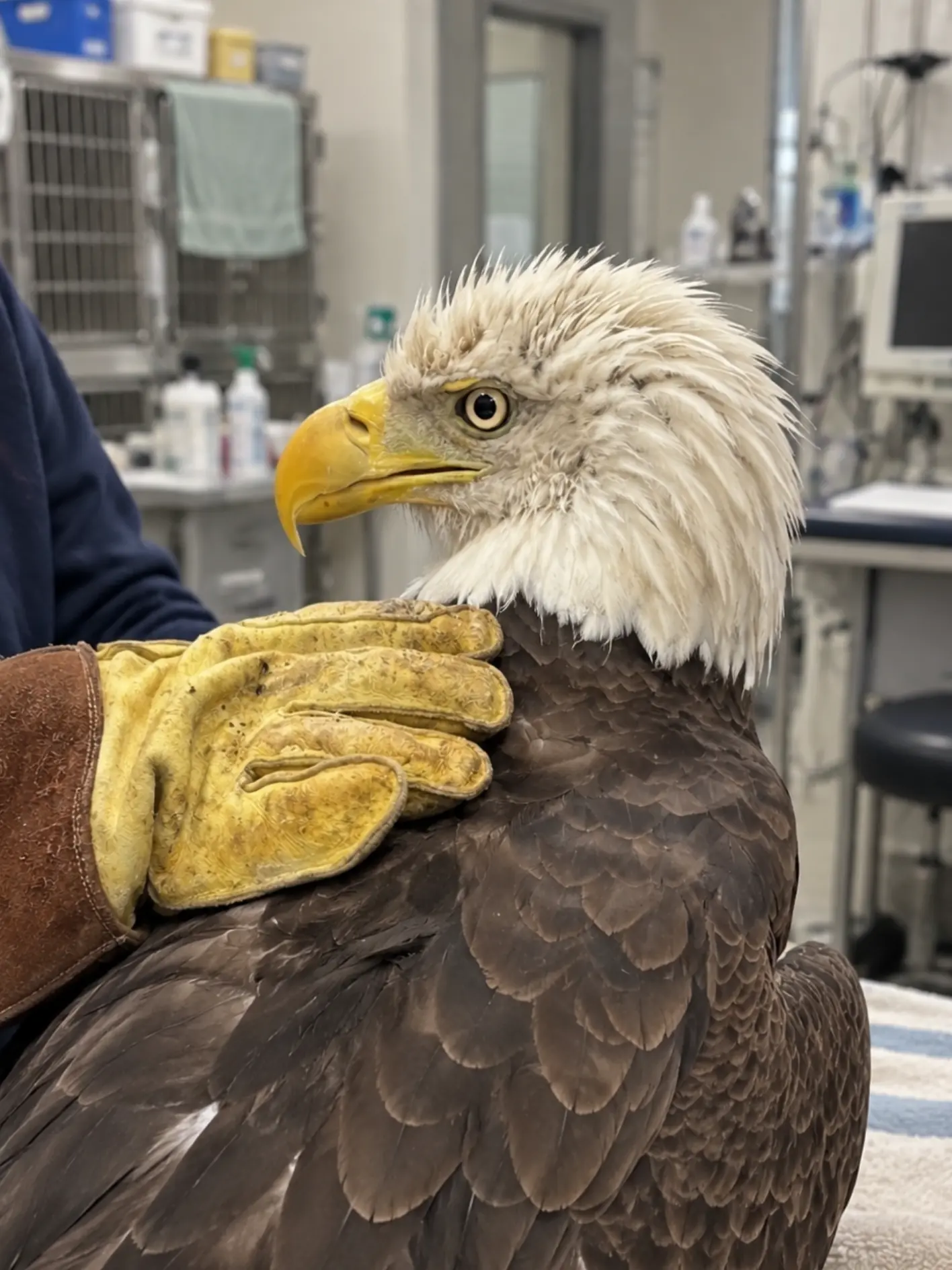
The calls were unusually loud and persistent.
When Reynolds stepped outside and looked toward the lake behind his property, he saw several Bald Eagles circling low over the water. Some were making tight turns. Others were diving toward the surface before climbing again.
Then he noticed one eagle that was not flying.
It was in the lake.
At first, Reynolds thought the bird might simply have landed to grab a fish. Bald Eagles are capable swimmers and occasionally end up in the water after pursuing prey.
But this eagle was behaving differently.
It spread both wings and beat them against the surface, apparently trying to lift itself free. Instead of rising, the bird remained low in the water.
Seconds later, its head disappeared beneath the surface.
It came back up.
Then it went under again.
“That was when I realized it wasn’t just swimming,” Reynolds later recalled. “It was in trouble.”
What happened immediately before the eagle entered the lake could not be established with certainty. Reynolds said several eagles had been interacting aggressively overhead, leading him to suspect a territorial dispute or competition over food.
“My guess was they had been fighting or competing over something,” he said. “This one looked like it had taken the worst of it.”
Whatever the cause, the situation on the water was deteriorating quickly.
The eagle was becoming exhausted.
Its feathers were increasingly saturated.
And then Reynolds noticed another movement farther out on the lake.
An alligator was moving through the same section of water.
For Reynolds, the situation had suddenly changed from a struggling bird to a wildlife emergency with two immediate risks.
The eagle could drown.
Or it could become vulnerable to a large aquatic predator before it ever reached shore.
A Bald Eagle That Could Not Get Out of the Water
Bald Eagles are powerful fliers, but taking off from water can require considerable effort, especially when a bird is injured or exhausted.
A healthy eagle that enters relatively calm water may be able to use its wings in a swimming motion until it reaches shore. Under favorable conditions, some birds can even regain flight.
But wet feathers add weight.
Cold or prolonged immersion increases heat loss.
And if an eagle has already sustained trauma, repeated attempts to launch can rapidly drain whatever strength remains.
That appeared to be what Reynolds was watching.
The bird would raise both wings, push against the surface, and make a brief effort to gain elevation.
Each time, it failed.
Then the body settled deeper.
“It kept trying,” Reynolds said. “But every attempt seemed weaker than the one before it.”
He called for someone at the house to contact wildlife authorities.
Then, fearing the eagle would disappear beneath the water before responders could arrive, Reynolds moved toward the lake.
His decision was extraordinarily risky.
Wildlife officials later emphasized that members of the public should never enter water where alligators may be present to attempt a wildlife rescue. Alligators can approach with little warning, and a distressed Bald Eagle can also inflict severe injuries with its talons.
The safest response is to call trained wildlife professionals and provide the animal’s exact location.
But in this case, Reynolds believed the bird had only minutes left.
“I Knew It Was Either Going to Drown or Something Was Going to Get It”
Reynolds entered the water while keeping his attention fixed on both the struggling eagle and the movement he had seen nearby.
The bird continued beating the water.
At one point, almost the entire head disappeared again.
“I knew it was either going to drown or something was going to get it,” Reynolds said.
As he moved closer, he expected the eagle to become defensive.
It barely did.
That was one of the most concerning signs.
A healthy adult Bald Eagle generally does not tolerate a close human approach. Even injured birds often roll onto their backs and present their feet defensively, striking with powerful talons.
This bird had little energy left to resist.
Reynolds reached the eagle and began guiding it toward shallower water.
The bird’s feathers were soaked.
Its wings hung heavily.
Its breathing appeared labored.
Once close enough to shore, he was able to get the eagle out of deeper water and onto land.
By then, the bird was exhausted.
“What scared me most was how little it fought,” Reynolds said. “You expect an eagle to fight you. This one just didn’t have much left.”
Wildlife Responders Take Over
When wildlife responders arrived, they immediately took control of the eagle’s feet.
That is one of the first rules of handling large raptors.
The beak may look intimidating, but the talons present the greatest handling risk.
The eagle was wrapped to limit wing movement and placed inside a padded transport carrier.
Responders were concerned about several possibilities.
The bird might have sustained trauma during an interaction with another eagle.
It could have inhaled water.
It could be hypothermic or severely exhausted.
And even if no bone was broken, the shoulder or flight muscles could have been injured badly enough to explain why the eagle could not leave the water.
The bird was transported to a licensed wildlife rehabilitation hospital for emergency evaluation.
By the time it arrived, the eagle was still alert but subdued.
The fact that it had survived the lake was encouraging.
It did not mean the danger had passed.
The Examination Looked for More Than Broken Bones
At the hospital, veterinary staff began with a complete physical examination.
The bird’s eyes were assessed.
The mouth and airway were examined.
Both wings were carefully palpated.
The shoulders, elbows, wrists, spine, chest, pelvis, legs, and feet were evaluated.
Staff looked for puncture wounds that might have been caused by another eagle’s talons.
They also examined the feathers and skin for abrasions or evidence of collision.
No catastrophic external injury was immediately apparent.
That was the first encouraging development.
Still, the eagle showed discomfort around one shoulder and surrounding soft tissues.
There were small areas of bruising and superficial trauma.
Radiographs were taken to look for hidden skeletal injuries.
The images did not reveal a major fracture.
There was no severely broken humerus.
No major radius or ulna fracture.
No obvious spinal injury.
That finding significantly improved the bird’s orthopedic prognosis.
But it did not explain everything.
A bird can have intact bones and still be unable to fly.
Soft-tissue injuries can be serious enough to prevent normal wing extension or powerful takeoff.
And in this case, veterinarians also had to consider what had happened after the eagle entered the water.
Near-Drowning Carries Risks That Are Not Visible on X-Rays
The most immediate concern was respiratory.
Reynolds had seen the eagle’s head go underwater several times.
Veterinary staff therefore treated the bird as potentially having aspirated water.
When water or other material enters the respiratory system, consequences can range from temporary irritation to serious respiratory compromise.
A bird may initially appear stable and deteriorate later.
That possibility meant the eagle needed close monitoring even though it had survived the rescue and showed no major fracture.
Staff monitored:
respiratory rate,
effort of breathing,
lung sounds,
oxygenation,
body temperature,
and overall alertness.
Supplemental oxygen was available if required.
The eagle was placed in a warm, quiet environment to minimize metabolic demand.
Fluids were administered according to clinical need.
Pain management addressed the suspected shoulder and soft-tissue trauma.
The team deliberately avoided unnecessary activity.
There would be no flight test that day.
The bird had already spent enough energy trying to survive.
Waterlogged Feathers Created Another Problem
A Bald Eagle’s feathers are essential not only for flight, but also for insulation.
When plumage becomes thoroughly saturated, the bird can lose body heat more rapidly.
That is particularly concerning in an animal already weakened by trauma and prolonged exertion.
The rehabilitation team allowed the eagle to dry gradually under controlled conditions.
Feather condition was monitored closely.
Staff did not want to damage the feather structure through aggressive drying or unnecessary handling.
For a release candidate, plumage matters.
A bird can have healed bones and normal bloodwork and still be unfit for release if its flight feathers have been badly damaged.
Fortunately, the eagle’s feathers appeared largely intact despite the prolonged time in the water.
They needed time to dry and return to normal condition.
The First Night Remained Guarded
During the first several hours, the eagle spent much of its time resting low.
It was responsive, but clearly exhausted.
Its grip was weaker than expected.
Food was not aggressively offered until veterinary staff were confident that the bird was alert enough to swallow normally and was not at significant aspiration risk.
The treatment area remained quiet.
Wild animals experience stress differently from domestic animals.
Repeated handling may itself become harmful, especially after severe exhaustion.
So much of the early treatment involved watching rather than touching.
Could the eagle hold its head upright?
Was breathing stable?
Would it reposition itself?
Was grip strength improving?
Did the bird respond more strongly when staff entered?
The answers slowly began to change.
The First Good Sign Was an Angry Eagle
By the following day, the bird was noticeably more alert.
It held its head upright.
Its eyes tracked staff immediately.
Grip strength had improved.
And during one examination, the eagle made a much stronger attempt to grab a handler’s protective glove.
For the rehabilitation team, that was good news.
“The first time it really tried to get the glove, everyone felt better,” one staff member said. “You want a wild eagle to behave like a wild eagle.”
The bird was no longer simply enduring human contact.
It was objecting to it.
That behavioral shift suggested strength and neurological responsiveness were returning.
Appetite Followed
Once the eagle was fully alert and swallowing safely, small portions of appropriate food were offered.
The bird initially ate cautiously.
Then appetite improved.
It began feeding independently.
That was another important milestone.
A critically exhausted eagle may stop eating because of pain, systemic illness, neurological impairment, or stress. Voluntary feeding suggests that several basic systems are working together again.
The bird used its feet normally to stabilize food.
The beak functioned appropriately.
No major head injury had been identified.
Body condition was monitored as the eagle continued eating and recovering.
The Shoulder Injury Became the Main Orthopedic Concern
With no major fracture on radiographs and no progressive respiratory problem, attention increasingly shifted toward the injured shoulder and surrounding soft tissues.
The suspected injury was consistent with several possible mechanisms.
The eagle could have been struck or grabbed during an aggressive encounter with another bird.
It may have hit the water awkwardly.
It could have strained the wing during repeated efforts to escape.
Without witnessing the complete event, veterinarians could not identify one mechanism with certainty.
Treatment therefore focused on what was known.
The bird showed discomfort.
Wing movement needed time to recover.
Initial rest was followed by gradual reassessment of range of motion.
The team monitored whether the eagle could extend both wings symmetrically.
They watched for swelling.
They looked for wing droop after activity.
The condition continued improving.
Why the Eagle Could Not Simply Take Off From the Lake
The incident also raised a question many people ask when seeing a large bird trapped in water.
Why did it not simply fly away?
Flight from water can be demanding.
An eagle must generate enough force to lift not only its body but also wet plumage while overcoming the drag of the water.
If the bird is already injured, the problem becomes more difficult.
If it is exhausted, more difficult still.
Repeated failed attempts consume energy.
As fatigue deepens, each launch attempt becomes weaker.
The bird settles lower.
Feathers become wetter.
Eventually, a situation that may have begun as a manageable landing becomes a life-threatening entrapment.
In this case, the eagle may also have entered the lake already carrying shoulder trauma.
That combination would explain why normal escape was not possible.