The first thing Daniel Mercer noticed was not the eagle itself but the strange movement on the surface of the pond behind his farmhouse. It was early morning in fictional Lancaster County, Pennsylvania, and the water was otherwise almost still. Mercer had stepped outside to check a section of fencing along the back pasture when he saw a large dark shape moving slowly toward the center of the pond, leaving a wide disturbance behind it.
At first he assumed a Canada Goose had become tangled in fishing line or injured itself near the bank. Then the animal lifted its head, and the white feathers around the crown became visible against the darker water. Mercer stopped immediately. What he was looking at was an adult Bald Eagle, and the bird was not simply swimming. Its wings were partly spread across the surface, the body rode dangerously low, and every few seconds the eagle beat both wings against the water as though trying to get enough lift to take off. Each attempt ended the same way. Water exploded outward, the bird’s chest rose slightly, and then the eagle settled back down again.
Mercer watched from the bank for several minutes before moving any closer. Bald Eagles can sometimes enter the water during fishing attempts and may use their wings to move toward shore, so he initially hoped the bird would recover and leave without human intervention. The problem became clearer as time passed. The eagle was not moving with the strength of a healthy bird. One wing appeared to open more slowly than the other, and when it tried to turn toward the closest bank, the body tilted unevenly. The bird made progress for several yards and then stopped. It rested with the white head held just above the surface before beginning another round of labored flapping.
The pond was not especially large, but the eagle had already reached a point where distance was becoming less important than exhaustion. Every failed attempt to leave the water was consuming the energy needed for the next attempt.
Mercer walked along the shoreline, keeping enough distance that the bird would not try to escape from him. As soon as the eagle noticed movement, however, it became more active. It raised its head, spread both wings and forced itself several yards farther from the bank. That response told Mercer two things. The eagle was still alert enough to fear people, which was encouraging, but approaching it directly would only drive it into deeper water and use more of its remaining strength.
He stopped and pulled out his phone.
The first call went to a county wildlife contact, who advised him to keep people and pets away from the pond and wait for trained assistance. A second call connected the case with the fictional Susquehanna Wildlife Response Team, a regional organization that handled injured raptors and other large wildlife. The dispatcher asked Mercer several questions. Was the eagle still keeping its head above water? Was there visible blood? Had anyone seen it fall into the pond? Could the bird reach the shoreline on its own? Was there fishing line, fencing, or other debris nearby?
Mercer could answer only some of those questions. No one had seen how the eagle entered the water. He could see a dark area near one shoulder that might have been blood or simply wet feathers. The bird was still alive, still responsive, and still trying to move, but it had not made any meaningful progress toward shore.
The dispatcher told him that a response team was on the way.
Mercer remained at the pond and watched.
The next twenty minutes showed how quickly a wildlife emergency can change. When he had first seen the bird, the eagle had been making frequent attempts to flap. By the time the first responders arrived, those attempts were less common and much weaker. The wings remained spread across the surface, but the bird no longer lifted its chest as high. The head was still upright, yet the eagle appeared to be spending more effort simply maintaining that position.
Field responder Sarah Langley assessed the scene before anyone approached the water. She had dealt with waterlogged raptors before and knew that the bird’s condition could not be judged by the fact that it was still conscious. Saturated feathers add weight, reduce insulation, and can make takeoff extremely difficult. If the eagle already had a shoulder or wing injury before entering the pond, the water would magnify that weakness.
The response team brought a small flat-bottomed boat, a long-handled wildlife net, thick leather gloves, towels and a padded transport crate. No one stepped into the pond. Even a shallow farm pond can contain deep mud, submerged debris and sudden drop-offs, and rescuers try to avoid creating a second emergency while helping the first.
Langley and another responder entered the boat and moved toward the eagle slowly. The bird noticed almost immediately. Its posture changed from exhausted stillness to intense alertness. The white head rose, the eyes fixed on the approaching boat, and both wings began striking the water again.
For several seconds, the eagle appeared almost strong.
It pushed forward hard enough to send water over its back. One wing drove downward normally, while the other seemed to hesitate midway through the motion. The bird gained a little distance but no height. By the time it stopped, the head had dropped lower than before.
Langley paused.
Chasing the eagle across the pond would defeat the purpose of the rescue. She wanted one controlled attempt, not a prolonged pursuit that left the bird completely exhausted.
The boat drifted closer from the side.
When the eagle stopped moving, the second responder extended the long-handled net beneath rather than over the bird. The idea was to support the body from below and reduce the chance of trapping or twisting the wings against the frame. The first approach missed when the eagle pushed away at the last moment. The team backed off, allowed the bird to settle and tried again.
On the second attempt, the net slid under the body.
The eagle reacted instantly. Its feet came forward, talons opening, and both wings struck the water. Langley controlled the legs above the feet while the other responder supported the chest and wings. Even in an exhausted state, an adult Bald Eagle can cause severe injuries with its talons, so securing the feet was the first priority.
Once the bird was lifted from the water, its condition became much easier to see.
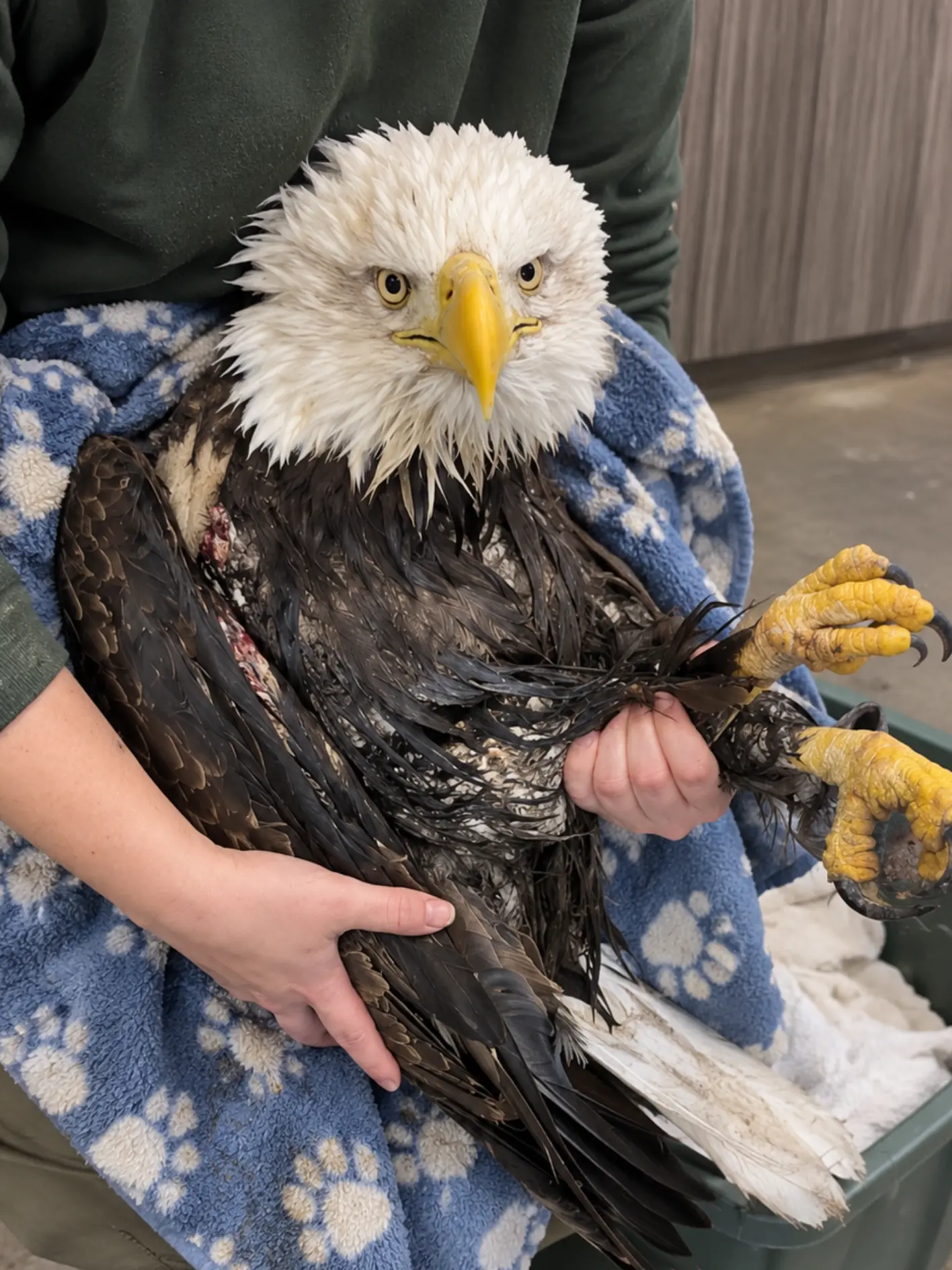
The feathers across the chest, abdomen and wings were completely saturated. Water streamed from the long flight feathers. One side of the upper wing showed a raw area beneath separated feathers, and there was a small amount of blood near the shoulder. The white head feathers were dirty and matted, but the eyes remained open and responsive. The eagle breathed rapidly with the beak slightly parted.
The bird tried to strike once with a foot, then seemed to lose the energy to continue resisting.
Langley wrapped a dry towel around the body without compressing the chest. Birds depend on movement of the sternum and body wall for ventilation, so restraint has to control the animal without preventing normal breathing. The injured wing was kept in a natural folded position, and the eagle was transferred into the padded crate.
Inside the carrier, the bird initially remained upright.
Less than a minute later, it lowered itself onto the towel.
For Langley, that change confirmed that the eagle had been much closer to complete exhaustion than its earlier defensive behavior suggested.
The team left for the fictional Keystone Raptor Medical Center immediately.
During transport, the crate was kept quiet and covered enough to reduce visual stimulation while still allowing good airflow. The responders did not repeatedly open the carrier to check the eagle. Once a wild bird has been secured and is breathing adequately, unnecessary handling can add stress without providing useful information.
Langley called the medical center on the way.
Adult Bald Eagle. Prolonged water exposure. Possible shoulder trauma. Fully saturated feathers. Rapid breathing. Significant fatigue. No witnessed collision. No known entanglement. No obvious catastrophic bleeding.
The veterinary staff prepared an examination space before the vehicle arrived.
When the crate door opened, the eagle was lying low on the towels. Its head rested partly against one side of the carrier, but the eye nearest the opening remained alert. The image looked dramatic because the bird appeared almost flattened beneath wet feathers, but the veterinary team focused on measurable clinical signs rather than appearance alone.
Dr. Rebecca Nolan, the center’s wildlife veterinarian, began with temperature, respiration, circulation and neurologic response. The eagle’s body temperature was moderately low, consistent with prolonged immersion. The bird was also dehydrated, a finding that sometimes surprises people because the animal had been surrounded by water. Being in water does not mean the bird has taken in useful fluid, and sustained exertion can worsen dehydration.
The respiratory rate was elevated. Nolan listened carefully for abnormal sounds and watched the depth and effort of each breath. Water aspiration was a concern, but there was no immediate evidence of severe respiratory failure.
The eagle responded to light in both eyes. Both feet retained sensation and grip, although the overall strength was reduced. There was no obvious spinal instability. The main painful area was the right shoulder and upper wing.
Because hypothermia and severe exhaustion can complicate sedation and diagnostic procedures, the team did not rush immediately into radiography. The bird was warmed gradually, given controlled fluid support and placed in a quiet treatment area until its temperature and circulation improved enough for further examination.
The wet feathers were not aggressively dried with hot air. Rapid, intense heating can create additional physiologic stress, and feather structure can be damaged by inappropriate handling. Instead, the bird was kept in a warm environment with dry absorbent bedding and carefully managed external heat.
As the eagle warmed, its level of awareness improved.
It began lifting the head rather than leaving it against the towel. When a technician approached, the bird followed her with both eyes. That response was reassuring, although the team still considered the case serious.
Several hours after admission, the eagle was stable enough for a more complete examination and radiographs.
The shoulder injury was easier to assess once wet feathers had been separated from the skin. There was a soft-tissue wound around the upper wing with bruising extending into the surrounding area. Several feathers were broken or disrupted. The injury did not resemble a massive open fracture, but it was painful enough that the eagle resisted extension of that wing.
Radiographs provided the next important piece of information.
There was no major fracture of the humerus, radius or ulna. The shoulder joint remained aligned. The coracoid did not show a catastrophic break. The spine appeared intact, and there was no obvious major internal hemorrhage visible on the initial imaging.
The primary orthopedic problem was soft-tissue trauma.
That was encouraging, but Nolan cautioned the staff against treating “no fracture” as equivalent to “minor injury.”
A bird flies with a system, not with bones alone.
Muscles power the wing. Tendons transfer force. Joints must move through the correct range. Nerves control timing and coordination. Feathers shape the airflow. An injury to any of those structures can prevent normal flight even if every bone remains intact.
The shoulder wound was cleaned thoroughly. Damaged and contaminated tissue was evaluated, and the area was flushed to reduce the risk of infection. Pain medication was administered. Fluid support continued. Because the wound had been submerged in pond water, antimicrobial therapy was considered appropriate based on the depth and contamination of the injury.
The team also continued monitoring respiratory function.
An eagle can inhale small amounts of water while struggling, and respiratory complications may not appear immediately. Nolan wanted the bird watched closely for increasing effort, abnormal sounds, changes in oxygenation or other signs that the lungs or air-sac system had been affected.
The cause of the original injury remained unknown.
The veterinary team could explain why the eagle had been unable to leave the pond. The shoulder was injured, the wing could not generate normal force, and the feathers had become progressively more saturated as the bird struggled. What they could not explain was what had happened before the water.
A failed fishing attempt was possible. Bald Eagles routinely take fish and may occasionally enter the water during an unsuccessful capture. A collision with a branch, fence or structure near the pond was another possibility. The bird may have already been injured elsewhere and landed in the water after losing control. A territorial encounter with another eagle could not be ruled out either.
No one had witnessed the beginning.
The center therefore recorded the cause as trauma of unknown origin rather than inventing a more satisfying story.
That first night was the most uncertain part of the case.
The eagle remained in an intensive-care enclosure lined with towels. No high perch was provided because the bird was too weak to use one safely. Lights were kept low, and staff entered only when treatment or monitoring required it.
For several hours, the eagle stayed almost completely still.
Its breathing gradually became slower and more regular as body temperature normalized. The head remained upright for longer periods. The bird still looked exhausted, but it no longer appeared to be losing ground.
Food was not forced during the earliest stage.