Residents along a wooded stretch of the Wisconsin River first noticed the two adult Bald Eagles because they were flying much lower than usual. On most mornings, eagles in the area could be seen moving between tall cottonwoods and open water, occasionally circling above the river before disappearing beyond the tree line. This time, however, the birds were following one another closely, banking sharply and repeatedly changing altitude. What initially looked like ordinary aerial interaction changed within seconds when one eagle turned toward the other, extended its feet, and drove forward with its talons exposed.
The second eagle responded immediately.
Both birds climbed, separated, and then turned back toward each other.
Their wings beat rapidly as they crossed above a narrow section of river where several homeowners had clear views from their yards. One witness, Linda Carver, later described the confrontation as something she had never seen despite living beside the river for more than twenty years.
“They were not just flying together,” she said. “They were going directly at each other.”
Carver watched from her kitchen window as the two eagles circled again. One bird dropped beneath the other and then climbed almost vertically. Both extended their legs. Their bodies came together briefly before separating.
The encounter lasted only a few seconds.
Then it happened again.
This time, the birds appeared to lock feet.
Their wings opened wide as they lost altitude together, turning awkwardly in the air while each tried to break away. They dropped toward the treetops before separating only a short distance above the branches.
One eagle recovered almost immediately.
It leveled out, crossed the river, and continued toward a line of pines on the opposite bank.
The other did not.
Its flight became irregular.
The bird beat both wings several times, but its body remained low. It passed above the shoreline, struck through several thin branches, and came down in a grassy clearing behind a row of homes.
Carver immediately stepped away from the window and called her husband.
They watched from inside.
The Bald Eagle was upright.
That was the first good sign.
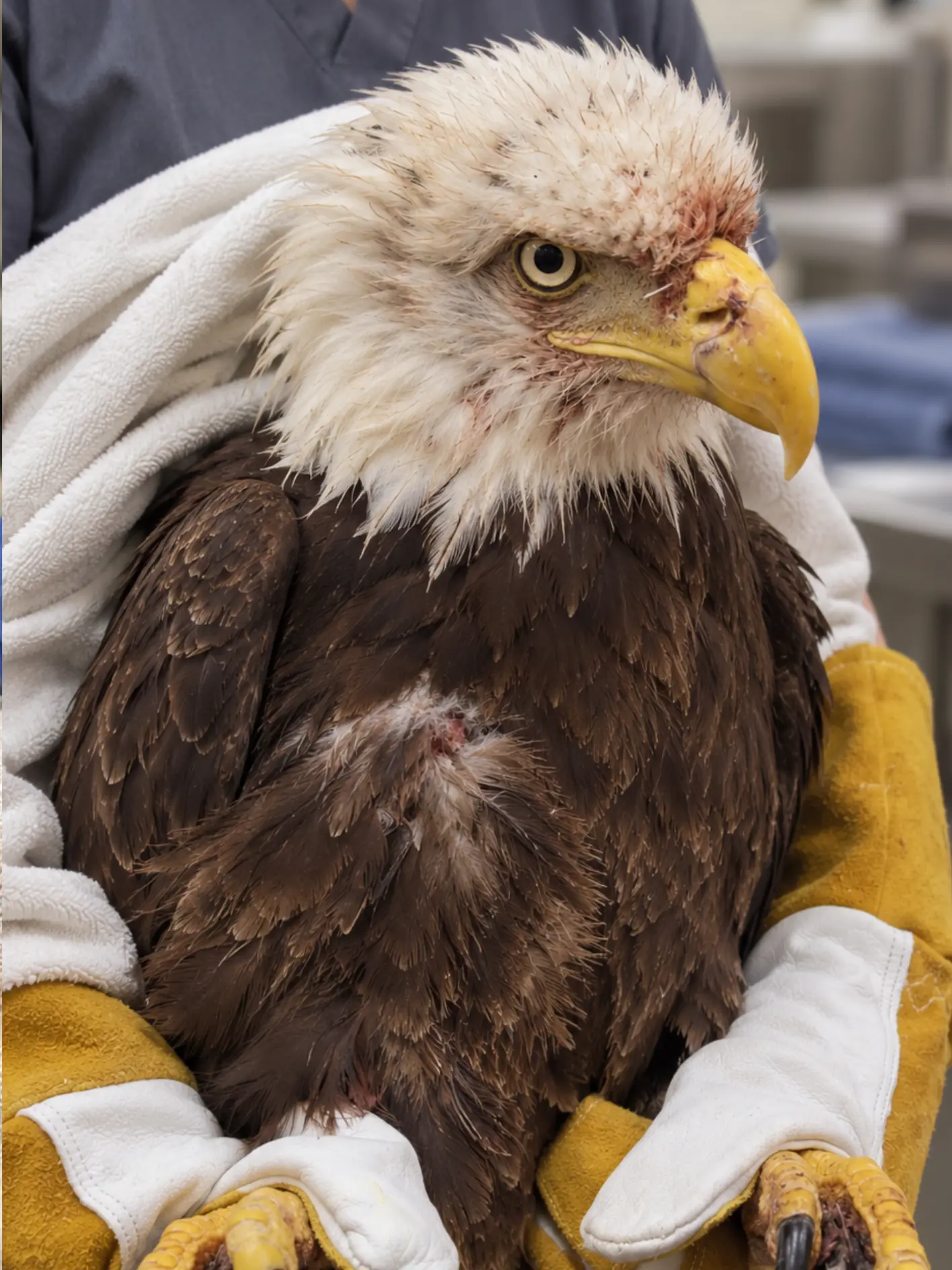
The bird’s white head was dirty, however, and several small streaks of blood were visible along the feathers near the face. One wing was partly extended. The eagle repeatedly tried to pull it closer to the body but seemed uncomfortable doing so.
The bird remained on the ground for several minutes.
Then it attempted to leave.
It lowered its body, spread both wings, and pushed forward.
The first few wingbeats lifted it slightly.
The eagle traveled only a short distance before coming down again.
Carver noticed another problem as soon as it landed.
One foot did not seem to be bearing weight normally.
The eagle stood with the injured foot partly raised while using the other to stabilize itself.
Despite the injuries, the bird was still intensely alert.
Its eyes followed movement around the yard.
Whenever a vehicle passed on the nearby road, the eagle turned its head immediately.
When Carver opened the back door only a few inches to get a clearer look, the bird spread both wings and opened its beak.
She closed the door again.
The eagle was clearly injured.
It was also still a wild predator capable of defending itself.
Carver called the county wildlife office and explained that she had witnessed two Bald Eagles fighting in the air and that one of them was now grounded behind her home.
The dispatcher transferred the report to a conservation officer and instructed Carver to keep everyone inside, bring pets in, and avoid approaching the bird.
A licensed response team from the fictional Great Lakes Raptor Rehabilitation Center was contacted.
While help was on the way, Carver continued watching from the house.
The eagle tried to move toward a low line of shrubs at the edge of the clearing.
Its walking pattern was uneven.
The injured foot touched the ground occasionally but was quickly lifted again.
Several feathers along the chest and shoulder were disturbed. From a distance, the wounds appeared small.
That appearance would later prove misleading.
The bird attempted a second short flight about fifteen minutes later.
It gained only a few feet of height.
One wingbeat looked strong.
The next became shallower.
The eagle landed awkwardly near the shrubs and remained there.
Carver said the most difficult part was resisting the urge to go outside.
“It looked like it needed help,” she recalled. “But every time it saw movement, it reacted like it wanted to defend itself. We knew getting closer would make things worse.”
Conservation Officer Ryan Mercer arrived first.
He observed the eagle from behind a fence using binoculars.
The bird remained conscious and responsive.
Mercer could see blood staining near the crown of the head and around one shoulder. One foot looked swollen. The eagle was also breathing faster than expected for a bird that had been resting.
He spoke with Carver about exactly what she had witnessed.
Two adult Bald Eagles.
Repeated aerial contact.
Feet extended.
Both birds losing altitude.
One bird leaving normally.
The second bird falling toward the neighborhood.
That history made a territorial or competitive fight the leading explanation for the injuries, but Mercer was careful not to assume why the confrontation had begun.
Bald Eagles can fight over nesting territories, food, preferred perches, shoreline access, or other resources. During certain times of year, adult birds may become especially defensive around established territories.
None of the witnesses had seen what happened before the two eagles entered view.
The fight itself was witnessed.
What triggered it was not.
The Great Lakes Raptor Rehabilitation Center team arrived approximately twenty minutes later.
Field responders Rachel Kim and Andrew Morales brought a large ventilated carrier, heavy protective gloves, towels, a soft capture net, and basic stabilization equipment.
The eagle was now sitting near the shrubs.
It had stopped attempting to fly.
Kim considered that both helpful and concerning.
A bird that can no longer repeatedly escape is easier to capture.
It may also be running out of strength.
The responders planned the approach carefully.
The road was behind them.
Dense brush was ahead of the eagle.
If the bird ran into the vegetation, capture would become more difficult and could produce additional injuries.
Morales positioned himself near the brush line.
Kim approached from the open side.
The eagle immediately reacted.
Its head came up.
The beak opened.
Both wings spread.
For several seconds, the bird looked far stronger than it had while sitting quietly.
Then it stood.
The injured foot remained partly lifted.
When Kim moved closer, the eagle began running.
The movement was uneven but surprisingly fast.
The bird opened its wings and tried to launch.
It became airborne briefly.
Then the body dropped back into the grass.
The failed attempt confirmed what the witnesses had reported.
The eagle could still generate some lift.
It could not sustain normal flight.
Kim stopped advancing until the bird settled.
Every unnecessary takeoff attempt carried a risk of worsening shoulder injuries or reopening puncture wounds.
After several minutes, Morales moved slightly to prevent access to the brush.
Kim closed the remaining distance with a towel.
The eagle raised both feet defensively.
That was the moment when the danger of handling became obvious.
One foot was injured.
The other was fully functional.
The talons opened toward the approaching responder.
Kim placed the towel over the bird’s upper body while Morales immediately controlled the legs above the feet.
The eagle struggled strongly.
The healthy foot struck repeatedly against the gloves.
Both wings pushed beneath the towel.