Bald eagles are a familiar sight across much of Alaska, where they can be seen perched above waterways, crossing roads, circling over neighborhoods, and gathering anywhere food is readily available.
Even in a state where seeing America’s national bird is hardly unusual, however, two adult bald eagles locked together in a violent aerial encounter are enough to make people stop and look.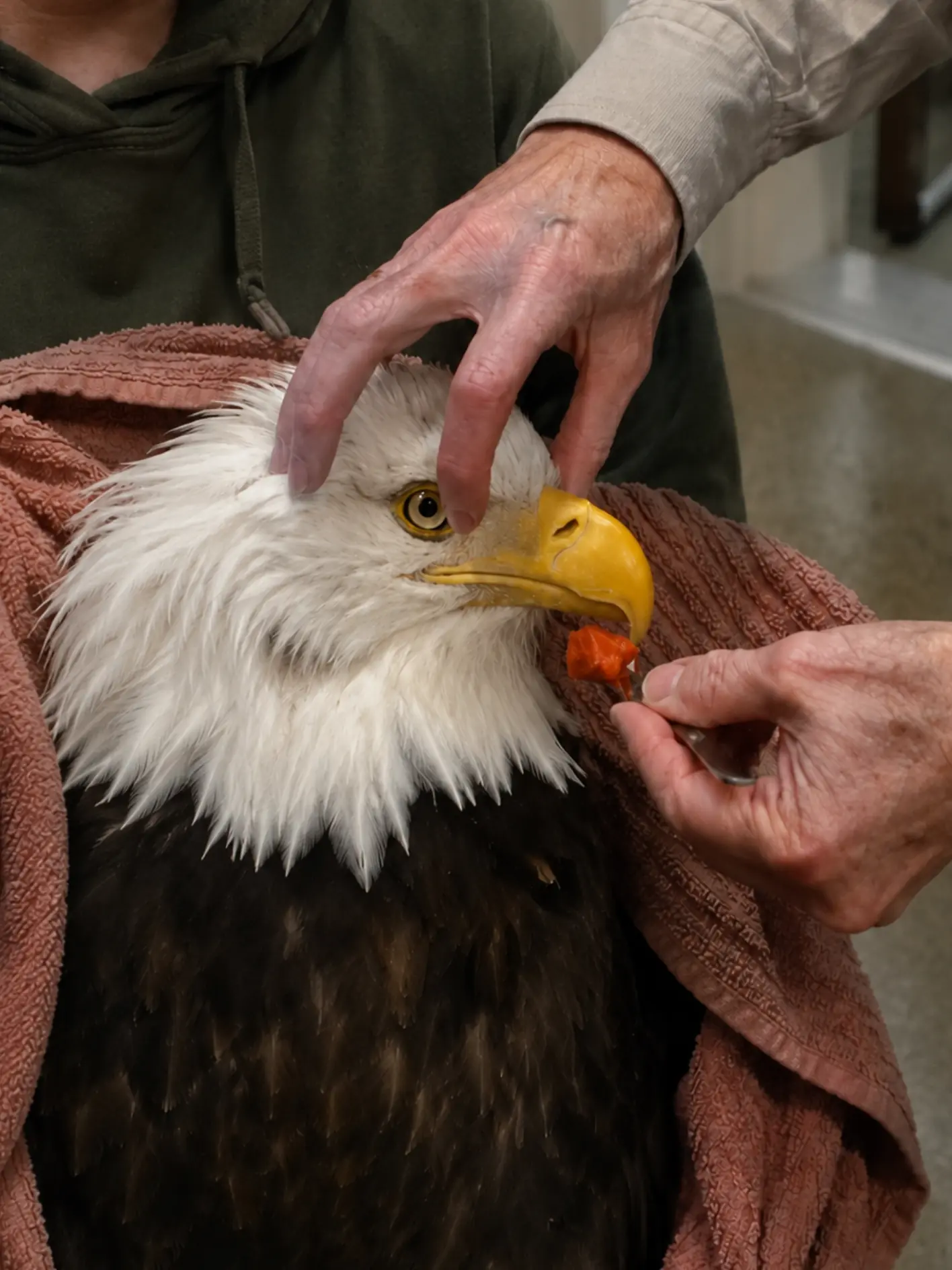
That is what happened near the Exchange area at Joint Base Elmendorf-Richardson in Anchorage, where employees and others on the installation witnessed two bald eagles become entangled in what appeared to be an aggressive territorial encounter above a busy parking area.
Within seconds, one of the birds was on the ground.
Megan Foster, a civilian clothing sales manager at the Exchange, was on her way to work when movement overhead caught her attention.
“Out of the corner of my eye, I could see something happening above the parking lot,” Foster recalled. “Their talons were locked together, and then there was this loud impact. One of them just dropped.”
The second eagle eventually left the area.
The fallen bird did not.
It remained on the ground, unable to return to flight, while ravens repeatedly swooped toward it. With employee vehicles, pedestrians, deliveries, and normal base traffic moving nearby, Foster realized the eagle was facing dangers well beyond whatever injuries it had sustained in the air.
She contacted military police.
That call began a coordinated response involving base personnel, law enforcement, wildlife responders, veterinary professionals, and rehabilitators.
The eagle is now recovering in professional care.
Footage recorded later during rehabilitation shows the adult bird awake and responsive while staff carefully restrain it in a towel and offer a small piece of food.
That scene looks considerably calmer than the chaotic moments that brought the eagle into care.
But wildlife specialists say the fact that the bird is alert and showing interest in food is only one part of the recovery process.
Before it can return to Alaska’s skies, it will need to prove that the damage from the aerial fight and subsequent fall has not permanently compromised the strength, coordination, or flight control required for life in the wild.
Bald Eagles Are Common in Alaska—This Was Not a Common Sight
For many Alaska residents, bald eagles are part of the ordinary landscape.
The state supports extensive habitat for the species, including coastlines, rivers, lakes, wetlands, forests, and areas with abundant fish and carrion.
Around Anchorage, eagles may be seen flying over developed areas just as readily as they are observed near more remote habitat.
Joint Base Elmendorf-Richardson sits within that larger environment.
Wildlife does not recognize the boundaries between military property and surrounding natural habitat, and large birds regularly move across areas where roads, buildings, parking lots, open fields, and forested land intersect.
That makes an eagle overhead relatively unremarkable.
Two adult eagles apparently grappling in midair are another matter entirely.
Aggressive interactions between bald eagles can occur for several reasons. Birds may defend space, feeding opportunities, or other resources. Some confrontations consist primarily of vocalizations, aerial pursuit, or posturing.
Others become physical.
Large raptors can extend their feet toward one another, make contact with their talons, and briefly grapple while airborne.
Most such interactions end when the birds separate.
The danger increases when they remain locked together long enough to lose altitude.
That appears to be what witnesses saw over JBER.
“Their Talons Were Locked Together”
Foster initially noticed the birds only peripherally.
The movement did not immediately register as an emergency.
Then she saw the two eagles close together in the air.
“Out of the corner of my eye, I could see something happening above the parking lot,” she said. “Their talons were locked together.”
Almost immediately afterward came a loud impact.
One of the eagles fell.
What caused the sound cannot be established from the eyewitness account alone. It could have been the bird contacting the ground or another surface during the fall.
What mattered was what Foster saw next.
The eagle did not recover and fly away.
It remained down.
That was the first indication the encounter had resulted in more than a temporary loss of balance.
A Midair Fight Can Produce Several Types of Injury
Bald eagles are powerful animals, but that power can work against them during direct physical encounters.
Their talons are designed to penetrate and grip.
During an aggressive interaction, those feet can create puncture wounds and soft-tissue trauma.
But the talons themselves may not be the most dangerous part of the event.
A pair of large birds concentrating on one another in flight can lose altitude rapidly.
If one bird separates too late, it may strike the ground, vegetation, a building, or another structure before regaining control.
That creates the potential for blunt-force trauma.
Veterinarians evaluating a bird after an event like this therefore have several possibilities to consider:
puncture wounds from talons,
soft-tissue injuries,
wing or shoulder trauma,
fractures,
head injury,
internal trauma,
and injuries caused by impact with the ground.
Without a complete examination, it would be impossible to determine which mechanism caused which injury.
That uncertainty was still present when the eagle lay on the parking area.
The Eagle Was Grounded—and Ravens Noticed
The injured bird soon attracted another kind of attention.
Ravens began moving toward it.
Foster said the birds repeatedly swooped at the grounded eagle while it remained unable to leave.
Ravens and other corvids may mob larger raptors under a variety of circumstances. The behavior can involve repeated approaches, vocalizations, and diving movements intended to drive a potential threat away.
A healthy bald eagle can usually respond by flying to another location.
An injured eagle cannot.
That changed the balance immediately.
The eagle was already compromised.
Now it was being repeatedly harassed while lying in an exposed area.
“At first I thought maybe it would shake it off and fly away,” Foster said. “But when it stayed down and the ravens started coming at it, that’s when we knew somebody had to step in.”
The Parking Lot Added Another Layer of Risk
The ravens were not the only problem.
The eagle had come down in or near a busy area of the installation.
Parking lots create hazards that do not exist in more isolated habitat.
Vehicles arrive and leave.
Employees walk through.
Delivery traffic moves nearby.
People may stop to look or attempt to photograph an unusual scene.
For a wild eagle already unable to fly, that activity can become dangerous very quickly.
A frightened bird may try to move despite its injuries.
A sudden attempt to escape can carry it toward vehicles or people.
Crowding can increase stress.
And repeated movement may worsen trauma that has not yet been identified.
Foster therefore called military police rather than attempting to resolve the situation alone.
Military Police Secured the Scene
The role of the responding officers was initially straightforward.
They did not need to diagnose the eagle.
They needed to prevent the situation from becoming worse.
Military police helped establish space around the injured bird and limit traffic and unnecessary human activity near it.
That gave the eagle a quieter area while appropriate wildlife assistance was arranged.
It also reduced the risk that someone unfamiliar with raptor handling would attempt to pick the bird up.
Even severely injured bald eagles can remain dangerous to handle.
The beak looks formidable, but experienced handlers often regard the feet as the greater risk.
A bald eagle’s talons are designed to seize and hold struggling prey.
A bird that cannot fly may still be capable of inflicting serious injury if frightened.
The safest rescue therefore required someone experienced with large raptors.
The Call Was Passed to Wildlife Responders
Military police contacted wildlife professionals capable of handling the eagle and arranging veterinary care.
That created the chain of cooperation that ultimately gave the bird its chance to recover.
One person saw the problem.
Military police secured the site.
A trained responder handled the bird.
Veterinary personnel evaluated it.
Rehabilitators then took over the longer process of recovery.
No single step would have been enough by itself.
Had Foster simply moved the eagle away from traffic without seeking medical care, internal injuries could have gone untreated.
Had veterinary help been available but the bird remained in the parking lot surrounded by traffic and ravens, it might have deteriorated before responders arrived.
The rescue worked because several different people handled different parts of the emergency.
Capturing the Eagle Required Specialized Handling
When wildlife responders reached the scene, the eagle was still alive and responsive.
That did not mean it was capable of defending itself normally.
A healthy adult eagle would ordinarily create distance long before a responder reached close range.
This bird remained grounded.
Handlers approached with the assumption that it could still use its talons.
A towel or other appropriate restraint can be placed over a raptor to reduce visual stimulation and help control movement.
The wings are kept close to the body.
The feet must be secured carefully.
The objective is to prevent the eagle from injuring the handler while also preventing the bird from worsening its own injuries during capture.
Once the bird was contained, it could be transported away from the base for a complete assessment.
The First Veterinary Question Was Not “Will It Fly Again?”
That question would come later.
The first concern was stability.
The eagle had experienced both an aerial confrontation and a fall significant enough to leave it grounded.
Veterinary professionals therefore needed to determine whether any immediately life-threatening problems were present.
Respiration was evaluated.
The bird’s neurological responsiveness was assessed.
The head and eyes required examination.
Both wings and shoulders had to be compared.
The legs and feet needed inspection for punctures or other trauma.
Feathers were moved aside to search for wounds that could have been hidden from view.
Hydration and overall body condition also provided information about the bird’s status.
Only after those basic questions were addressed could clinicians begin building a longer-term prognosis.
Talon Wounds Can Be Easy to Miss
One specific concern after an eagle-on-eagle encounter is puncture trauma.
The talons can create relatively small openings at the skin while extending farther into deeper tissue.
Dense feathers may hide the surface wound entirely.
That means staff have to examine areas of concern carefully rather than relying on what can be seen from several feet away.
A puncture may damage muscle.
It may create bleeding.
It can introduce contamination.
Depending on location, it may also affect structures involved in flight.
The presence of a puncture wound would not automatically explain every sign, particularly after a fall.
It would simply become one component of the overall trauma assessment.
The Fall May Have Done More Damage Than the Fight
When large birds grapple in the air, the eventual impact with the ground can be medically significant.
An eagle’s body is designed to absorb forces associated with normal takeoff and landing.
An uncontrolled fall is very different.
The bird may strike on a wing.
It may hit the shoulder.
The head can make contact.
A leg may take the force unevenly.
Even when no bone is visibly displaced, soft tissues can be injured.
That is why diagnostic imaging may be considered if physical examination suggests orthopedic trauma.
Radiographs can help identify fractures and joint abnormalities.
They cannot reveal every soft-tissue injury, so follow-up examinations and functional observations may remain necessary even if skeletal imaging is reassuring.
No One Could Assume the Other Eagle “Won”
It would be easy to describe the encounter in dramatic terms—a battle, a defeat, one eagle overpowering another.
Wildlife behavior is rarely that simple.
The witnesses saw an aggressive aerial interaction.
One eagle ended up injured on the ground.
The other left.
That does not establish exactly why the confrontation began or whether one bird was defending territory, food, or another resource.
For that reason, the most accurate description remains an apparent territorial or aggressive encounter between two adult bald eagles.
There is no need to assign human motives to the birds.
The injury is compelling enough without doing so.
Early Rehabilitation Focused on Quiet and Stability
After the veterinary assessment, the eagle entered the first phase of rehabilitation.
This stage can be intentionally uneventful.
Quiet housing.
Limited movement.
Minimal handling.
Pain control when indicated.
Observation.
For a wild bird, rest is not simply comfort.
It is treatment.
An injured eagle given too much space too early may repeatedly attempt to escape, potentially aggravating wing or soft-tissue trauma.
A smaller controlled environment allows the body to stabilize.
Staff can monitor whether posture changes.
They can watch whether the bird begins using both wings more normally.
They can observe appetite, breathing, balance, and responsiveness.
The eagle’s behavior becomes part of the medical record.
The Later Footage Shows a Very Different Moment
The footage now associated with the eagle does not show the parking-lot emergency.
It was recorded later during professional care.
In the image, the eagle is upright and alert while being carefully restrained in a towel.
A caregiver offers a small piece of food near the beak.
Another person stabilizes the head during the controlled handling session.
That distinction matters.
The bird is no longer on the ground surrounded by traffic and ravens.
It is in a rehabilitation setting, where staff can observe feeding behavior safely.
The scene is encouraging.
It is not proof that the eagle has completely recovered.
Showing Interest in Food Is an Important Milestone
Appetite can reveal a great deal about an injured wildlife patient.
A bird in severe pain, shock, or profound physiological distress may refuse food.