An adult bald eagle found injured and unable to fly in Pueblo County, Colorado, is recovering after wildlife veterinarians performed surgery to remove a metallic BB lodged in one of its wings, while Colorado Parks and Wildlife officers continue searching for whoever fired the shot.
The eagle was discovered grounded in a rural area not far from the Arkansas River, where open farmland, riparian corridors, and scattered stands of trees provide suitable habitat for bald eagles moving through southern Colorado.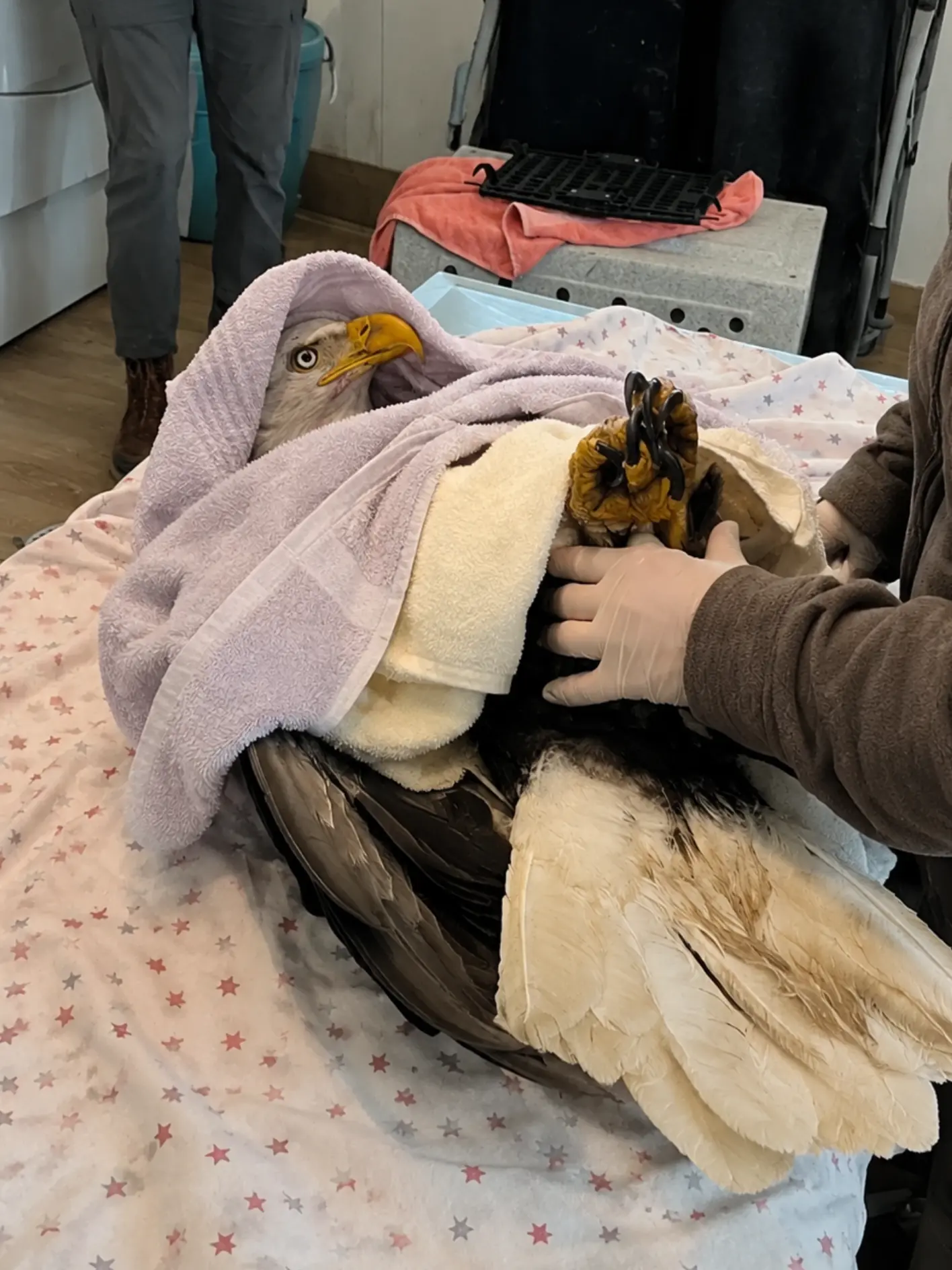
At first, there was no obvious explanation for why the bird could not leave.
It remained alive and alert, but one wing was not functioning normally. There was no dramatic open fracture, no large external wound, and no immediately visible object embedded in the feathers.
The answer appeared only after veterinarians took X-rays.
Diagnostic images revealed a small metallic projectile lodged inside the injured wing.
The finding was consistent with a BB or similar pellet.
That discovery changed the case from a routine wildlife trauma admission into both a surgical emergency and a wildlife law-enforcement investigation.
Veterinarians determined that the projectile needed to be removed because leaving it in place could contribute to ongoing pain, inflammation, tissue damage, infection, and impaired wing movement.
The eagle underwent surgery, and the BB was successfully removed.
For the rehabilitation team, the most encouraging finding came afterward.
Although the projectile had caused significant soft-tissue injury, the damage did not appear to have destroyed a major joint or created the kind of catastrophic wing injury that would automatically eliminate the possibility of future flight.
Officials now say they are cautiously optimistic that the eagle may eventually be able to fly again.
But while the medical team works toward that goal, another question remains unanswered.
Who shot it?
A Grounded Eagle in Pueblo County
The case began when the adult bald eagle was found on the ground in Pueblo County, in an area where bald eagles may be seen traveling between the Arkansas River, reservoirs, agricultural fields, and other feeding habitat.
A healthy adult bald eagle typically does not allow people to approach closely on open ground.
Even when feeding or resting, the bird usually retains the ability to move away quickly.
This eagle did not.
Its inability to fly was the clearest sign that something was wrong.
Wildlife responders approached carefully and secured the bird for transport.
Handling an injured bald eagle requires specialized precautions.
The bird may be weak, but its talons remain capable of causing serious injury.
The feet must be controlled while the wings are protected from further trauma.
The eagle was transferred to a licensed wildlife rehabilitation facility in southern Colorado, where staff could perform a complete examination.
At that stage, no one knew exactly what had happened.
The bird might have suffered a collision.
It might have been injured in a territorial encounter.
It might have struck a structure.
Or it could have sustained trauma that was not immediately visible.
The veterinary team began with the evidence in front of them.
A bald eagle was alive.
It could not fly.
And one wing was not functioning normally.
The First Examination Did Not Reveal the Whole Story
During the initial physical examination, veterinarians assessed the eagle’s overall condition before focusing specifically on the injured wing.
They evaluated respiration.
Hydration.
Body condition.
Neurological responses.
Both eyes.
The beak and head.
The legs and feet.
Then they carefully compared the wings.
The injured side showed enough abnormality to justify diagnostic imaging, but the outside of the wing did not reveal the full extent of the problem.
That is common in raptors.
Dense feathers can conceal wounds.
Small puncture sites may disappear beneath plumage.
Soft-tissue injuries can be severe even when the skin looks relatively normal.
A small projectile can enter the wing, leave a very limited external opening, and become lodged deeper in muscle or other tissue.
Without imaging, the cause may remain hidden.
X-Rays Revealed a Metallic Projectile
Radiographs provided the breakthrough.
Inside the injured wing, veterinarians could see a small metallic object.
Its appearance was consistent with a BB or pellet.
That finding immediately raised concern that the bald eagle had been shot.
The precise weapon could not be identified from the initial medical evaluation alone.
A BB may be fired from an air gun, while other small projectiles can have different origins.
Wildlife investigators would need to evaluate the recovered evidence before drawing conclusions about the exact device used.
But from a medical standpoint, the key fact was already clear.
There was a foreign metallic object lodged inside the wing.
And it was located in a place where it could interfere with healing and normal function.
Why the BB Had to Come Out
Not every retained projectile in wildlife is automatically removed.
Sometimes the risks of surgical extraction are greater than the risks of leaving an object in place.
Location matters.
Depth matters.
Proximity to blood vessels, nerves, joints, and bone matters.
In this case, however, the veterinary team determined that removal was appropriate.
The BB was associated with the injured wing and could contribute to persistent inflammation or mechanical irritation.
Foreign material can also create a route for contamination.
If the projectile had carried debris into deeper tissues, infection could become a concern.
More importantly for a wild bald eagle, anything that limits wing motion or causes continuing pain can jeopardize the possibility of release.
A bird can survive with many types of injuries in a controlled environment.
A wild eagle must be able to fly powerfully and repeatedly.
The medical team therefore needed to eliminate as many barriers to normal wing function as possible.
Preparing the Eagle for Surgery
Before surgery, veterinarians evaluated whether the bird was stable enough for anesthesia.
Wildlife anesthesia carries special considerations.
Bald eagles are powerful but physiologically sensitive patients.
The team needed to assess hydration, respiratory status, circulation, and general stability before proceeding.
Bloodwork may also be used to evaluate whether there are underlying problems that could increase anesthetic risk.
The injured wing was examined again with the radiographs available as a guide.
The team needed to understand where the projectile sat in relation to the major bones, joints, tendons, blood vessels, and nerves.
The goal was not simply to locate the BB.
It was to determine the safest way to reach it.
The Surgery
The eagle was placed under general anesthesia so the surgical team could work without causing additional stress or pain.
Once the bird was stable, veterinarians carefully approached the area where imaging had shown the metallic projectile.
The tissues around the wound were examined.
The BB was located and removed.
The wound tract was cleaned, and surrounding tissue was evaluated for additional damage.
One of the most important questions was whether the projectile had shattered bone or severely disrupted a major joint.
Those findings would have changed the prognosis dramatically.
Fortunately, the injury did not appear to have caused the kind of catastrophic structural destruction that would make normal flight obviously impossible.
There was significant trauma.
But there was also enough preserved anatomy to justify continued rehabilitation.
The BB was removed successfully.
The operation ended with something the medical team had hoped to retain from the beginning:
a realistic possibility of functional recovery.
The Image Shows a Patient in Professional Care
The treatment image shows the adult bald eagle lying on a padded examination surface while trained personnel restrain the bird using towels and protective gloves.
The eagle is wrapped securely, and one handler controls the feet while another supports the body.
That type of restraint is important in large raptors because the talons remain dangerous even when the patient is sedated, weakened, or recovering from a procedure.
The image should not be interpreted as showing the BB itself.
The projectile was hidden inside the wing and identified through diagnostic imaging.
The photograph instead captures the intensive handling and veterinary care required after a protected wild bird is brought in with serious trauma.
Recovery From Anesthesia
After surgery, the eagle entered a closely monitored recovery phase.
The first hours after anesthesia can be important in any raptor patient.
Veterinary staff watched breathing, circulation, body temperature, responsiveness, and the surgical site.
They also monitored the position of the injured wing.
Pain control was an important part of postoperative care.
A bird cannot explain that a wound hurts.
Instead, clinicians observe posture, behavior, appetite, and how the animal holds or uses the injured limb.
The eagle recovered from the procedure without an immediate major complication.
That was encouraging.
But the successful removal of the projectile was only the beginning of rehabilitation.
A Wing Can Look Better Before It Works Better
Following surgery, inflammation can remain even after the foreign object is gone.
Muscle tissue may be bruised.
The wound tract must heal.
The bird may avoid using the injured wing normally because of pain or stiffness.
That means veterinarians cannot judge long-term outcome immediately.
For the first part of recovery, the eagle needs controlled rest.
Too much movement could disrupt the healing tissue.
Powerful wingbeats place considerable strain on muscles, tendons, and joints.
Allowing a raptor to repeatedly attempt flight immediately after surgery could cause additional trauma.
The bird is therefore kept in a controlled enclosure while staff monitor the wound and overall condition.
Wound Care and Infection Monitoring
Penetrating injuries require careful follow-up.
The surgical site must remain clean.
Veterinarians watch for swelling, heat, discharge, discoloration, or changes in the bird’s behavior that could suggest infection or persistent pain.
Antibiotics may be prescribed when clinically appropriate, particularly if contamination is a concern.
The eagle’s appetite also matters.
A bird recovering normally should eventually show increasing interest in food.
Body weight is monitored because prolonged weakness or poor appetite can slow healing.
Each small improvement helps the team determine whether the bird is moving toward rehabilitation rather than simply surviving the procedure.
Colorado Parks and Wildlife Opens an Investigation
While veterinary staff focused on the eagle, Colorado Parks and Wildlife began examining how the bird had been shot.
Wildlife officers are now trying to determine where the shooting occurred, when it happened, and who may have been responsible.
No suspect has been identified.
No motive has been established.
Those facts matter because a bald eagle may travel some distance after being injured.
The place where the bird was discovered is not necessarily the place where it was shot.
An eagle with partial wing function may remain mobile for some time before inflammation, pain, or exhaustion makes further flight impossible.
That complicates the investigation.
Officers may need to rely on witness reports, physical evidence, the recovered projectile, and information about where the eagle had been seen before it was found.
The Recovered BB May Become Evidence
The projectile removed during surgery may have value beyond the medical case.
Once a foreign object is removed from an animal involved in a suspected wildlife crime, it can potentially become part of the evidence reviewed by investigators.
That does not mean the BB will automatically reveal who fired it.
A small projectile may provide limited identifying information.
But its size, composition, deformation, and other characteristics could help investigators understand the type of weapon involved.
The medical team’s responsibility is treatment.
The wildlife officers’ responsibility is determining whether a criminal violation occurred and, if possible, who committed it.
The two parts of the case now proceed simultaneously.
Bald Eagles Are Protected Under Federal Law
Bald eagles receive substantial legal protection in the United States.
They are protected under the Bald and Golden Eagle Protection Act and the Migratory Bird Treaty Act, along with applicable state wildlife protections.
Those laws prohibit unauthorized killing, wounding, taking, or possession of bald eagles and their parts.
The legal consequences of intentionally shooting an eagle can be serious.
However, it would be inappropriate to assign guilt or discuss a specific penalty before investigators identify a suspect and establish what happened.
For now, Colorado Parks and Wildlife is asking a simpler question:
Who fired the shot?
Why People Shoot Protected Raptors Is Not Something Investigators Assume
Wildlife crimes can occur for many reasons, but speculation about motive does not help an investigation.
The eagle may have been deliberately targeted.
The shooter may have mistaken the bird for something else.
The incident may have involved reckless shooting.
Or circumstances may differ from any of those possibilities.
Without evidence, none should be presented as fact.
Investigators will need to reconstruct the event from available information.
The medical team does not need to know the motive to treat the injury.
It needs only to understand the anatomy.
The Good News: Major Flight Structures Remain Viable
The strongest reason for cautious optimism came from what veterinarians did not find.
The projectile had not produced obvious irreversible destruction of the entire wing.
A major joint did not appear to be catastrophically lost.
The wing remained potentially functional.
That matters because many raptor injuries have poor outcomes precisely when essential flight structures cannot be restored.
In this case, staff believe there is a realistic chance that the bird could regain sufficient movement and strength for flight.
That does not mean the eagle is ready to be released.
It means release has not been ruled out.
“Cautiously Favorable” Is Different From “Fully Recovered”
Wildlife medicine often uses careful language because early improvement can be misleading.
A surgical wound may close.
The bird may become alert.
The wing may begin moving more normally.
But the final test is functional performance.