When Michael Turner opened the back door of his home shortly after 7 a.m., he expected to find nothing more unusual than the fallen branches left behind by the previous night’s wind. His property in western Michigan backed up to several acres of mixed woodland, with the Muskegon River corridor less than two miles away. Deer occasionally crossed the yard before sunrise, wild turkeys wandered through in small groups, and Bald Eagles were sometimes visible above the trees during the colder months.
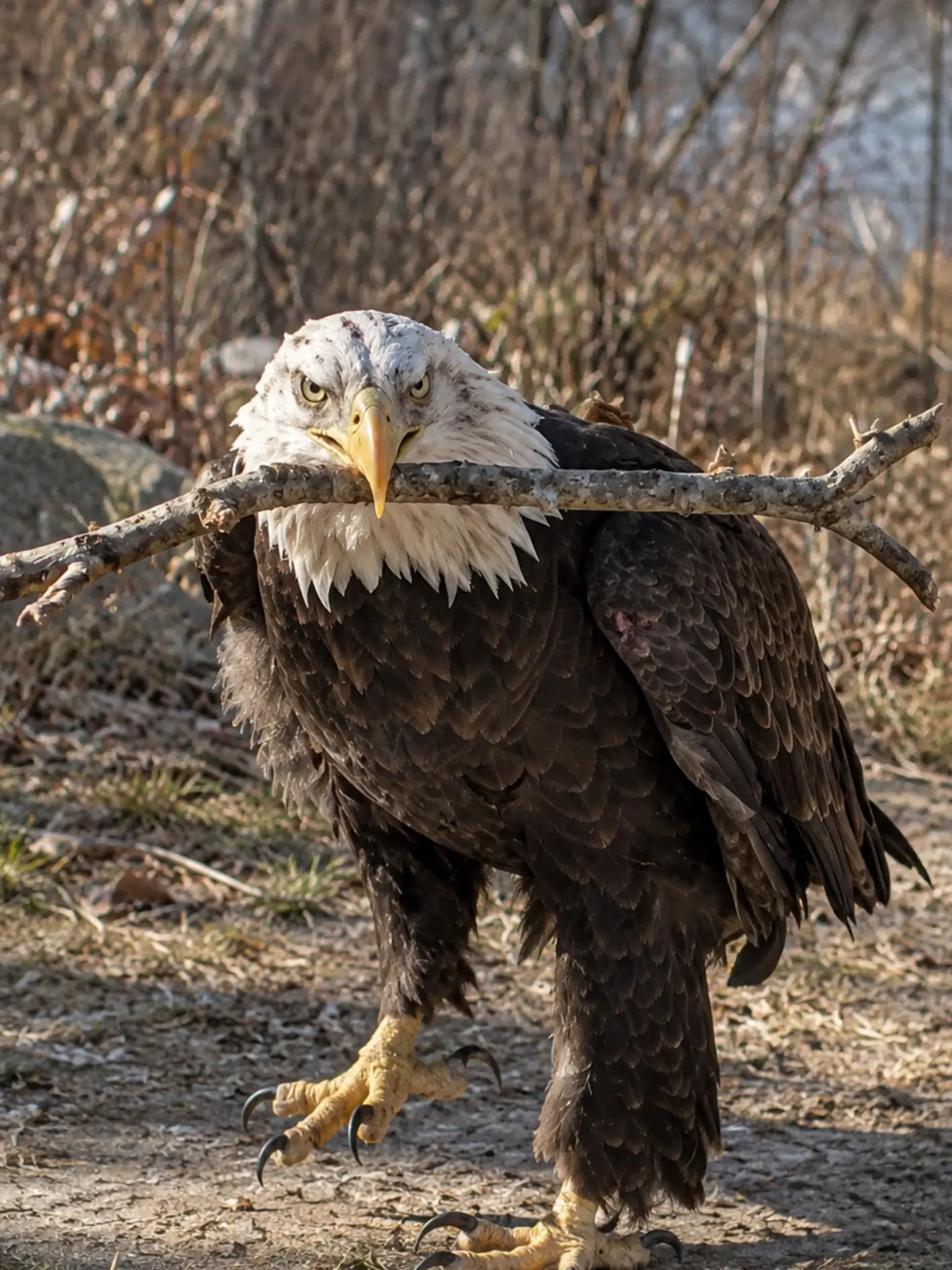
What Turner did not expect was to find an adult Bald Eagle standing less than twenty feet from his porch.
The bird was facing the house.
For several seconds, Turner did not move.
The eagle did not move either.
Its white head feathers were dirty and slightly disordered, and several small reddish marks were visible near the crown. One wing seemed to sit a little lower than the other. The bird’s chest rose and fell more quickly than Turner expected, but both feet were planted firmly on the ground and the eagle’s eyes remained fixed on him.
A branch lay across the ground in front of the bird.
Turner’s first thought was that the eagle had landed to investigate something in the yard. He quietly stepped back inside, closed the door, and watched through the kitchen window.
His wife, Rachel, joined him.
“Is that really an eagle?”
Michael nodded.
Neither of them approached.
They had two dogs, both of which had already begun reacting to the unfamiliar animal outside. Michael moved them into a closed room on the opposite side of the house.
Then he waited.
Ten minutes passed.
The eagle was still there.
It shifted its weight once and took several steps across the yard.
Michael expected it to open its wings and leave.
Instead, it stopped beside a low maple tree.
Another ten minutes passed.
The bird had moved slightly closer to the house.
That was when the situation stopped feeling like an unusual wildlife encounter and began to look like an emergency.
Michael opened the back door only far enough to observe from behind the frame.
The eagle immediately noticed him.
Its head came up.
Its posture changed.
For a few seconds, the bird looked strong.
Then it crouched.
Both wings opened.
Michael instinctively stepped backward as the eagle began to run across the grass.
Three or four powerful wingbeats followed.
The left wing moved through a full arc.
The right wing did not.
The bird rose perhaps a foot from the ground, traveled several yards, then dropped back onto the lawn.
It stood there breathing heavily.
Michael closed the door.
“The wing’s hurt,” he told Rachel.
The eagle did not attempt another flight.
Instead, it began walking.
It moved in a slow line toward the porch, occasionally pausing to look around. When Michael changed position behind the kitchen window, the eagle turned its head in his direction and continued several more steps.
To the Turners, the behavior looked almost intentional.
It seemed as though the bird had come toward the house because it needed help.
Wildlife professionals would later describe that interpretation more carefully. An injured, exhausted raptor may move toward open ground, shelter, shade, or the easiest route available. There is no way to know whether the eagle understood the house as a place where people might provide assistance.
What could be established was simpler.
A wild adult Bald Eagle had entered a residential yard.
It had remained close to the home for an extended period.
It had attempted to fly and failed.
That was enough for Michael to make the call.
He contacted the local conservation office and reported an injured Bald Eagle in his backyard.
The dispatcher asked him to remain inside and keep people and pets away from the bird.
Michael described what he had seen.
The eagle could walk.
Both feet appeared functional.
There was no severe bleeding.
One wing moved abnormally.
The bird had tried to fly but could not gain altitude.
The dispatcher advised him not to test the bird again by approaching.
Repeated escape attempts could worsen an injury that was not visible from the outside.
A conservation officer was dispatched, and a licensed wildlife rehabilitation team was contacted.
Michael then called his nearest neighbor.
“Don’t come over right now,” he said. “There’s an injured eagle in the yard.”
Word still traveled quickly.
Within fifteen minutes, two people were standing at the end of the neighboring driveway hoping to see the bird.
Michael asked them to stay back.
The eagle had moved beneath the maple tree by then. It stood in partial shade with both wings folded, although the right side remained slightly lower.
It did not look helpless.
That was one reason Michael understood why people might underestimate the danger.
The feet were enormous.
The talons were long and sharply curved.
The eyes remained alert.
This was still an adult Bald Eagle, even if it could not fly.
Conservation Officer Dana Mitchell arrived shortly after eight.
She parked along the road rather than pulling into the driveway and walked toward the house first.
Michael met her at the front door.
Together, they looked through a side window toward the backyard.
Mitchell used binoculars.
The eagle was still standing beneath the maple.
She immediately noticed the uneven wing position.
She also saw a small area of missing or disturbed feathers near the shoulder and several marks around the head.
“What happened to it?” Michael asked.
Mitchell shook her head.
“We know where it ended up,” she said. “That does not tell us what happened before it got here.”
She asked whether anyone had heard a collision during the night.
No.
Any vehicle strike nearby?
Not that Michael knew of.
Any power lines in the immediate backyard?
None.
Had Michael seen another eagle?
No.
The previous night had been windy, but there had been no severe thunderstorm.
Mitchell noted each detail but avoided turning possibilities into conclusions.
An eagle unable to fly could have suffered a collision with a tree, a vehicle, a wire, a structure, or another bird. It might also have been injured elsewhere and traveled some distance before reaching the property.
A medical examination would be needed before anyone could say more.
Mitchell called the fictional Great Lakes Wildlife Rehabilitation Center and confirmed that a field team was on the way.
Until they arrived, she remained near the house.
The eagle attempted to move once more.
It walked toward a wooden fence bordering the rear of the property.
When it reached the fence, the bird stopped.
The top rail was only about four feet high.
A healthy adult Bald Eagle could have cleared it easily.
This bird crouched, opened both wings, and made another attempt.
Again, the left wing generated a broad, powerful stroke.
Again, the right side did not match it.
The eagle lifted only slightly and dropped back onto the grass.
Mitchell immediately moved everyone farther away.
“No more pressure,” she said. “We do not want it trying again.”
The failed takeoff provided useful information.
The bird was not simply tired.
The problem appeared mechanical or painful enough to interfere with powered flight.
The wildlife responders arrived approximately twenty minutes later.
Field rehabilitators Claire Benton and Mark Ruiz stepped out carrying a ventilated transport crate, heavy gloves, towels, and a soft capture net.
Before they approached the eagle, Mitchell described everything that had happened.
Benton watched the bird from the patio.
The eagle stood normally on both feet.
The head remained upright.
There was no obvious tremor.
The wings folded against the body, but the right shoulder sat lower.
That pattern made severe generalized poisoning less likely than trauma, though toxic exposure could not yet be ruled out.
The team planned the capture.
The property presented one advantage.
The yard was enclosed on three sides.
It also presented one risk.
If the eagle managed to clear the rear fence, it would enter dense brush leading toward a drainage corridor.
Benton positioned herself between the bird and the fence.