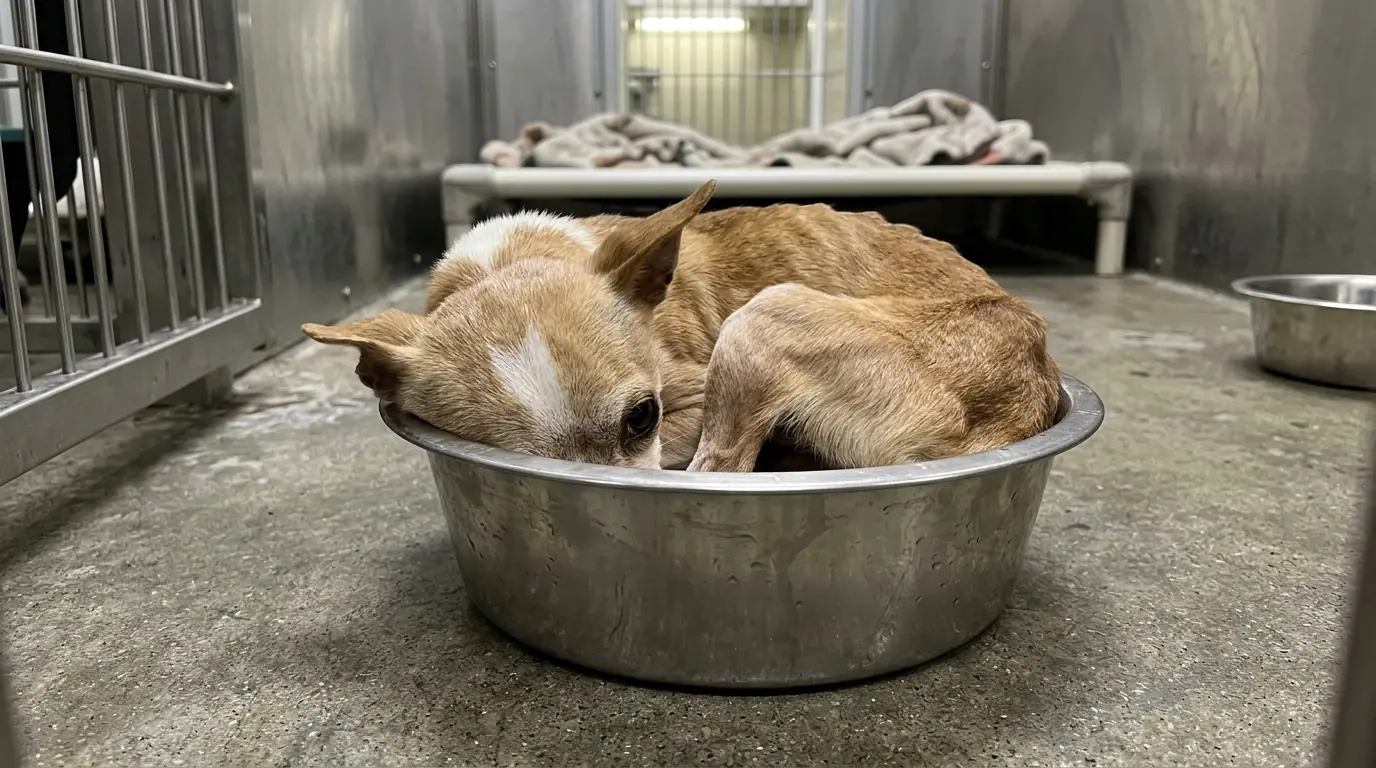
Bean has a bed.
It is soft, low to the floor, and large enough for his tiny body to disappear into the blankets.
But when the shelter hallway suddenly erupts with barking, the five-year-old Chihuahua mix does not run toward it.
He goes somewhere much stranger.
Bean hurries toward his empty stainless-steel food bowl.
He lowers his front half into it.
Then he pulls his weak hindquarters after him.
Within seconds, nearly his entire body is folded inside a container that was never meant to be a bed.
His spine curves around the metal.
His legs tuck tightly beneath him.
Bean pushes his head down between his front paws and begins to tremble.
Outside the kennel, the barking continues.
Inside it, one of the smallest dogs in the building has made himself even smaller.
And he does not climb out until the hallway becomes quiet again.
Bean Is Already Physically Vulnerable Before the Noise Starts
He weighs only a few pounds.
His ribs and hips remain easy to see beneath his coat.
He is recovering from an injury around the hip, and one hind leg is noticeably weaker than the other.
When Bean walks slowly, he can compensate.
His front legs do much of the work.
His stronger rear leg helps stabilize him.
The weaker one sometimes hesitates.
But Bean can get around his kennel.
Until the noise changes.
The Barking Is the Trigger
One dog barking occasionally may make Bean lift his head.
Several dogs suddenly barking together produces something different.
His ears pull back.
His body lowers.
He looks toward the hallway.
Then Bean starts moving.
He does not pace.
He does not bark back.
He does not run toward the kennel door.
He heads directly toward the bowl.
The Bowl Is Usually Empty by Then
That detail makes the behavior even more unusual.
Bean is not climbing into it to reach food.
He may have finished eating long before.
The stainless-steel dish sits on the floor with nothing inside.
During calm periods, Bean treats it exactly as expected.
He eats from it.
Sniffs it.
Walks away.
But once the hallway becomes loud, the function of the bowl changes.
Getting Inside Is Not Easy
Bean may be tiny, but the bowl is still a bowl.
It has a curved interior.
A raised rim.
A hard metal surface.
Bean first places his front paws inside.
Then lowers his chest.
His hindquarters remain outside.
Because of his hip injury and weak rear leg, pulling the rest of himself over the rim takes effort.
Sometimes his hind paw slips.
Bean keeps trying.
Eventually, his hips cross the edge.
Then he folds.
There Is Barely Enough Room
Bean curls his spine.
His knees draw inward.
His front legs come together.
His muzzle disappears between them.
The metal bowl surrounds the lower half of his body.
From the hallway, someone might initially see little more than a pair of ears and a trembling back.
It is not comfortable in any conventional sense.
Yet Bean chooses it over the bed.
His Bed Is Only a Few Feet Away
That becomes the obvious question.
Why the bowl?
The bed is softer.
Warmer.
Larger.
It allows Bean to stretch without putting pressure on his recovering hip.
If comfort were simply about cushioning, the choice would make little sense.
But physical softness may not be what Bean is seeking during those moments.
The Bowl Has Something the Bed Doesn't
It has hard boundaries on nearly every side.