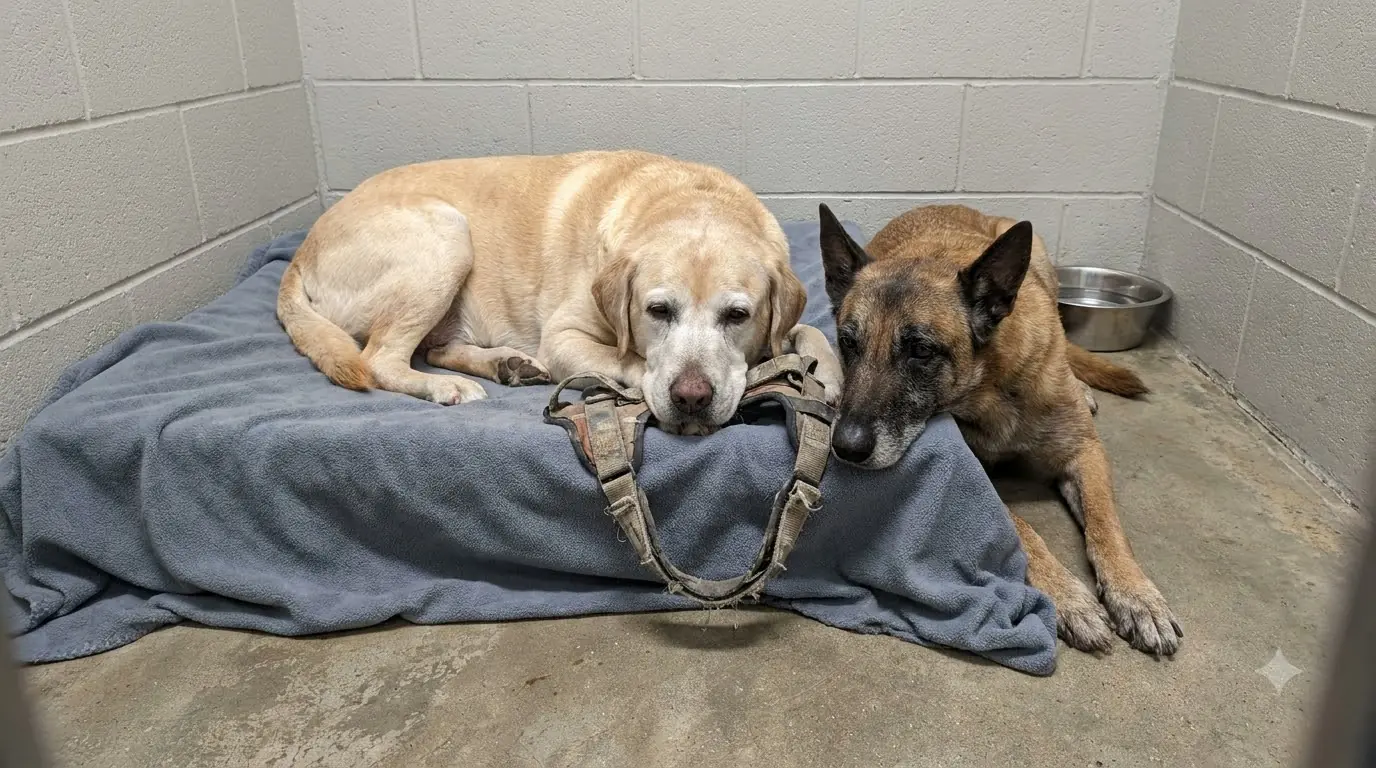
Bear does not do much with the old harness once he reaches Cooper’s bed.
He simply carries it there.
The retired Belgian Malinois takes the worn working harness carefully in his mouth, crosses their shared kennel, and drops it between the front paws of the aging Labrador Retriever stretched out on an orthopedic bed.
Then Bear lies down beside him.
Cooper is usually too weak to get up. Cancer has taken much of his strength, and most of his days are now spent resting. His muzzle has gone silver with age, and even repositioning himself can require more effort than it once did.
But when the harness lands between his paws, Cooper sometimes lowers his head onto it.
And Bear stays beside him.
For rescue staff, it has become one of the most difficult routines to watch—not because the harness itself is remarkable, but because of what they know about the two dogs who keep returning to it.
The Harness Belonged to Another Part of Their Lives
Bear and Cooper had not always been two senior dogs resting in a medical kennel.
Both had histories connected to search work.
Bear, a Belgian Malinois, had worked as a search-and-rescue dog. Cooper, a Labrador Retriever, had also worked with the search team.
Their breeds brought different strengths to that kind of work, but both dogs had spent years around the routines that came with training and deployment: equipment coming out, harnesses being fitted, handlers preparing to move, and long periods of activity followed by rest.
Eventually, that working life ended.
The dogs retired together and remained together under the care of their longtime caregiver.
By the time circumstances changed and that person could no longer care for both senior dogs, Bear and Cooper had already shared far more than a kennel.
So when they entered rescue, they came together.
And among the belongings that followed them was an old working harness.
Cooper Arrived With a Much Bigger Problem
The rescue quickly learned that Cooper’s needs went far beyond ordinary senior-dog care.
He had cancer.
His disease had progressed to the point that his stamina was severely limited. There were periods when he could raise himself and reposition, but much of his time was spent lying down.
For a Labrador that had once been physically active, the contrast was striking.
Staff focused first on what could still be controlled.
Cooper received veterinary evaluation to determine what treatment or supportive care was appropriate at his stage of disease. His comfort, appetite, hydration, breathing, mobility and ability to rest were monitored closely.
An orthopedic bed gave his aging body a supportive surface and helped reduce pressure during the long hours he spent lying down.
His care was no longer about returning him to the physical condition of his working years.
It was about making the days he had now as comfortable as possible.
Bear remained beside him through that transition.
Staff Initially Treated the Harness Like Any Other Belonging
The old harness was familiar equipment, but it was no longer needed for work.
At first, there was little reason to think it would matter inside the kennel.
Then someone placed it within Bear’s reach.
Bear picked it up.
He did not chew it or shake it like a toy.
Instead, he carried it toward Cooper.
Staff watched as the Malinois approached the orthopedic bed and released the harness near Cooper’s front legs.
Bear then settled beside him.
Cooper remained where he was.
After a while, his silver muzzle came down over the worn material.
It could have been a one-time interaction.
It wasn’t.
Bear Kept Bringing It Back
When the harness was moved elsewhere in their space and later made available again, Bear repeated the behavior.
He picked it up.
He carried it to Cooper.
He left it between or near the Labrador’s paws.
Then he lay beside him.
No one could know what Bear associated with the object.
Dogs can form strong associations with familiar objects through scent, repetition and experience, but that does not allow anyone to say that Bear was consciously reminiscing about specific missions or trying to remind Cooper of their past.
Staff did not need to make that claim.
The observable behavior was moving enough on its own.
Given access to an object connected with their former working life, Bear repeatedly chose to bring it to the dog who had shared that life with him.
And Cooper repeatedly accepted its presence beside his bed.
Their Shared Kennel Began to Look Different
As Cooper weakened, the kennel had to change around him.
His orthopedic bed became the center of the space because he was spending so much time there. Water needed to be easily accessible. The floor around him had to remain clear enough for staff to assist him without forcing him to make unnecessary movements.
Bear needed room as well.
A retired Belgian Malinois can remain alert and physically engaged even as age slows the body, and staff wanted to make sure Bear still had opportunities to move, sniff and interact outside Cooper’s resting area.
But Bear frequently chose proximity.
He might rest elsewhere for a while, then return to Cooper’s bed.
Sometimes their bodies touched.
Sometimes Bear simply lay close enough that only a narrow strip of bedding separated them.
The old harness was allowed to remain part of that environment when it was safe to do so.
Not as working equipment anymore.
Just as a familiar object.
Cancer Changed What a “Good Day” Meant for Cooper
With a seriously ill senior dog, progress does not always mean improvement.
That became especially important in Cooper’s case.
There were no promises that the next week would be better than the previous one. Depending on his cancer, treatment options and overall condition, aggressive intervention might not necessarily provide the best quality of life.
Instead, his veterinary team and rescue caregivers had to keep asking practical questions.
Was he comfortable at rest?
Was he eating willingly?
Could he drink without difficulty?
Could he reposition himself, or did he need assistance?
Was his breathing comfortable?
Did he still respond to people, Bear and activity around him?
Were there more comfortable periods than distressed ones?
Those observations mattered because palliative care is not about pretending a terminal disease is getting better.
It is about controlling what can be controlled—pain, nausea, anxiety, mobility difficulties and other symptoms—while protecting the dog’s quality of life.
Some days, Cooper ate well and lifted his head when someone entered.
Other days required more rest.
Bear adjusted to those quieter days simply by spending more time on the floor beside him.
Bear Needed Care, Too
It would have been easy for every bit of attention to revolve around Cooper.
Rescue staff were careful not to let that happen.
Bear had experienced major changes of his own.
His longtime home was gone. His familiar caregiver was no longer caring for him. His working years had ended long before, and now the dog who had been part of that life was seriously ill.
Whatever Bear understood about those changes, staff could observe how he responded to his environment.
So they kept his days predictable.
He received individual attention and appropriate activity rather than being expected to remain beside Cooper constantly. His appetite and behavior were monitored. He had his own comfortable resting place.
Keeping the pair together did not mean Bear had to become Cooper’s caretaker.
That responsibility belonged to people.
Bear was allowed simply to remain his companion.
There Was No Need to Separate Them Yet
For some bonded dogs, medical needs eventually make shared housing difficult.
One dog may need equipment, procedures or monitoring that cannot safely happen with another dog in the same space.
For Bear and Cooper, staff continued evaluating that balance.
As long as Bear remained calm around Cooper’s care and Cooper appeared comfortable with his presence, keeping them close offered something that could not be provided through medication or bedding: continuity.
Their surroundings had changed.
Their daily routine had changed.
Their caregiver had changed.
Cooper’s body had changed dramatically.
But the other dog was still there.
That was one part of their environment the rescue could preserve.
The Harness Became Less Important Than the Routine Around It
Over time, staff realized that the most affecting part of Bear’s behavior was not simply that he carried an old piece of equipment.
It was what happened afterward.
Bear never seemed particularly interested in taking the harness away again.
Once it reached Cooper, his task—whatever prompted it—appeared finished.
He would settle down.
Sometimes Cooper rested his muzzle directly across it.
Sometimes it remained untouched between his paws while he slept.
Sometimes Bear lay close enough that his front legs nearly reached Cooper’s bed.
Nothing dramatic happened.
There was no sudden burst of energy from the sick Labrador.
The harness did not make Cooper stand again.
It did not change his diagnosis.
And that was exactly why staff stopped looking at the behavior as something that needed a dramatic explanation.
The small routine was enough.
Their Next Home Would Need to Understand What Cooper Needed
Finding placement for a pair like Bear and Cooper would never be simple.
Cooper needed a home prepared for serious medical care, potentially including hospice or palliative support as his cancer progressed.
That meant comfortable flooring, accessible outdoor trips, medication management if prescribed, regular veterinary communication and caregivers willing to make difficult quality-of-life decisions when necessary.
Bear needed a home willing to keep caring for him as an individual, too.
Separating them solely to make placement easier would have meant disrupting one of the few familiar relationships still present in both dogs’ lives.
So any rescue, foster or adopter considering the pair would need to understand that they were not simply taking home two retired working dogs.
They were taking home one dog approaching a medically uncertain final chapter and another senior dog who continued choosing to stay near him.
Bear Still Carries It Over
The old harness does not come out because anyone expects Bear or Cooper to work again.
Those years are over.
Cooper could no longer physically handle that life even if the opportunity existed. On difficult days, simply lifting his head from the orthopedic bed is enough activity.
Bear has slowed, too.
But occasionally the old harness is still placed where he can reach it.
And the sequence remains familiar.
Bear takes the worn material gently in his mouth.
He walks across the kennel.
He reaches Cooper’s bed and drops it between the Labrador’s front paws.
Then he lowers himself beside his longtime partner.
Cooper does not get up.
He does not need to.
Sometimes he only shifts his head until his silver muzzle comes to rest across the old harness.
Years ago, that piece of equipment belonged to a life built around getting up and going wherever the work required.
Now it lies on an orthopedic bed between two retired dogs who are no longer being asked to go anywhere.
And for as long as Cooper remains comfortable, Bear can keep doing the one part of their old routine that his aging body still allows:
bringing the harness to his partner—and lying down beside him once it gets there.