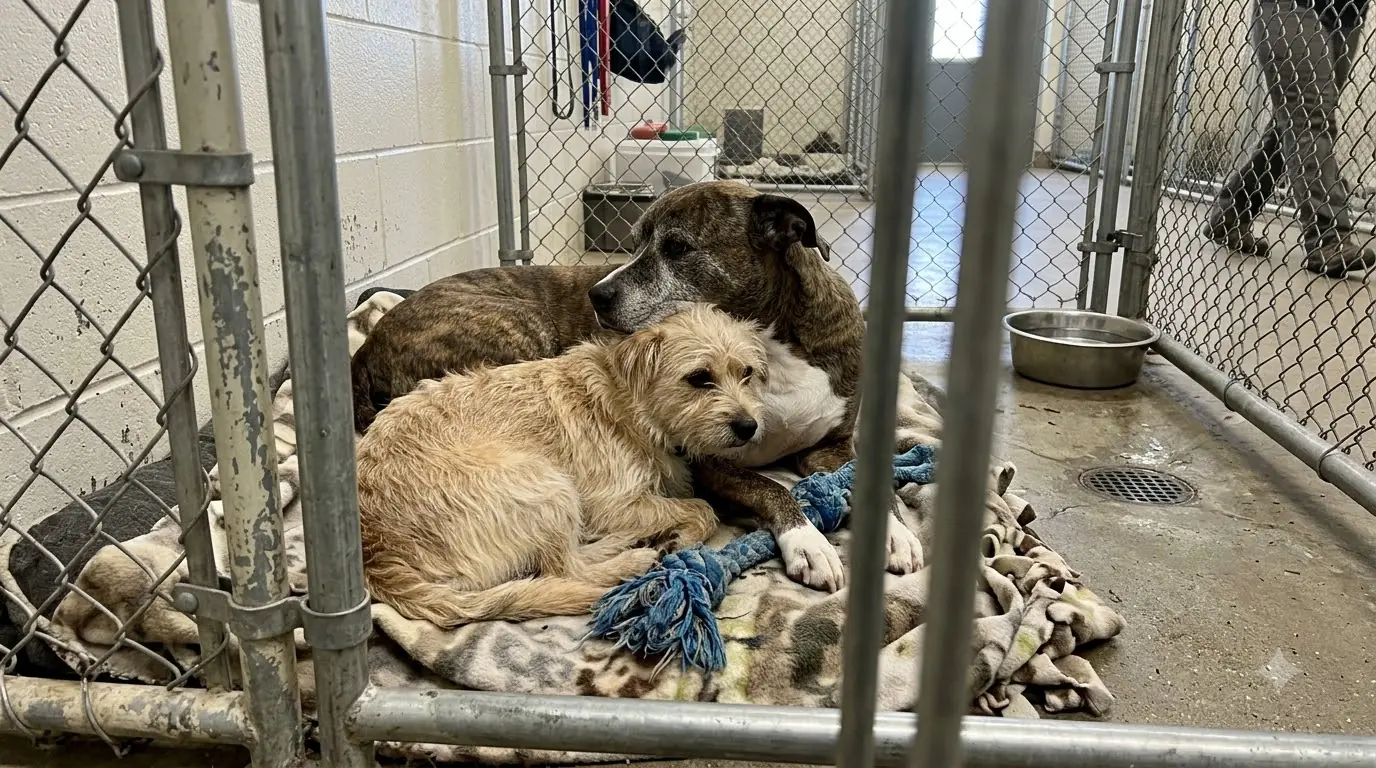
Every night, Finn chooses the side of the bed closest to the kennel door.
Rosie chooses Finn.
The arrangement has become so consistent that staff members rarely have to look twice when they make their evening rounds.
Finn, a 4-year-old Terrier mix, is usually curled along the outer edge.
Rosie, a 7-year-old Pit Bull mix, settles directly behind him or beside him, often with part of her body touching his.
There is plenty of room for them to sleep separately.
Most nights, they don't.
The same pattern happens when visitors enter their row.
Finn notices the footsteps first.
His head rises.
He stands.
A moment later, Rosie gets up too.
She walks toward him and gently presses her shoulder against his side.
Then they wait together.
Sometimes the footsteps stop.
Often, they continue.
When that happens, Finn eventually turns around.
Rosie follows.
They return to the same bed.
And somewhere nearby is usually a worn blue rope toy that belongs, in practice, to both of them.
Rosie and Finn Arrived Together
Rosie and Finn came into rescue care together after their previous household could no longer keep them.
Rosie was 7.
Finn was 4.
The information available at intake established that they had already been living together, but a shared address alone was not enough for us to immediately label them a bonded pair.
Dogs can live together without needing to remain together.
Some tolerate each other.
Some enjoy each other's company but adapt easily when separated.
And in some cases, placing dogs individually can give each animal a wider range of suitable homes.
So our team observed Rosie and Finn rather than making an assumption.
We watched how they behaved during intake.
We watched them rest.
We watched them eat.
We watched what happened when one moved out of the other's sight.
Most importantly, we watched what happened when they were reunited.
The pattern became increasingly difficult to dismiss.
Rosie and Finn weren't simply two dogs who happened to arrive together.
They consistently used each other as part of how they navigated unfamiliar situations.
Their First Days in Rescue
Finn adjusted more quickly to the activity around him.
He was usually the first to investigate.
If someone entered, Finn looked.
If a leash appeared, Finn stood.
If something changed in the hallway, Finn wanted to know about it.
Rosie was more measured.
She watched Finn before deciding what to do.
That did not mean Rosie was incapable of functioning without him.
It meant his behavior appeared to provide useful information to her.
If Finn relaxed, Rosie often relaxed.
If Finn moved toward a familiar staff member, Rosie was more likely to follow.
At rest, the pattern reversed in an interesting way.
Finn might be the first dog to investigate something new, but when the activity ended, he frequently sought Rosie.
He curled beside her.
He rested against her.
Sometimes he tucked himself against her chest.
The relationship did not appear to move in only one direction.
They seemed to provide different things for each other.
The Kennel Arrangement
Because of those observations, Rosie and Finn were housed together in a kennel large enough for both dogs to have appropriate resting space.
They were given separate resources where necessary and monitored carefully, as any pair of dogs sharing space should be.
Their sleeping pattern emerged almost immediately.
Finn took the outside position.
Rosie stayed close behind him.
During the day, they sometimes moved independently.
One might drink while the other remained in bed.
Finn might investigate a toy while Rosie rested.
Rosie might stand near the gate while Finn was elsewhere in the kennel.
They were not physically attached every second.
That is important.
Being bonded does not mean two animals panic whenever they are more than a few feet apart.
It means their relationship is significant enough that separation may negatively affect their well-being and should be considered carefully.
With Rosie and Finn, the strongest evidence appeared during transitions.
Unfamiliar situations.
Busy periods.
Departures.
Reunions.
Those were the moments when they repeatedly sought each other.
One Kennel Card, One Difficult Requirement
Their kennel card makes the challenge clear:
Must be adopted together.
That one sentence changes almost everything about their adoption prospects.
Adopting one dog is a major commitment.
Adopting two at the same time requires more.
There are two food bowls.
Two sets of preventive veterinary care.
Two dogs to transport.
Two leashes.
Two bodies in the house.
Two animals whose individual needs must still be met even though they share a close relationship.
Housing can become more complicated as well.
Some rentals limit the number of pets.
Others have size or breed restrictions.
Rosie is a Pit Bull mix, which can create additional housing limitations depending on where a potential adopter lives.
And even for someone who owns their home, two dogs may simply be more than their schedule, budget, space, or physical ability can reasonably accommodate.
Those are legitimate considerations.
The rescue does not want someone to adopt Rosie and Finn out of guilt and discover a month later that caring for two dogs is unsustainable.
They need one home capable of supporting both of them.
That reduces the pool of potential adopters considerably.
What Happens When People Walk By
Rosie and Finn are easy to observe because their response to visitors is so consistent.
Footsteps enter the row.
Finn gets up first.
He walks toward the kennel door.
Rosie follows.
Then comes the small gesture staff have seen over and over.
Rosie moves alongside Finn and presses her shoulder against him.
Sometimes they remain that way while a visitor reads their kennel card.
Then the person notices the requirement.
Two dogs.
Together.
Some continue watching.
Some ask questions.
Others move to another kennel.
We do not know what every visitor is thinking, and we don't assume the requirement is always why someone leaves.
People come to shelters with different needs.
Some are specifically looking for a small dog.
Some already have pets.
Some need a dog compatible with a particular living arrangement.
Some simply connect with another animal.
But we know from conversations with prospective adopters that adopting two dogs together is a practical barrier for many households.
Rosie and Finn need a relatively uncommon match.
They Are Still Individuals
One risk in telling the story of a bonded pair is reducing them to the relationship.
Rosie is not simply "Finn's dog."
Finn is not simply "Rosie's dog."
They have individual personalities.
Rosie, at 7, tends to move through the world with a little more deliberation.
Once she is comfortable, she enjoys staying near familiar people without demanding constant attention.
She can settle quietly.
She likes a comfortable bed.
She is affectionate in an understated way, often choosing physical closeness over excited greetings.
Finn is younger and generally quicker to investigate.
He notices movement.
He is more likely to stand first when something happens.
He has a little more restless curiosity and tends to check his surroundings before settling.
Their differences are part of what makes their relationship work.
Finn often goes first.
Rosie often follows.
Then, when Finn is finished investigating, he frequently comes back to Rosie.
The Blue Rope Toy
The worn blue rope toy is one of the few objects that seems to move almost as predictably as the dogs.
Finn plays with it.
Rosie carries it.
Sometimes it lies untouched near the bed.
Sometimes one dog has an end while the other investigates.
It is frayed now from ordinary use.
Staff could replace it easily.
There are newer toys available.
But the blue rope remains in their rotation because both dogs continue choosing it.
As with any familiar object, we avoid inventing a complicated emotional meaning that we cannot prove.
We cannot say the rope represents their previous home.
We cannot say either dog thinks of it as a symbol of the other.
What we can describe is what happened last week when Finn left the kennel without Rosie.
That is where the toy became part of a moment staff remembered.
Why Finn Left Alone
A potential adopter had expressed interest and wanted to spend time with Finn.
Because the rescue's goal remains placing Rosie and Finn together, staff explained their relationship and the adoption requirement.
Still, an individual interaction can sometimes provide useful information about a dog's behavior and about the strength of a pair's attachment.
So Finn was taken for a short, controlled meet-and-greet while Rosie remained in the kennel.
Staff monitored both dogs.
Finn left.
Rosie watched him go.
The kennel door closed.
For the first time that afternoon, Rosie was alone.
What Rosie Did
Rosie did not bark.
She did not throw herself against the kennel door.
She did not begin frantically pacing.
Those behaviors would have been obvious.
Instead, she stood for a while.
Then she found the blue rope toy.
Rosie picked it up.
She carried it to the front of the kennel.
And she lay down beside the door.
That was all.
She stayed there.
There is a temptation to describe quiet behavior as less meaningful than dramatic behavior.
In this case, the opposite was true.
Rosie had an entire kennel available to her.
The shared bed remained behind her.
Instead, she chose the door through which Finn had disappeared.
The rope toy remained beside her.
Staff continued their work while keeping an eye on her.
Five minutes passed.
Then more.
Rosie waited.
Finn's Meet-and-Greet
Finn's meeting gave the prospective adopter an opportunity to see him away from the kennel.
He investigated the new environment.
He interacted appropriately.
Staff answered questions about his routine, temperament, and relationship with Rosie.
The conversation returned to the same issue that has followed the pair throughout their adoption search.
Finn does not come alone.
Ultimately, the meeting did not lead to a plan to adopt both dogs.
That did not make the visitor cruel or irresponsible.
Quite the opposite.
Adopting two animals when a household is only prepared for one would not serve the dogs.
The important part was recognizing the mismatch before making a commitment.
After approximately twenty minutes, Finn was brought back.
Rosie was still waiting near the door.
The Reunion
Finn noticed the kennel immediately.
When the door opened, he hurried inside.
Rosie stood.
Finn moved toward her.
Then he circled Rosie twice.
It was quick enough that staff watching had barely finished closing the kennel door before he was already moving around her.
After the second circle, Finn settled.
He curled against Rosie's chest.
Rosie lowered herself around him.
The blue rope toy ended up between their front paws.
Neither dog did anything dramatic afterward.
That was part of what made the moment so clear.
Finn did not continue pacing.
Rosie did not remain stationed at the door.
They returned to their familiar resting arrangement.
Together.
Why We Still Won't Separate Them
A bonded-pair decision should not be made solely because two dogs look cute sleeping together.
Our responsibility is to consider welfare, behavior, history, and what happens during separation.
With Rosie and Finn, repeated observations have supported keeping them together.
They seek each other during uncertainty.
They settle together.
Rosie appears to use Finn's responses as information in unfamiliar situations.
Finn repeatedly returns to Rosie for rest and contact.
And short separations have reinforced how quickly they reconnect when reunited.
Could both dogs physically survive in separate homes?
Probably.
That is not the only question.
The more relevant question is whether separating them would unnecessarily remove an important, stabilizing relationship when there is no welfare reason requiring it.
At this point, we believe it would.
So the kennel card remains unchanged.
Must be adopted together.
The Cost of That Decision
Keeping Rosie and Finn together makes placement harder.
We know that.
A single dog may fit a household that cannot accommodate two.
A person interested in Finn may not have the space for Rosie.
Someone drawn to Rosie may already have a dog at home and be unable to add two more.
Every requirement narrows possibilities.
Two dogs narrow them further.
But adoption speed is not the only measure of good shelter work.
The fastest placement is not always the right placement.
Our responsibility is not simply to empty a kennel.
It is to make a decision we believe protects the animals' long-term welfare.
For Rosie and Finn, that means waiting for one family rather than searching for two.
Their Veterinary Care
Both dogs have received routine veterinary assessment and preventive care while in rescue.
Rosie, at 7, is entering the stage of life when ongoing attention to weight, mobility, dental health, and age-related changes becomes increasingly important.
She currently participates comfortably in normal daily activity, but her future adopter should plan for routine senior-oriented veterinary monitoring as she gets older.
Finn is 4 and has different age-related needs.
His preventive care includes routine examinations, vaccinations as appropriate, parasite prevention, dental monitoring, and attention to any changes in appetite, weight, mobility, skin, coat, ears, or behavior.
Neither dog's adoption story is centered on a major medical crisis.
Their primary challenge is their relationship.
Two healthy dogs still mean two veterinary budgets.
Potential adopters should think about that honestly.
There will be routine expenses for both.
There may eventually be unexpected expenses for either.
A successful bonded-pair adoption requires financial planning as much as emotional commitment.
Life in the Kennel
Their mornings begin together.
The shelter wakes up.
Lights come on.
Cleaning begins.
Breakfast arrives.
Finn is usually quicker to stand.
Rosie follows.
They go through their routine, receive opportunities for exercise and enrichment, and spend time outside their kennel when staffing and schedules allow.
They do not need to perform every activity side by side.
Individual attention remains important.
Each dog needs a relationship with people.
Each needs appropriate handling and enrichment.
But after activities, they return to the same kennel.
And eventually, they return to the same bed.
Visitors arrive later.
Finn notices.
Rosie joins him.
Sometimes someone stops.
Sometimes a visitor crouches to look more closely.
Sometimes the kennel card is read.
Then comes the question.
"Both?"
The answer is yes.
Both.
Helping Two Dogs Get Noticed as Two Individuals
One challenge with bonded pairs is that photographs can accidentally make one animal disappear behind the other.
Rosie is larger.
Finn is smaller.
Depending on how they are positioned, one can dominate the image.
So staff work to show them both together and separately.
Their adoption profile includes individual information about each dog.
Potential adopters need to know what Rosie likes.
They need to know what Finn likes.
They need to understand that adopting a bonded pair does not mean treating them as one animal.
They need individual walks or training opportunities when appropriate.
They need separate veterinary attention.
They may need separate feeding spaces.
They need opportunities to develop relationships with their new people.
Their bond should be respected without making them dependent on each other for every aspect of daily life.
Meet-and-Greets Look Different for a Bonded Pair
A family considering Rosie and Finn needs enough time to understand both dogs.
One may make the stronger first impression.
That is normal.
Finn may approach first.
Rosie may stay closer to him initially.
Later, Rosie may be the one who settles beside a person while Finn continues investigating.
The goal is not for an adopter to feel exactly the same connection with both dogs in the first ten minutes.
The goal is to determine whether the household can meet both dogs' needs and whether the dogs appear comfortable with the family.
Practical questions matter.
Can the home accommodate two dogs?
Are there existing pets?
Are there housing restrictions affecting Rosie?
Does the family have time for individual attention?
Can they handle the combined veterinary expenses?
How will they transport both dogs?
What happens when one needs a veterinary appointment without the other?
These questions are not barriers designed to make adoption difficult.
They are part of making the adoption last.
There Have Been Interested People
Rosie and Finn have attracted attention.
Their relationship is easy to notice once someone watches them for a while.
But interest has not yet become the right placement.
Some people can adopt only one dog.
Others already have pets and cannot reasonably add two.
Some housing situations will not accommodate Rosie.
Others are simply not appropriate for the pair's combined needs.
Those outcomes can be disappointing without anyone being at fault.
A successful adoption requires more than wanting the story to end happily.
The logistics have to work on an ordinary Tuesday morning months after the excitement of adoption has passed.
That is the standard we use for Rosie and Finn.
What Their Home Needs to Look Like
Their ideal home needs enough physical and financial room for two dogs.
It also needs people who understand that Rosie and Finn are bonded without expecting them to behave identically.
Finn is younger and may want more activity.
Rosie may appreciate a slightly steadier pace.
Their adopter will need to balance those needs.
They should have comfortable resting spaces even if they continue choosing the same bed.
Predictable routines would likely help them settle.
If a home has resident animals, careful introductions are essential.
Compatibility cannot be assumed simply because Rosie and Finn get along with each other.
Children, if present, should be considered based on the dogs' observed comfort, the household's activity level, supervision, and everyone's ability to respect appropriate boundaries.
Housing must permit both dogs, including Rosie.
And the family must genuinely want two dogs.
Not one dog plus an obligation.
Both.
The Most Important Part of Their Bond
The most striking thing about Rosie and Finn is not that they are always touching.
They aren't.
It isn't that they panic whenever separated.
They don't.
It is the consistency with which they choose each other when given the opportunity.
Finn chooses the space nearest the door.
Rosie chooses the space nearest Finn.
When something happens, Finn stands.
Rosie joins him.
When nothing happens, they return together.
When Finn left, Rosie waited near the door.
When he returned, Finn went directly back to her.
Those patterns have repeated enough that they matter.
Their Current Status
Rosie and Finn are still available for adoption together.
We continue sharing their story, updating their photos, providing enrichment, and talking with potential adopters who may be able to accommodate both dogs.
We are also realistic about the fact that their search may take longer than the search for either dog individually.
That is part of the decision we made when we committed to keeping them together.
We are not waiting for a perfect fantasy home.
We are waiting for an appropriate one.
There is a difference.
The family does not need an enormous property.
They do not need to spend every hour at home.
They do not need to treat Rosie and Finn as fragile.
They need appropriate housing, realistic resources, time, patience, and a willingness to welcome two individual dogs whose relationship with each other is part of the package.
What Happens If Someone Asks for Only One Again
We will explain the same thing.
Rosie and Finn are being placed together.
We understand why someone might be interested in only one.
Finn is younger and smaller.
Rosie may appeal to someone specifically looking for a mature Pit Bull mix.
But choosing the easier placement by separating them would contradict what we have learned while caring for them.
If new behavioral information eventually gave us a compelling reason to reconsider, responsible rescue work would require us to evaluate it.
For now, the evidence continues pointing in the same direction.
Together.
Tonight Looks Much Like Last Night
By closing time, the adoption row becomes quiet.
The conversations stop.
The doors stop opening.
The dogs begin settling.
Finn usually circles the bed before choosing his familiar place closest to the kennel door.
Rosie lowers herself beside him.
Sometimes Finn curls into Rosie's chest.
Sometimes Rosie stretches along his back.
The blue rope toy ends up wherever they left it.
Tonight, it is between them.
Tomorrow, footsteps will enter the hallway again.
Finn will probably hear them first.
He will stand.
Rosie will rise behind him and move toward his side.
Someone may stop.
Someone may read their card.
Someone may ask whether "must be adopted together" really means both dogs have to leave in the same car.
It does.
And if the footsteps continue toward another kennel, Rosie and Finn will eventually turn away from the door.
They will walk back to their bed.
Finn will settle closest to the hallway.
Rosie will settle closest to Finn.
They are not waiting for two people to choose them separately.
They are waiting for one home with room to choose them both.