The slap cracked through the Fifth Avenue boutique so sharply that even the pianist in the mezzanine stopped playing.
For one impossible second, nothing moved.
A waiter stood frozen with a silver tray balanced against one palm.
Champagne trembled inside crystal flutes.
A woman near the diamond counter held her phone halfway to her face.
Two sales associates stopped speaking in the middle of a sentence.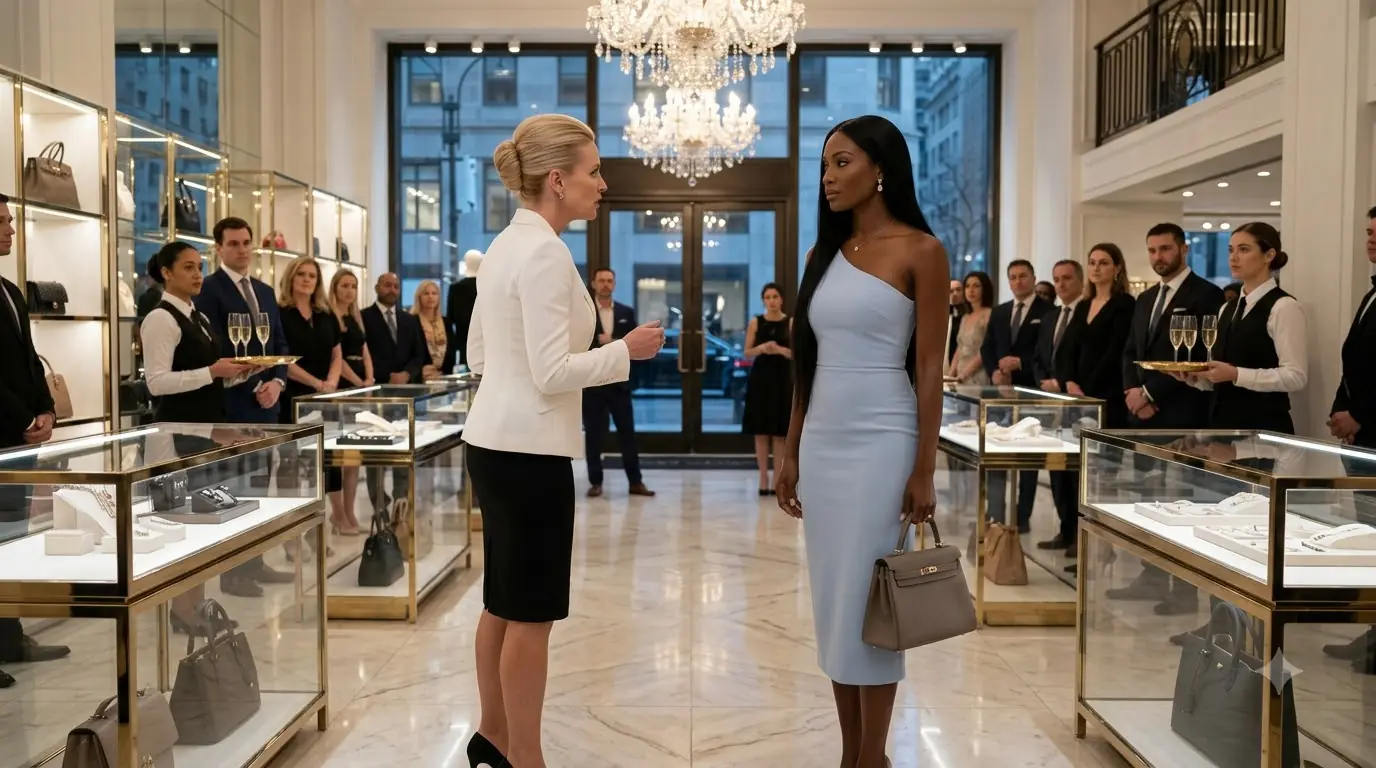
And beneath a chandelier made from hundreds of hand-cut glass petals, the Black woman in the fitted powder-blue dress stood perfectly still.
Her head had turned slightly from the impact.
One long curtain of sleek black hair had fallen forward over her shoulder.
The manager’s hand remained suspended between them.
Nobody seemed to understand what they had just witnessed.
Then the manager lowered her arm.
“You were warned.”
Her voice carried across the silent showroom.
The Black woman slowly turned her face back.
A faint red mark was already forming high on her cheek.
Her expression, however, barely changed.
That disturbed the manager more than tears would have.
The woman did not shout.
She did not threaten.
She did not reach for the manager.
She simply looked at her.
Calmly.
Closely.
As though committing every detail to memory.
The blonde manager straightened the lapels of her white designer blazer.
“This collection is not open browsing.”
The Black woman said nothing.
“You touched a restricted piece.”
Still nothing.
“You ignored my instructions.”
Silence.
The manager’s confidence began returning now that the initial shock had passed.
She glanced around the boutique and saw dozens of faces watching.
That should have embarrassed her.
Instead, it made her perform.
“This is exactly why we have private-client standards.”
A woman standing near the shoe salon frowned.
Another customer whispered, “She slapped her.”
The manager heard.
Her jaw tightened.
The Black woman finally spoke.
Her voice was soft.
“Are you finished?”
The question was so controlled that it changed the air.
The manager gave a short laugh.
“You should be asking yourself that.”
She pointed toward the entrance.
“Leave.”
The Black woman remained where she stood.
Her fitted light-blue dress was elegant without appearing theatrical. A small diamond pendant rested at the base of her throat. Her taupe-gray handbag sat on the edge of a marble display table several feet away.
Nothing about her suggested panic.
Nothing about her suggested confusion.
The manager took another step forward.
“I said leave.”
The Black woman looked toward the glass display case beside them.
Inside rested a structured handbag from the boutique’s newest private collection.
Hand-stitched Italian leather.
Custom hardware.
Only twelve made.
Retail price: eighty-seven thousand dollars.
The Black woman had touched the handle earlier.
That was apparently the offense that started everything.
She looked back at the manager.
“I asked whether I could examine it.”
“You picked it up.”
“After the sales associate opened the case.”
“That associate made a mistake.”
The Black woman glanced toward the young employee standing near the rear counter.
The associate immediately looked down.
The manager continued.
“This section is for platinum clients.”
“I know.”
“No, you clearly don’t.”
The Black woman tilted her head.
“Interesting.”
The manager’s mouth tightened.
“You walked into one of the most exclusive boutiques in Manhattan without an appointment.”
“I had one.”
“You refused to provide a platinum account number.”
“I said I was meeting someone.”
“You claimed you wanted the owner.”
“I asked for the owner.”
The manager laughed.
“And that’s where your little performance became ridiculous.”
Several phones were raised now.
Openly recording.
The manager noticed.
Her voice grew louder.
“I manage this flagship. Nobody gets access to private inventory simply because they demand it.”
The Black woman looked toward one of the phones.
Then another.