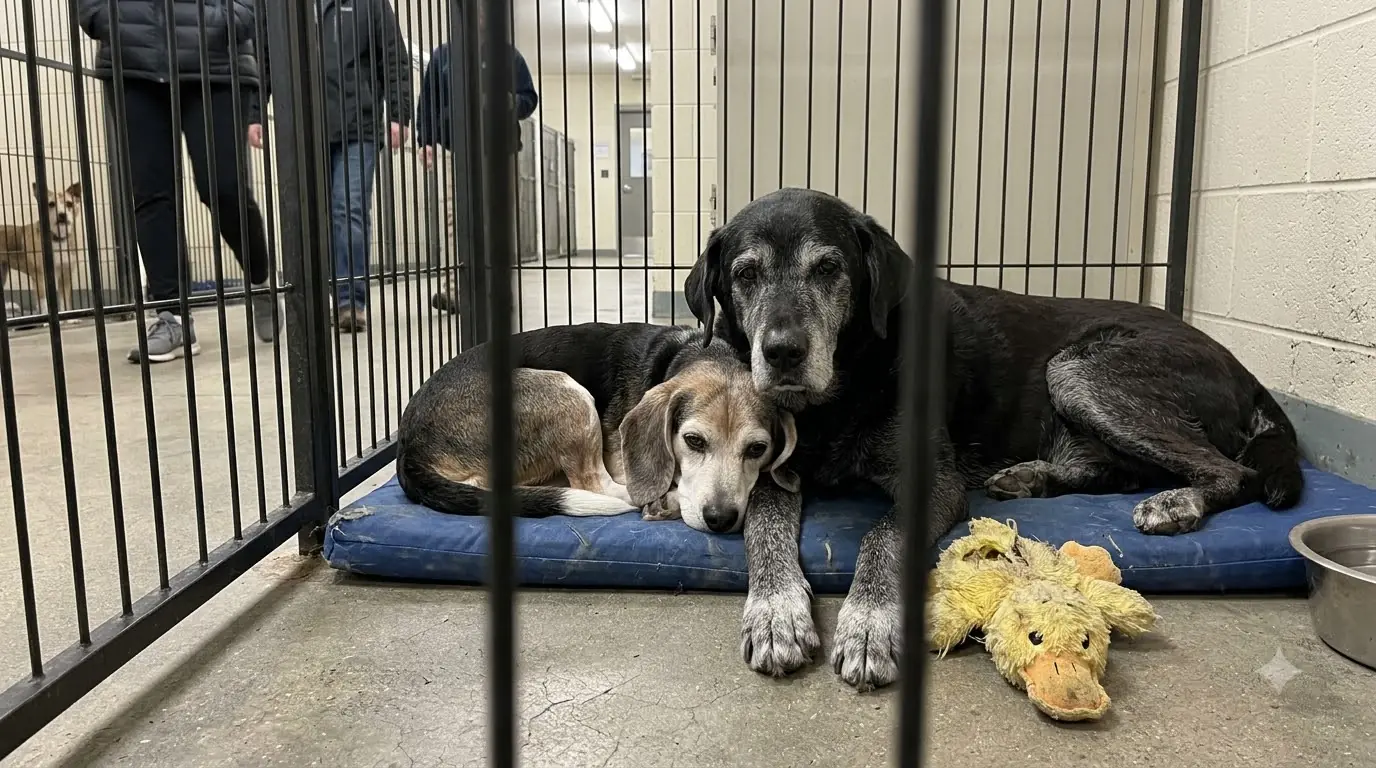
Every morning, Daisy could reach the kennel gate before Buddy.
She never does.
Buddy is a 12-year-old Labrador mix, and his back legs are not as strong as they once were. Getting up from his bed has become a process rather than a single movement.
He shifts forward.
Plants his front paws.
Pushes.
Pauses.
Then tries to bring his back legs underneath him.
Some mornings are easier than others.
Daisy, an 8-year-old Beagle mix, could spend those minutes watching the hallway. She could stand at the gate where breakfast, leashes, staff members, and visitors eventually appear.
Instead, she waits beside Buddy's bed.
Only when Buddy is standing does Daisy begin walking toward the front of the kennel.
And she does something else staff members noticed quickly.
She slows down.
Buddy's steps are uneven now. Daisy's are not.
Still, she walks beside him at his pace.
For two dogs who spent years in the same home before arriving at the shelter together, it is one of many routines that seem to have followed them through the kennel door.
Buddy takes longer.
Daisy waits.
Buddy moves slowly.
Daisy moves slowly too.
And on one afternoon when Buddy was simply too tired to get up, Daisy did not leave him behind.
She brought something to him instead.
They Came to the Shelter Together
Buddy and Daisy entered care after their owner could no longer care for them.
There was no dramatic rescue.
There is no reason to turn their history into one.
Sometimes circumstances change, and a person who has cared for animals for years reaches a point where continuing that care is no longer possible.
What mattered to shelter staff when Buddy and Daisy arrived was immediately practical: these were two dogs entering an unfamiliar environment after sharing a familiar life.
Buddy was the older of the pair.
At 12, he moved carefully.
Daisy was eight and physically more capable of getting around.
If age alone determined their shelter routines, Daisy could easily have begun doing everything ahead of Buddy.
She could reach the gate faster.
She could cross the kennel faster.
She could be ready for a walk faster.
But Daisy seemed to have another routine already established.
She waited for Buddy.
Staff began noticing it during their first mornings.
When activity started in the kennel row, Daisy woke.
Buddy woke too, but getting from lying down to standing required more effort.
Daisy did not immediately move to the front.
She stayed near him.
Sometimes she stood.
Sometimes she sat.
Sometimes she sniffed around the bed.
But she did not head toward the gate until Buddy was ready.
Then the two dogs walked there together.
Buddy Has His Own Pace Now
Buddy's weak back legs affect the way he moves, but they do not define everything about him.
He remains interested in what is happening around him.
He enjoys attention.
He notices familiar routines.
He still wants to participate.
He simply needs more time.
That distinction is important.
Older dogs can be underestimated when their bodies begin moving more slowly.
Buddy does not need everyone to hurry him.
He needs the opposite.
Time to stand.
Time to find his balance.
Time to move across the kennel without being rushed.
Staff naturally accommodate that.
What was more surprising was how naturally Daisy seemed to accommodate it too.
When Buddy begins moving, Daisy does not race several feet ahead and wait at the destination.
She frequently stays beside him.
Her normal gait could carry her much faster.
Instead, her pace changes.
Buddy steps.
Daisy steps.
Buddy adjusts his back legs.
Daisy remains near his shoulder.
If he pauses, she often pauses too.
Nobody taught her this as part of a shelter routine.
It was simply what she began doing.
Perhaps it is something she had already been doing long before the shelter ever met them.
Their previous life together belongs partly to a history staff cannot observe.
Their current behavior does not.
And every morning, Daisy makes the same basic decision.
She could go first.
She waits.
Two Dogs Adjusting to One Unfamiliar Place
A shelter is a major environmental change even for confident dogs.
There are unfamiliar smells everywhere.
Doors open and close.
Dogs bark unexpectedly.
Food arrives according to a schedule the animals do not yet know.
Different people handle leashes.
Cleaning changes the smells inside the kennel.
Visitors appear and disappear.
For Buddy and Daisy, however, one important part of their environment did not change.
Each other.
That became especially noticeable during quiet periods.
Buddy enjoys resting and naturally spends more time lying down than Daisy.
Daisy is more likely to become curious about movement outside.
Her Beagle nose gives her plenty to investigate.
Yet she repeatedly returns to Buddy.
She may sniff around the kennel.
She may check a toy.
She may look through the gate.
Then she comes back.
At rest, she often chooses a place close enough to know exactly where he is.
Buddy does not constantly seek her out in the same obvious way.
His role in their relationship is quieter.
He is simply there.
For Daisy, that seems to matter.
The Morning Routine Became Impossible to Miss
Shelter routines reveal patterns because they repeat.
One morning of Daisy waiting beside Buddy could have meant very little.
Then it happened again.
And again.
Morning activity would begin.
Daisy would become alert.
Buddy would remain on his bed for another moment.
Daisy stayed.
Buddy shifted forward.
Daisy watched.
He pushed himself upward.
Once all four paws were underneath him, Daisy finally began moving.
Then they crossed the kennel together.
Staff learned not to call Daisy toward the gate while Buddy was still getting up.
There was little reason to.
She had already decided where she wanted to be.
Beside him.
There is something particularly revealing about that choice because Daisy is physically capable of doing otherwise.
Buddy does not restrain her.
There is no leash connecting them.
She is free to move.
She repeatedly adjusts herself to him.
Daisy Doesn't Need Buddy to Be Fast
Their exercise time shows the same pattern in a larger space.
Daisy is younger and naturally more mobile.
Once outside, her nose becomes busy.
There are scents to investigate and places she could reach much more quickly than Buddy.
Sometimes she moves ahead.
But she does not simply disappear into her own activity.
She checks back.
Buddy continues at his manageable pace.
Daisy circles.
She investigates.
Then she comes nearer again.
Staff do not require her to remain attached to Buddy's side. In fact, it is important that Daisy receives opportunities appropriate for her own age and physical abilities.
Being part of a bonded pair should not mean one animal's world becomes artificially limited to the other's abilities.
Daisy still needs exercise.
She still needs enrichment.
She still needs individual attention.
But given the freedom to move away and return, Daisy returns frequently.
Buddy's slower pace has become part of the rhythm she understands.
The Afternoon Buddy Stayed Down
One afternoon was different.
Buddy had been resting on his bed.
Daisy was awake.
There was activity outside their kennel, but Buddy did not get up.
He was tired.
For a senior dog with mobility limitations, some periods naturally require more rest than others.
Staff were attentive to him and his condition, as they are with any older animal whose mobility needs monitoring.
Daisy had options.
She could move toward the gate.
She could watch the other dogs.
She could investigate the kennel.
Instead, she walked to the other side.
There was a little stuffed duck among their things.
Daisy picked it up.
She carried it across the kennel.
Then she brought it to Buddy.
She placed the stuffed duck near his front paws.
Buddy remained lying down.
Daisy lowered herself beside him.
And there she stayed.
The Stuffed Duck Wasn't the Important Part
It would be easy to assign a complicated human explanation to Daisy's behavior.
We cannot know what she intended when she carried the toy to Buddy.
We should not pretend that we do.
What staff can describe is exactly what happened.
Buddy remained on his bed.
Daisy retrieved an object from elsewhere in the kennel.
She carried it to him.
She placed it beside his paws.
Then she chose to lie beside him rather than return to the gate.
The stuffed duck itself was not what made the moment meaningful.
The choice was.
Daisy had something she could have kept elsewhere.
She brought it into Buddy's space.
Then she brought herself there too.
Later that evening, activity increased outside the kennel.
People walked through the shelter.
Dogs noticed.
Some moved toward their gates.
Daisy normally had every reason to be curious.
That evening, she did not join them.
She remained with Buddy.
The stuffed duck stayed nearby.
Sometimes a Bond Is Most Visible When Nothing Happens
Many memorable shelter moments involve action.
A dog runs toward someone.
A cat reaches through a kennel door.
An animal sees a familiar person and becomes excited.
Buddy and Daisy's strongest moments often involve the opposite.
Waiting.
Buddy is slow to stand.
Daisy waits.
Buddy pauses during a walk.
Daisy slows.
Buddy spends an afternoon resting.
Daisy lies down.
Nothing spectacular happens.
That is exactly why the pattern feels so genuine.
Daisy does not appear to stay beside Buddy only when people are watching.
It happens during ordinary parts of the day.
It happens when there is something more interesting at the kennel gate.
It happens when she has the physical ability to move faster.
It happens when Buddy cannot follow immediately.
She adjusts.
Buddy Gives Daisy Something Too
Because Buddy's mobility is limited, it can be tempting to describe the relationship as though Daisy is simply taking care of him.
That would miss half of the story.
Buddy gives Daisy something important too: familiarity.
The shelter is new.
Buddy is not.
When noises change around them, Daisy can return to the same dog she knew before arriving.
When they settle for the night, Buddy is there.
When morning comes, he is there.
When they enter an outdoor area, Daisy can explore and then return to him.
Buddy's physical pace may be slower, but his presence is steady.
Daisy appears comfortable building her routine around that steadiness.
This is one reason staff think carefully about their adoption future.
Separating two animals should never be treated as automatically harmful simply because they have lived together.
Each case deserves individual evaluation.
With Buddy and Daisy, however, staff continue seeing behavior that supports keeping them together if an appropriate home can be found.
Daisy does not merely tolerate Buddy's limitations.
She repeatedly incorporates them into her own choices.
Finding One Home Would Be Easier
This is where their story becomes difficult.
There are people who specifically want senior dogs.
There are adopters who might see Buddy's gray muzzle and slower walk and immediately appreciate him.
There are also people who might be drawn to Daisy.
At eight, she is mature but more mobile.
Her Beagle curiosity gives her a different personality from Buddy.
If they were being considered individually, each would appeal to a somewhat different group of adopters.
But they are not simply two unrelated dogs occupying neighboring kennels.
Their history and current behavior matter.
The shelter is trying to find a home prepared to take both.
That is a significantly larger request.
Two Dogs Mean Two Real Responsibilities
Someone may have enough space for Daisy but not for a Labrador-sized dog with mobility limitations.
Someone may be prepared for Buddy's senior lifestyle but not want the additional responsibility of a second dog.
A landlord may permit only one pet.
A household may already have animals.
Transportation can matter, especially if Buddy eventually needs assistance getting into a vehicle.
Veterinary expenses matter too.
At 12, Buddy is at an age when ongoing medical monitoring becomes increasingly important.
His weak back legs require appropriate veterinary oversight, and his future mobility needs could change.
Daisy is eight and has her own healthcare needs as an individual dog.
Adopting them together means committing financially to both.
That is not something the shelter minimizes.
A successful adoption needs to survive beyond the emotional moment when someone sees Daisy waiting beside Buddy's bed.
Love for their story is not enough.
Resources matter.
Time matters.
Housing matters.
Physical ability matters.
Planning matters.
Buddy's Mobility Changes the Kind of Home They Need
The physical environment is particularly important for Buddy.
A home with difficult stairs may require careful consideration.
Slippery floors can be challenging for dogs with weak back legs.
Access to comfortable resting areas matters.
An adopter may eventually need to consider rugs, traction, ramps, supportive equipment, or other veterinarian-recommended accommodations depending on how Buddy's mobility progresses.
Exercise needs to match what Buddy can comfortably manage.
But Daisy should not automatically be restricted to Buddy's level of activity.
She is younger.
She may benefit from additional walks, sniffing opportunities, or enrichment that Buddy does not always join.
That means the adopter needs to think in two directions at once.
Preserve their companionship.
Meet their individual needs.
Daisy can wait beside Buddy because she chooses to.
A responsible home should not require her to spend every part of her life waiting.
Their Shelter Day Reflects That Balance
Staff work to give both dogs appropriate experiences.
Buddy gets time to move at his own pace.
Daisy gets opportunities to use her nose and explore.
They spend time together.
They also receive individual attention.
Meals are monitored.
Rest is respected.
Mobility is observed.
During busier periods, Daisy may become interested in the hallway while Buddy remains comfortable farther back.
She can investigate.
She simply tends to return.
At quieter times, they settle near each other.
The little stuffed duck moves around the kennel.
Sometimes Daisy has it.
Sometimes it is left somewhere on the floor.
After that afternoon, staff could not look at it quite the same way.
Not because the toy itself had changed.
Because they had seen where Daisy chose to put it when Buddy did not get up.
Visitors Often Notice Daisy First at the Gate
Adoption visitors do not always see the whole relationship immediately.
If Buddy is resting, Daisy may be the first dog they notice.
She can stand more quickly.
She can approach.
Buddy may take additional time before joining her.
That can create an incomplete first impression.
Someone sees an 8-year-old Beagle mix who appears ready to interact.
Then Buddy begins getting up.
Daisy's attention changes.
She waits.
When he reaches her, the picture becomes clearer.
Staff can explain their history.
They can describe the morning routine.
They can talk about Buddy's mobility.
They can explain what Daisy did with the stuffed duck.
But the goal is not to pressure visitors emotionally.
It is to give them enough information to decide responsibly whether their household could meet the needs of both dogs.
A Meet-and-Greet Has to Include Buddy's Pace
Meeting Buddy and Daisy cannot be rushed.
Buddy may need extra time simply to move from one place to another.
A potential adopter needs to be comfortable with that reality.
Daisy may make the process look easier because she naturally adjusts to him.
A human adopter must be willing to do the same.
That means waiting instead of pulling.
Allowing Buddy to find his footing.
Planning outings around what he can manage.
Recognizing when he needs rest.
At the same time, the adopter needs to see Daisy as more than Buddy's companion.
She should have her own relationship with the people in the home.
She should have enrichment appropriate for a Beagle mix.
She should have opportunities to explore at her own pace.
The ideal adopter understands both sides.
Buddy should not be hurried to keep up with Daisy.
Daisy should not have her entire life restricted to Buddy's slower pace.
Why the Shelter Keeps Presenting Them Together
Adoption photos of Buddy alone could tell a compelling story.
So could photos of Daisy.
But separate profiles would leave out one of the most consistent features of their current lives.
Daisy waits for Buddy.
The shelter therefore makes their relationship visible.
Photos can show them together.
Updates can describe their morning routine.
Potential adopters can watch them move through a shared space.
Videos can show Daisy matching Buddy's pace without turning the moment into something exaggerated.
That matters because someone considering both needs to understand what they are actually offering a home to.
Not a sad story.
Not a symbolic "senior pair."
Buddy and Daisy.
One dog whose body requires patience.
One dog who repeatedly demonstrates that patience herself.
Serious Interest Looks Different With Senior Dogs
When someone asks about adopting both dogs, staff need to have practical conversations early.
Is the home accessible for Buddy?
Are there many stairs?
What type of flooring is there?
Can the adopter physically assist a Labrador mix if that ever becomes necessary?
Can they transport both dogs safely?
Are they financially prepared for senior veterinary care?
Does their daily schedule provide enough time for Buddy's slower routines and Daisy's individual exercise?
Are there resident pets?
If so, can introductions be handled appropriately?
These questions do not make an adoption less emotional.
They make it more responsible.
The shelter would rather wait for a sustainable home than send Buddy and Daisy somewhere based solely on good intentions.
Not Every Home Can Take Two
There may be visitors who would gladly adopt Daisy alone.
There may be people with experience caring for senior Labradors who would consider Buddy but cannot add a second dog.
Those people are not doing anything wrong.
Recognizing a household's limitations can be one of the most responsible decisions a potential adopter makes.
That is what makes bonded-pair placement difficult.
The problem is not a lack of people who care.
The problem is finding the overlap.
Someone who wants Buddy.
Someone who wants Daisy.
Someone whose home works for Buddy's mobility.
Someone who can meet Daisy's needs.
Someone who can afford two dogs.
Someone whose housing permits two dogs.
Someone willing to preserve the relationship they already have.
All of those things need to exist in the same household.
Their Current Status
Buddy and Daisy remain together while the shelter continues looking for that home.
Buddy's mobility is being monitored, and his daily routine is adjusted according to what he can comfortably manage.
Some days he gets up more easily.
Other times he needs longer.
Daisy continues to notice.
The morning pattern has not disappeared.
She wakes.
She could go to the gate.
Instead, she remains near Buddy.
When he starts the process of standing, she waits.
Once he is ready, they move together.
Daisy still has her own activities and opportunities.
Buddy still receives individual care.
The shelter does not expect either dog to function only as part of a pair.
But at the end of those individual moments, they continue choosing to reconnect.
That is the behavior staff cannot ignore when thinking about their future.
What Happens as Buddy Gets Older Matters
There is another reality a potential adopter needs to understand.
Buddy is 12.
Daisy is eight.
Their age difference means the years ahead may not look the same for both dogs.
Buddy may need increasing support before Daisy does.
His mobility could change.
His activity level could decrease.
His veterinary needs could become more complex.
No responsible shelter can predict exactly how quickly any of those things will happen.
But an adopter needs to be prepared for the possibility.
Daisy, meanwhile, may remain more active.
She will continue needing her own exercise, preventive care, veterinary attention, and opportunities to engage with the world.
Their bond does not eliminate those differences.
It makes thoughtful planning even more important.
The Home That Could Say Yes to Both
Buddy and Daisy would benefit from a household that appreciates a slower daily rhythm without assuming Daisy wants no activity.
Easy access to outdoor areas could help Buddy.
Secure footing would be useful.
Comfortable beds should be available in more than one location.
Their adopter should be prepared to follow veterinary guidance regarding Buddy's mobility rather than improvising treatment.
Daisy should have opportunities for sniff walks and enrichment.
Both dogs should receive individual attention.
They can continue sleeping near each other if they choose.
They can continue walking together when Buddy feels able.
And when Daisy wants a little more exploration, the home should be able to give her that too.
Above all, their adopter needs realistic expectations.
Taking home a bonded senior pair is not simply taking home twice the affection.
It is accepting responsibility for two aging bodies moving through different stages of life.
That is a meaningful commitment.
It is also the kind of commitment the shelter is trying to find.
The Gate Can Wait
Toward evening, the kennel row becomes interesting again.
Visitors move through.
Doors open.
Leashes jingle.
Dogs stand at their gates to see what is happening.
Daisy notices those sounds too.
She is a Beagle mix.
Curiosity has not disappeared simply because Buddy moves slowly.
But that afternoon, Buddy was still lying down.
The little stuffed duck rested near his front paws where Daisy had placed it.
There was activity beyond the kennel.
Daisy could have gone to watch.
She did not.
She curled beside Buddy instead.
Eventually the hallway quieted.
The visitors disappeared.
The other dogs settled.
Buddy remained on his bed.
Daisy remained against him.
Tomorrow morning, she may wake before he does.
She may be ready to walk to the gate long before Buddy has his back legs underneath him.
But if the pattern continues, she will wait.
Buddy will push himself up when he is ready.
Daisy will take the first slow step beside him.
Then another.
And somewhere beyond that kennel, the shelter will continue looking for someone who sees those uneven steps and understands that the goal is not to make Buddy move faster.
It is to find a home where Daisy can keep walking beside him.