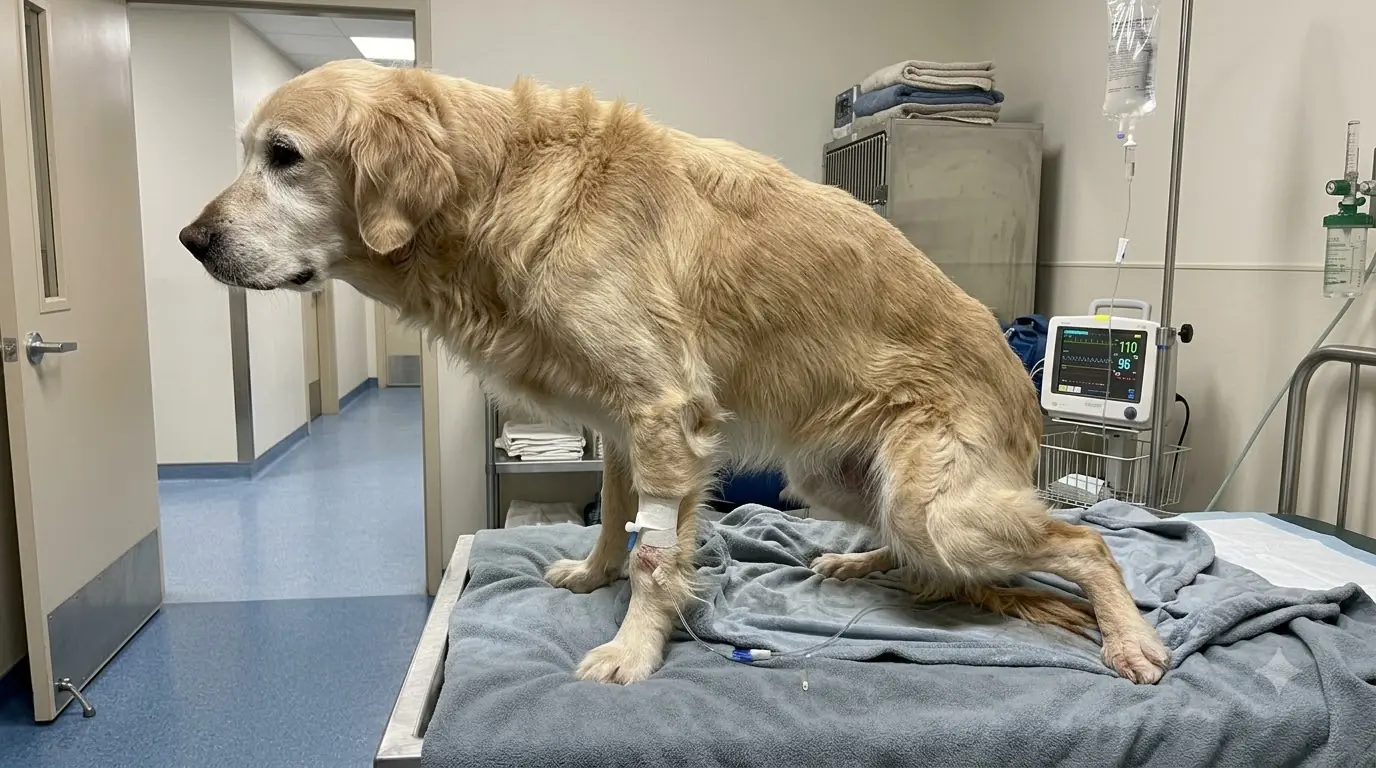
Charlie was finally resting.
The 11-year-old Golden Retriever lay stretched across the padded floor of his recovery kennel, his body thin beneath his coat and his hind legs resting almost completely still behind him.
A rescue worker sat on the floor nearby.
As long as the person remained there, Charlie barely moved.
His head rested down.
His breathing gradually settled.
Then the worker stood.
Charlie noticed immediately.
Before the person could reach the door, his front legs pushed against the bedding.
His chest lifted.
Then Charlie tried to bring his hindquarters underneath himself.
Both rear legs began shaking violently.
For a second, he almost looked as though he might make it.
Then they folded.
Charlie dropped back down.
The worker stopped and returned to the floor.
Within minutes, Charlie was resting again.
Later, they tried to leave once more.
Charlie tried to stand again.
And after watching his weakened body collapse for the second time, staff realized something had to change.
Charlie could not keep exhausting himself every time someone walked out of the room.
Charlie Had Already Spent Days Alone Before Anyone Found Him
His story had begun inside a house that had suddenly gone quiet.
Charlie's owner had died.
Neighbors did not discover that Charlie was still inside until days later.
By the time help reached him, the senior Golden Retriever was in poor physical condition.
He was severely dehydrated.
He had lost weight.
And his hindquarters were so weak that supporting his own body had become extremely difficult.
Exactly what happened during every hour Charlie spent inside that house could not be reconstructed.
But rescuers did not need to guess at the effect on his body.
Charlie needed medical attention.
Getting Him Out of the House Didn't Restore His Strength
Water could begin correcting dehydration.
Appropriate nutrition could support his depleted body.
A safe place could replace the empty house.
But none of those things could instantly give Charlie his legs back.
At 11 years old, he was already a senior dog.
His hind-limb weakness needed veterinary assessment rather than being blamed automatically on one cause.
Dehydration, prolonged inactivity, loss of muscle and underlying age-related orthopedic or neurological problems could all potentially affect mobility.
The rescue team needed to determine what was actually contributing.
In the meantime, Charlie needed help simply getting through the day without repeatedly pushing his body beyond what it could manage.
His Front Half Still Looked Much Stronger
That created a deceptive picture.
Charlie could plant his front paws.
He could push his chest upward.
For a moment, the front of his body looked ready to stand.
Then the effort reached his hindquarters.
His rear legs trembled.
His hips dropped.
And the rest of him followed.
Strong front legs can sometimes hide how much function a dog has lost behind them.
Charlie still had determination in those first movements.
His body simply could not consistently complete what he started.
Staff Initially Thought He Was Trying to Reposition Himself
The first time Charlie pushed upward, a worker assumed he might be uncomfortable.
Maybe he needed to change position.
They helped him settle.
Charlie rested.
Nothing else happened.
Then the person stood to leave.