The barking usually starts somewhere else.
One dog reacts.
Then another.
Within seconds, the noise can roll through an entire shelter row.
That is when Cooper starts moving.
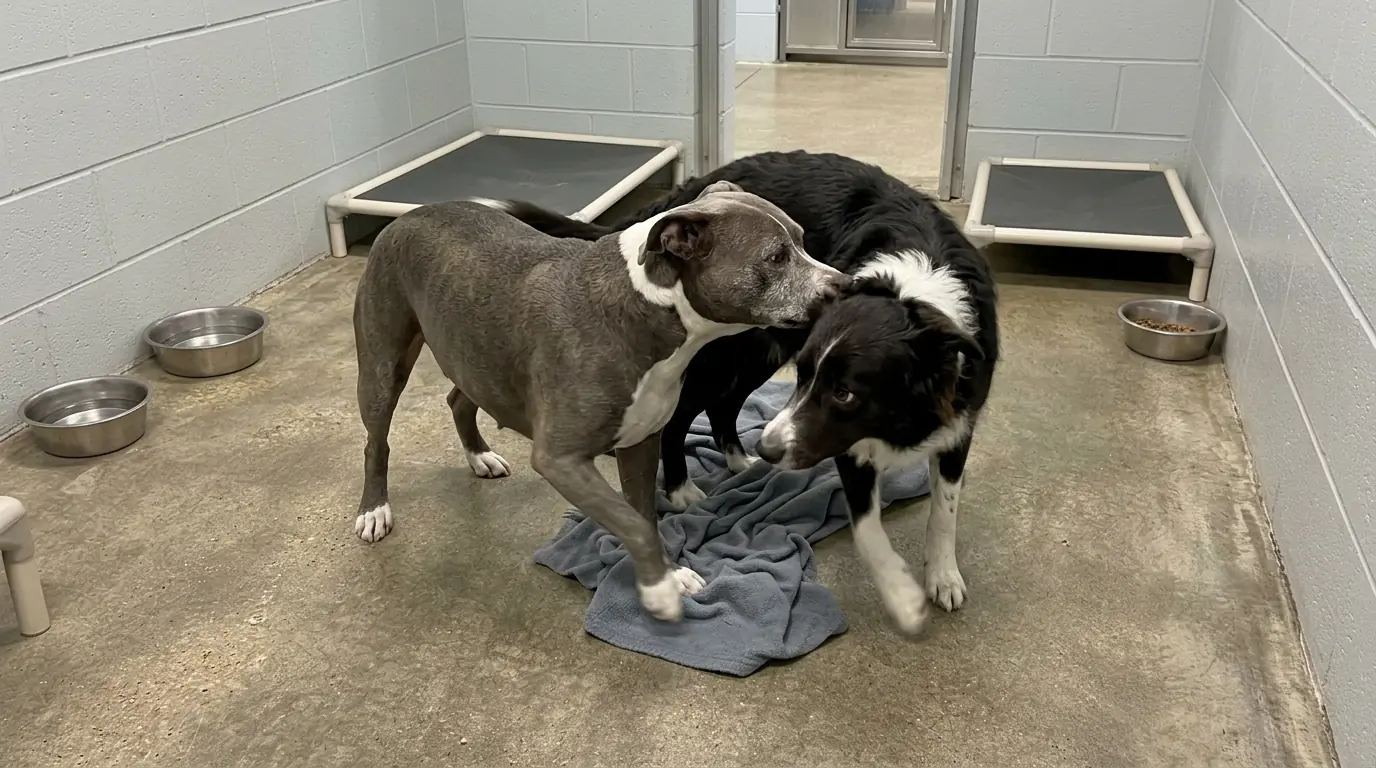
The six-year-old Border Collie mix begins circling the shared kennel.
At first, the loops are wide.
Then they tighten.
His pace increases.
He keeps turning faster and faster as the barking around him builds.
Molly notices almost immediately.
The eight-year-old Pit Bull mix steps into Cooper's path, presses the length of her body against his side, and starts moving with him.
She does not block him.
She does not knock him down.
She simply stays pressed against him as both dogs continue circling.
Cooper's pace gradually slows.
The loops widen.
Then, eventually, he stops.
Only after he stops does Molly stop too.
Cooper and Molly Came From a Backyard Breeding Property
The two dogs had been removed from a backyard breeding property before arriving at the shelter.
Beyond that, staff could not know every detail of what their daily lives had looked like there.
They could not say exactly what Cooper had experienced around other dogs, loud noise, confinement, or repeated barking.
What they could see was how he responded now.
Much of the time, Cooper could move around the shared kennel without incident.
He could investigate the space.
He could drink.
He could rest.
Then the shelter noise changed.
A sudden burst of intense barking could trigger a completely different pattern.
Cooper began circling.
The Faster the Noise Became, the Faster Cooper Moved
Shelter barking is not a single sound.
It can build quickly.
One dog may begin vocalizing because a person walks past.
Another reacts to that dog.
Then several kennels join in.
For some dogs, the sudden escalation can be difficult to tolerate.
Cooper's response was physical.
He did not simply bark back.
He moved.
Round the kennel.
Again.
And again.