The County Inspector kicked the irrigation ridge before he read the soil report.
That was what the Older Farm Woman remembered later.
Not the shouting.
Not the government truck parked beside the red dirt road.
Not even the notice ordering her family to plow under nearly twelve acres of vegetables before the end of the week.
She remembered his shoe.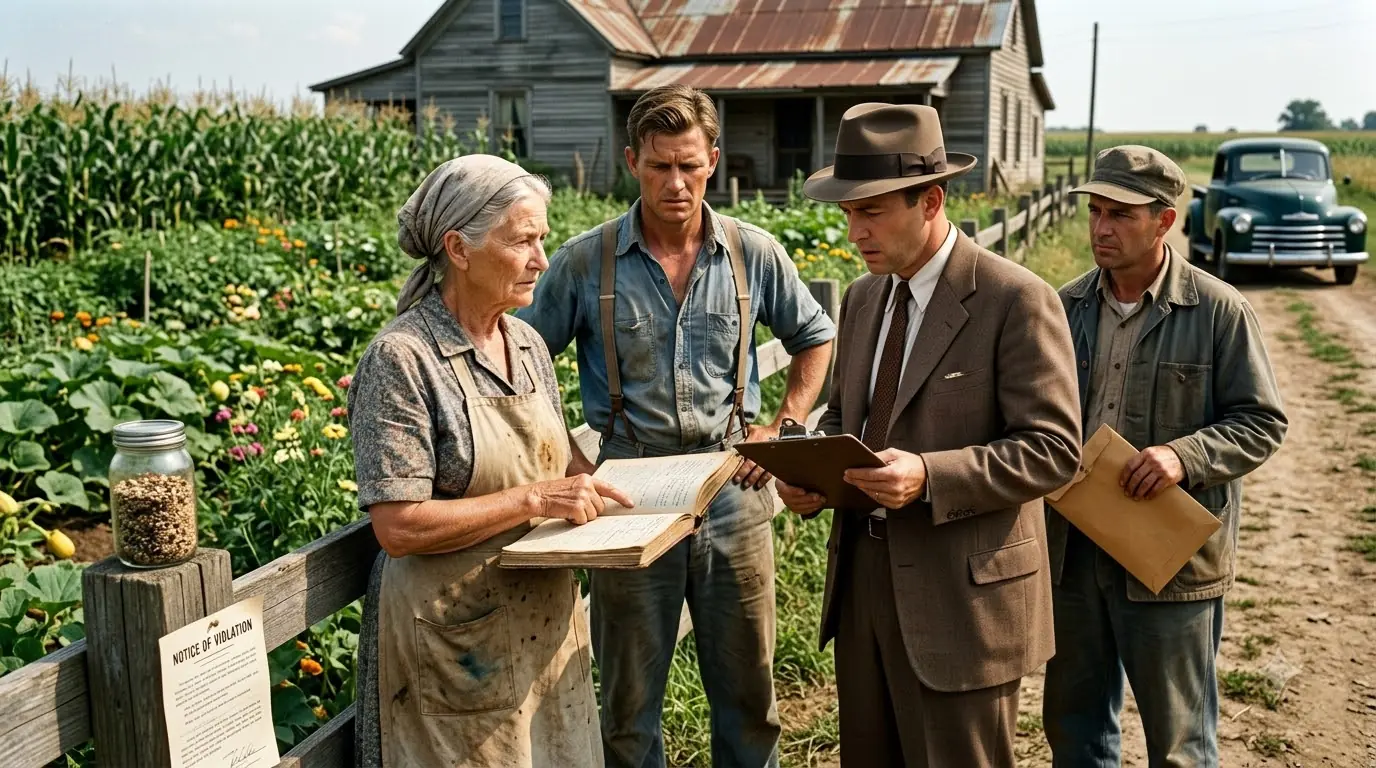
Polished brown leather.
Too clean for a field.
It struck the low ridge her son had shaped by hand after the spring rain and sent a small wall of loose Georgia soil collapsing into the furrow.
The Older Farm Woman looked down.
Then at him.
The County Inspector did not seem to realize he had made a mistake.
He held a clipboard in one hand and an official county notice in the other.
Behind him, a dark green pickup stood beside the road, its engine ticking in the heat.
Beyond the truck lay the neighboring demonstration acreage, planted in perfect straight lines with the seed and fertilizer package the county had recommended that spring.
The crops were green from a distance.
Up close, parts of the soil between them had hardened into a pale crust.
On the Older Farm Woman’s side of the fence, the land looked untidy by comparison.
Corn grew beside climbing beans.
Squash leaves spread beneath the taller plants.
Sunflowers bordered the western rows.
Cowpeas covered ground that would otherwise have been bare.
Flowers appeared in places the County Inspector considered wasted space.
A shallow series of ridges and channels curved around the natural slope instead of cutting directly downhill.
There were no uniform blocks.
No clean, empty spaces between every crop.
To the County Inspector, it looked like disorder.
To the Older Farm Woman, it looked like August.
Her Farmer Son stood beside her.
He was thirty-three, tall and lean, with light brown hair darkened by sweat and a blue work shirt rolled above his elbows.
He had inherited his father’s habit of clenching his jaw before speaking.
The Older Farm Woman saw it happening now.
“Don’t,” she murmured.
Her son looked at her.
“I haven’t said anything.”
“Your face has.”
A few feet away, the Field Agent tried not to smile.
He had arrived separately from Atlanta that morning with a leather sample case, three sealed envelopes, and the expression of a man already regretting whatever meeting had sent him to Whitfield Farms.
He was younger than the County Inspector, perhaps thirty-five, with a pale short-sleeved shirt and a narrow dark tie he had loosened almost immediately after stepping into the Georgia heat.
He had spent two hours walking both farms.
Taking soil cores.
Checking roots.
Measuring moisture.
Looking at erosion.
Asking questions.
Unlike the County Inspector, he had touched the dirt.
That mattered to the Older Farm Woman.
The County Inspector thrust the notice toward the Farmer Son.
“You signed the county rehabilitation agreement.”
The Farmer Son did not take it.
“I signed for a machinery loan.”
“You signed for participation in the soil improvement program.”
“Because the tractor transmission failed.”
“Then you accepted the conditions.”
The Older Farm Woman spoke.
“We accepted a loan.”
The County Inspector looked at her as though reminded she was still standing there.
He was in his late thirties, broad through the chest, with carefully combed brown hair and the confident manner of a man accustomed to arriving with paperwork that ended arguments.
“Ma’am, the conditions were explained.”
“To my son.”
“He is the legal operator.”
The Farmer Son’s jaw tightened again.
The Older Farm Woman noticed.
“He is one legal operator.”
The inspector glanced at his clipboard.
“Whitfield Farms is registered under his name.”
“And mine.”
A pause.
The Field Agent looked toward the paperwork.
The inspector flipped a page.
The Older Farm Woman waited.
His face changed slightly.
Not much.
Enough.
Her name was there.
Half interest.
She had owned half since her husband’s death.
The inspector cleared his throat.
“Regardless, this property received subsidized seed credit, fertilizer credit, and equipment financing under a standardized recovery plan.”
The Older Farm Woman looked toward the field.
“We didn’t use your seed on these twelve acres.”
“Exactly.”
“We bought our own.”
“That is not the point.”
“We didn’t use your fertilizer either.”
“Also the point.”
The Farmer Son stepped closer.
“We paid for those acres ourselves.”
The County Inspector turned toward him.
“But they are included inside the registered demonstration tract.”
“Because your office drew the map wrong.”
The inspector’s expression hardened.
“Be careful.”
The Farmer Son almost laughed.