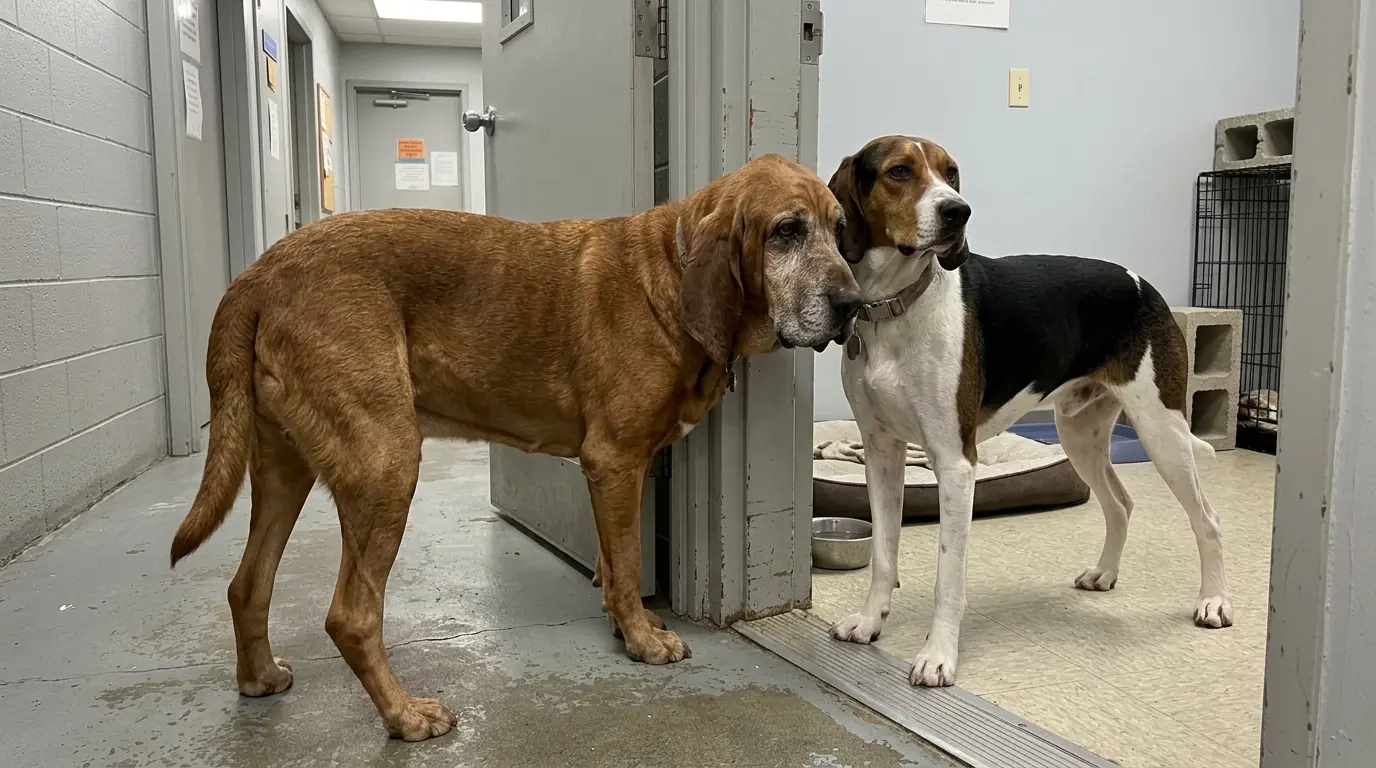
Daisy could walk perfectly well across the room.
The six-year-old Coonhound could move from her bed to her water bowl, circle the kennel, and follow Otis without any obvious physical difficulty.
Then she reached a doorway.
Everything stopped.
Daisy planted all four paws before the threshold and became rigid. An open hallway could be waiting on the other side. Nothing had to be blocking her path.
Still, she would not cross.
That was when Otis did something shelter staff had never taught him to do.
The ten-year-old Bloodhound turned around.
Instead of walking through the doorway normally, Otis backed through it.
One slow step.
Then another.
He continued until his hindquarters were on the other side while his chest remained close to Daisy.
Only then did Daisy move.
She stepped forward, staying so close that her chest nearly touched his.
Within seconds, both dogs were through.
At the next doorway, the entire strange routine could begin again.
Daisy and Otis Had Come From a Crowded Hoarding Property
Before entering the shelter, Daisy and Otis had lived on a property with dozens of other dogs crowded into small rooms.
Beyond that basic history, staff had to be careful about assumptions.
They could not know every interaction Daisy had experienced around doors or why thresholds had become so difficult for her.
What they could see was the dog standing in front of them now.
Away from doorways, Daisy was physically capable of walking.
She could navigate an open area.
She could change direction.
She could follow another dog.
There was no obvious mechanical reason she could cross the middle of a room but not the final few inches into the hallway.
The doorway itself appeared to be the difficult part.
And Otis had somehow become part of the way she got through it.
Staff First Tried Giving Daisy More Time
There was no reason to drag her across.
Forcing a fearful dog through a doorway can intensify the very hesitation people are trying to solve.
So staff allowed Daisy time to investigate.
The doorway was kept open.