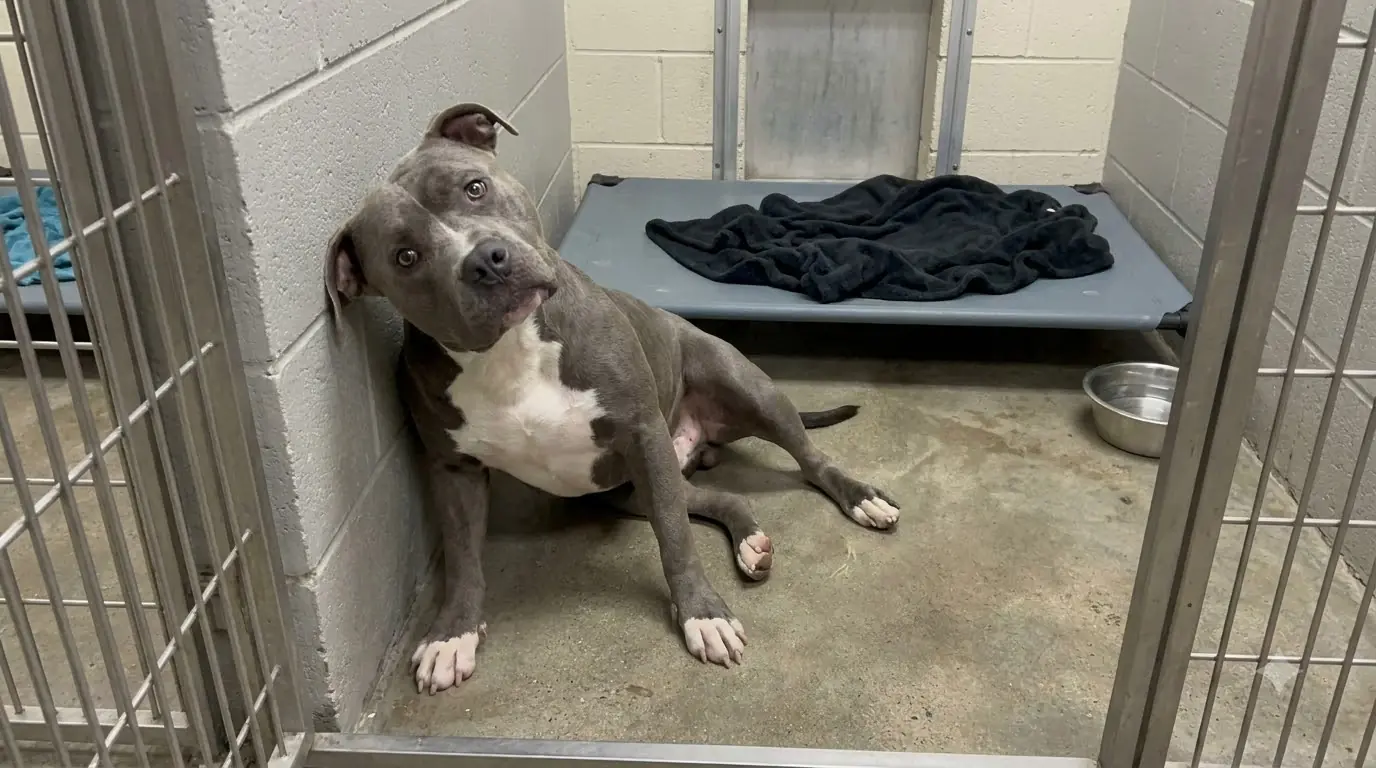
At first, it looked like Diesel had simply lost his footing.
The 7-year-old American Pit Bull Terrier stood inside his shelter kennel and tried to walk toward the gate.
He made it several steps.
Then something changed.
His body suddenly drifted sideways.
Diesel tried to correct himself, but instead of reaching the door, he veered sharply toward the wall.
His shoulder hit first.
The impact stopped him.
For a moment, Diesel stood there looking disoriented, his head tilted noticeably to one side.
Then staff saw his eyes.
They were moving abnormally too.
That was when an awkward stumble stopped looking like a simple balance problem.
Something was wrong.
And veterinarians needed to determine whether the problem was coming from Diesel's inner ear, his vestibular system—or somewhere deeper inside his nervous system.
The First Sign Wasn't the Collision
Before Diesel began hitting the kennel wall, caregivers had already noticed something unusual about his posture.
His head was tilted.
Not a curious tilt that disappeared when someone called his name.
It remained noticeably angled to one side.
Then came the balance problems.
Diesel could stand on all four legs.
There was no obvious injury to explain why he suddenly could not walk in a straight line.
But when he tried to move, his body sometimes swayed.
His steps became poorly directed.
At moments, he seemed unable to keep himself oriented.
That combination immediately changed the medical concern.
Then His Eyes Started Moving Strangely
Abnormal eye movement alongside a persistent head tilt and sudden loss of balance can be an important neurological or vestibular sign.
The vestibular system helps an animal maintain balance and understand the position and movement of the head.
When something disrupts that system, a dog can appear profoundly dizzy or disoriented even when the legs themselves are capable of bearing weight.
To someone watching from outside the kennel, the result can be frightening.
Diesel might try to walk forward.
His legs moved.
But his body did not reliably follow the direction he seemed to be attempting to go.
One Attempt to Reach the Gate Became the Moment Staff Couldn't Ignore
Someone approached Diesel's kennel.
He noticed.
Diesel tried to come forward.
He pushed himself upright and took several steps toward the gate.
Then his balance suddenly shifted.
His body leaned.
One front paw crossed awkwardly as he tried to correct himself.
Diesel moved sideways instead of forward.
A second later, his shoulder struck the kennel wall.
The sound brought staff immediately toward him.
Diesel had not deliberately thrown himself into anything.
He had lost control of his direction.
That distinction mattered.
The Kennel Was No Longer Safe in Its Normal Setup
A dog experiencing sudden severe imbalance can injure himself simply by trying to move.
Diesel did not need stairs or a long run to be at risk.
A few uncontrolled steps toward a concrete wall were enough.
So while veterinary evaluation became the priority, his environment also had to be managed.
The goal was to reduce opportunities for another hard collision.
Diesel needed secure footing.
He needed unnecessary obstacles removed.
He needed close observation.
And he did not need people repeatedly encouraging him to walk toward the gate just to see whether he could make it.
His Four Legs Weren't Giving Veterinarians the Obvious Answer
There was no clear orthopedic injury that explained what staff were seeing.
Diesel had four limbs beneath him.
Yet balance involves much more than leg strength.
A dog needs the nervous system, sensory information and balance mechanisms to work together to understand where the body is in space and how to keep it upright.
When that system malfunctions, an otherwise weight-bearing dog can suddenly look incapable of navigating a room.
That was why Diesel needed more than a quick check of his paws and joints.
The Vestibular System Became One Possibility
Diesel's combination of signs raised concern for vestibular dysfunction.
The vestibular system includes structures involved in maintaining balance and spatial orientation.
Problems affecting this system can produce dramatic symptoms.
Head tilt.
Loss of balance.
Falling or leaning.
Difficulty walking normally.
Abnormal involuntary eye movements.
A dog experiencing these symptoms may look as though the entire room is moving around him.
But identifying a vestibular pattern is only the beginning.
The next question is why it is happening.
The Inner Ear Was Another Place Veterinarians Had to Consider
Some balance problems can be associated with disease affecting the middle or inner ear.
That means an ear problem can sometimes become much more serious than ordinary external irritation.
The structures deeper within the ear are closely connected with balance.
But Diesel's shelter team could not simply look at his head tilt and declare that he had an inner-ear infection.
The same outward signs can have different causes.
That uncertainty was exactly why the sudden episode required veterinary assessment.
The More Serious Concern Was Neurological Disease
Veterinarians also had to consider whether Diesel's symptoms could be associated with a problem involving the central nervous system.
That possibility changes the level of concern.
Balance abnormalities can originate in different parts of the vestibular pathway, and distinguishing peripheral problems from central neurological disease may require careful examination and, depending on the findings, additional diagnostics.
Diesel's age, history, neurological responses, eye movements and other examination findings all mattered.
The shelter could describe what they had seen.
The veterinary team had to determine what those observations meant.
Nobody Could Diagnose Diesel From the Kennel Video
The footage was useful.
It showed the direction of his fall.
It captured his abnormal movement.
It documented how suddenly his orientation could change.
But a video could not answer the central medical question by itself.
Was the source peripheral vestibular disease?
A deeper ear problem?
A central neurological condition?
Something else?
Staff did not turn the most dramatic-looking possibility into a diagnosis before the examination was complete.
For Diesel, uncertainty was part of the story.
His Head Tilt Remained Even While He Rested
After the episode, Diesel spent more time lying down.
That reduced the chance of another uncontrolled collision.
But the abnormal posture did not simply disappear when he stopped walking.
His head remained angled.
When activity occurred outside the kennel, Diesel could still look toward it.
But his orientation was visibly different.
At times, even repositioning himself required more care than usual.
A dog does not need to be running to struggle with severe dizziness or balance dysfunction.
For Diesel, standing up could be enough.
Food and Water Became More Complicated Too
When balance is severely affected, ordinary tasks can become difficult.
A bowl that was once easy to approach may suddenly require a dog to lower and position his head while already struggling to remain oriented.
So Diesel's caregivers had to pay attention to more than whether food was present.
Could he reach it safely?
Was he interested in eating?
Could he drink without losing his balance?
Did nausea appear to be affecting him?
Did he need assistance or environmental adjustments according to veterinary guidance?
Those practical questions mattered while the larger diagnosis was being investigated.
Staff Stopped Making Him Come to Them
Diesel still reacted when people approached.
That created a problem.
His desire to move toward the kennel front did not mean his body could safely do it.
After seeing him veer into the wall, caregivers no longer stood at the gate encouraging him to cross the kennel.
They came closer to him instead.
If Diesel was resting safely, interaction could happen there.
He did not have to demonstrate that he could walk.
He did not have to cross the kennel to receive attention.
That simple change reduced one reason for him to take unnecessary steps while severely unsteady.
His Symptoms Could Look Worse Than His Strength Actually Was
One of the most confusing parts of a balance disorder is how dramatic it can appear.
Diesel could have enough strength to stand.
He could move each leg.
He could still attempt to walk.
Yet within seconds, he might lean heavily to one side or travel in the wrong direction.
That does not mean the problem is minor.
Strength and coordination are not the same thing.
A dog can have functional muscles and still be profoundly impaired when the systems controlling balance and orientation are disrupted.
Diesel was showing staff that difference every time he tried to cross the kennel.
The Veterinary Team Had to Look for Other Neurological Clues
A careful neurological examination can help veterinarians understand where a problem may be located.
Diesel's head tilt and abnormal eye movements were important.
But they were not the only things that mattered.
His awareness.
His posture.
How he placed his feet.
How he moved.
Whether there were abnormalities involving other nerves or functions.
All of those findings could help narrow the possibilities.
The shelter's job was not to guess which diagnosis sounded most dramatic.
It was to make sure Diesel reached veterinary care quickly enough for those distinctions to be made.
Meanwhile, Preventing Another Collision Became Part of Treatment
Whatever the eventual cause, Diesel could not keep crashing into hard surfaces.
His kennel setup needed to reflect what his body could safely manage at that moment.
That meant minimizing unnecessary movement and making his resting area as safe and accessible as practical.
Staff also had to remember that Diesel's condition could change.
A dog who manages several steps safely once may still suddenly lose balance on the next attempt.
One successful walk across the kennel would not prove that the danger had passed.
Then Diesel Tried to Stand Again
A caregiver approached quietly.
Diesel lifted his head.
The tilt was still there.
He shifted his front paws beneath himself.
Then pushed up.
For a few seconds, he remained standing.
His body swayed.
The caregiver did not call him forward.
Diesel took one step anyway.
Then another.
His weight began drifting toward the same side.
This time, someone was close enough to intervene before his shoulder reached the wall.
Diesel was guided back toward a safer position and allowed to rest.
There was no need for a third step.
Small Improvement Would Not Mean the Cause Was Gone
Some balance disorders can improve.
Others depend heavily on the underlying cause.
That distinction is important.
If Diesel later manages to walk farther without falling, that would be encouraging.
It would not automatically identify what caused the episode.
Likewise, a persistent head tilt would need to be interpreted in the context of his diagnosis and overall progress rather than treated as the only measure of recovery.
The veterinary team's concern remained the underlying problem.
Not simply making the most visible symptom disappear.
For Now, Diesel's World Has Become Smaller
The kennel door is only a short distance away.
Before the balance episodes, that distance would have meant little.
Now it can be difficult.
Diesel sees someone outside.
He raises his head.
Sometimes his front legs tense as though he is preparing to stand.
But caregivers no longer wait at the gate for him to make the journey.
Someone comes inside.
Diesel stays where he is.
A hand reaches him without requiring his body to cross the room.
For an unsteady dog, those few saved steps matter.
What Happens Next Depends on What Veterinarians Find
Diesel's symptoms are not a diagnosis.
The head tilt is a clue.
The abnormal eye movements are a clue.
The sudden sideways drifting is a clue.
The collision with the wall showed how severely those abnormalities were affecting his ability to function safely.
But the most important question remains unresolved.
Where is the problem coming from?
If it involves the peripheral vestibular system, the treatment and outlook may differ from a deeper neurological cause.
If the inner ear is involved, that may require its own approach.
If examination points toward central nervous system disease, further investigation may become especially important.
Until the veterinary team can narrow that down, Diesel needs careful supportive care and protection from the symptoms themselves.
The Wall Is Still There, but Staff No Longer Let Diesel Fight His Way Toward It
A noise comes from the hallway.
Diesel looks up.
His head remains tilted.
The kennel gate is several feet away.
He starts to rise.
For a moment, his four legs are underneath him.
Then his body begins to drift.
Before Diesel can stagger across the kennel and strike the wall again, a caregiver moves toward him instead.
He is helped back into a safe position.
Diesel settles.
His eyes remain focused on the person now sitting near him.
Nobody asks him to try again.
Because the frightening part of Diesel's condition was never that his legs suddenly stopped working.
It was that he could still try to walk while the system telling his body where “straight ahead” was had stopped giving him a reliable answer.
Now the veterinary team has to find out why.