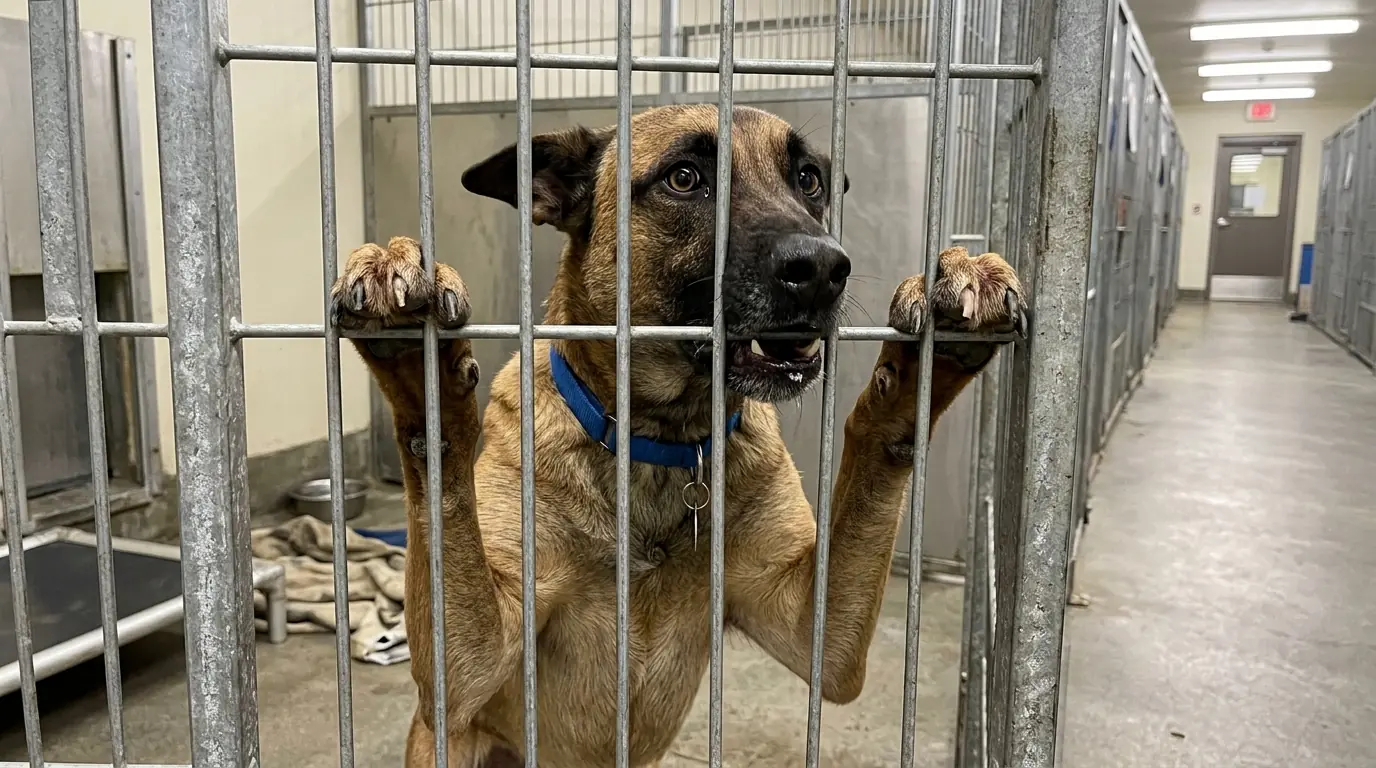
Diesel can stand only a few feet from someone and appear completely under control.
The seven-year-old Belgian Malinois mix approaches the front of his shelter kennel when someone stops outside. His ears come forward. His eyes follow the person. Sometimes he stands quietly at the gate without barking at all.
Nothing about those moments suggests what is about to happen.
The person turns around.
Takes one step away.
Diesel explodes.
He throws himself toward the kennel door, barking sharply. His paws rake against the barrier. When he cannot get through, he spins away and races around the kennel as though searching for another exit.
Then the person turns back.
Diesel sees their face again.
And just as suddenly as the frantic movement began, he drops.
His chest hits the floor.
His body flattens.
The barking stops.
But Diesel is still trembling.
The person has returned.
His panic has not.
At First, It Looks Like Diesel Simply Doesn't Want People to Leave
That would be an understandable explanation.
Dogs in shelters often become highly interested in people passing their kennels. Some bark when attention disappears. Others jump against gates or follow people along the front of their enclosure.
But Diesel's reaction is unusually specific.
Walking past him is not enough.
Standing near him is not enough.
Even stepping sideways does not always produce the same response.
The strongest trigger is the turn.
A person faces Diesel.
Then their shoulders rotate away.
Their back becomes visible.
They begin walking.
That is when Diesel loses control.
Sometimes the Panic Starts Before the First Full Step
Staff begin noticing how early Diesel recognizes the movement.
A person does not have to reach the next kennel.
They barely have to leave.
The hips turn.
One foot shifts.
Diesel's posture changes immediately.
His mouth closes.
His weight moves forward.
His eyes lock onto the departing figure.
Then he launches toward the door.
He Doesn't Just Bark From Where He Is
That distinction matters.
Diesel appears desperate to move.
He reaches the barrier and scratches.
Then he turns away from it.
He runs toward the rear of the kennel.
Circles.
Returns to the front.
Sometimes he checks another side as though the route the person used might somehow be accessible from there.
His movement is fast enough that keeping good traction and a clear kennel becomes important.
Then Eye Contact Changes Everything
The person hears the commotion.
They turn around.
Diesel sees the movement.
He stops.
Sometimes he freezes for a fraction of a second.
Then he lowers himself rapidly to the floor.
It can look almost like someone has flipped a switch.
The frantic dog disappears.
A trembling dog remains.
Lying Down Doesn't Mean Diesel Is Calm
That becomes one of the most important details.
From a distance, the second posture could be mistaken for obedience.
A Belgian Malinois suddenly dropping to the floor can resemble a trained down.
But Diesel's body tells a different story.
His muscles remain tight.
His breathing can stay rapid.
His ears may be pinned back.
His body trembles against the floor.
The movement has stopped.
The distress has not.
Staff Stop Treating the Drop as a Command Response
Nobody has asked Diesel to lie down.
The posture appears after the person turns back toward him.
That makes it part of the same behavioral sequence.
Facing person.