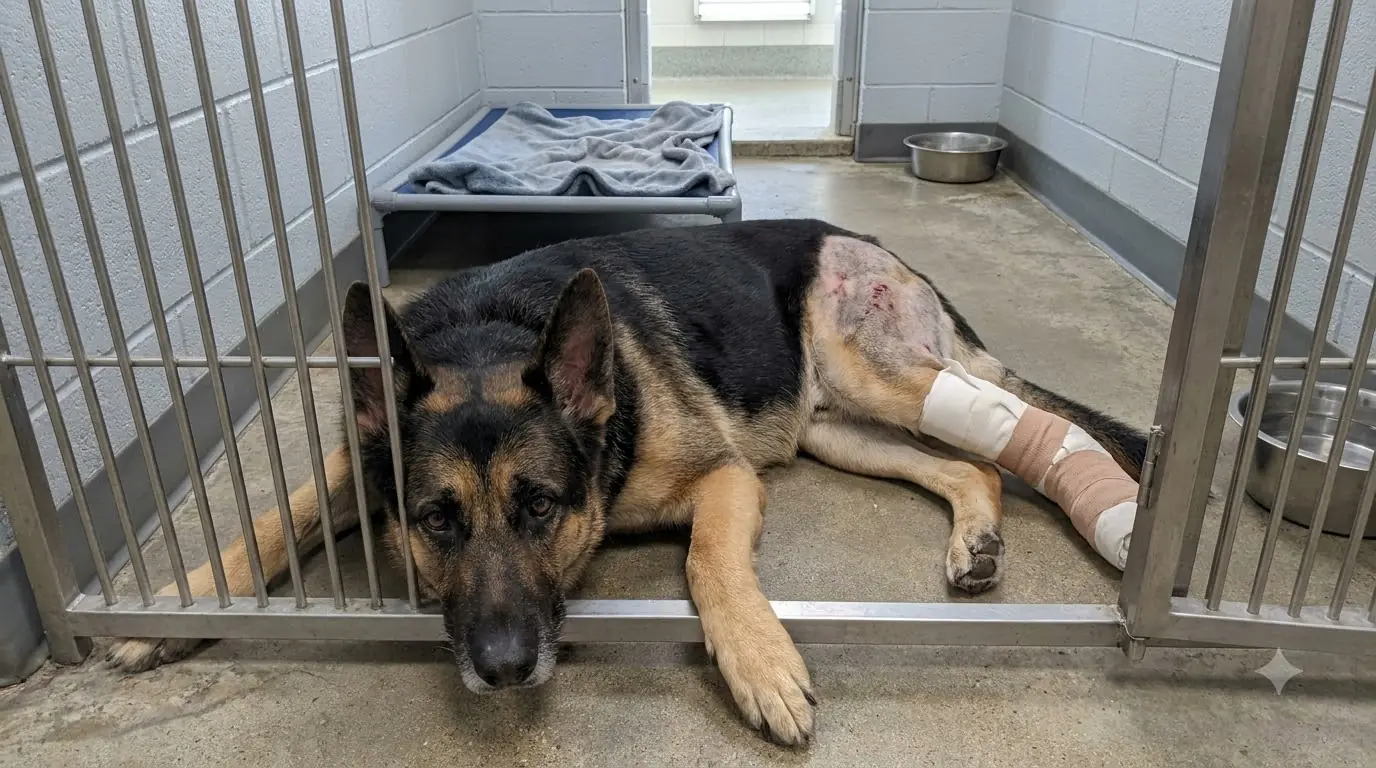
Diesel is supposed to stay on his medical bed.
After what happened at the construction site, rest is not optional.
The 7-year-old German Shepherd has a shaved area around his hip, several abrasions that are still healing, and one hind leg secured in a splint.
Staff keep his bed toward the back of the medical kennel where he can lie comfortably without unnecessary movement.
Most of the time, Diesel stays there.
Then someone sits down outside his kennel.
His head rises.
His ears turn forward.
And almost immediately, Diesel begins moving.
Not walking.
He cannot safely do that yet.
Instead, he plants both front paws into the bedding and pulls his chest forward.
His hindquarters follow.
The splinted leg trails carefully behind him.
Diesel stops.
Rests.
Then pulls again.
By the time he reaches the kennel gate, he has crossed only a few feet.
But his body has worked for every inch.
Then Diesel does something surprisingly quiet.
He doesn't try to stand.
He doesn't bark.
He simply lies against the bars, pushes his muzzle toward the opening, and gives a small wag of his tail.
Diesel Came In After an Accident at a Construction Site
His injuries required emergency rescue care.
The abrasions across his body were visible immediately, particularly around the shaved area near his hip where the medical team needed access for evaluation and treatment.
The hind leg was the bigger mobility problem.
It required stabilization.
From that point forward, keeping Diesel from putting unnecessary strain on the injured area became part of his recovery.
Staff could treat the wounds they could see.
They could protect the injured limb.
They could manage pain and follow the veterinary plan for restricted activity.
What they could not do was explain to Diesel why suddenly moving toward someone had become something he was not supposed to do.
At First, He Barely Tried to Leave the Bed
During the earliest part of his recovery, Diesel spent long periods resting.
That was exactly what his body needed.
His movements were limited.