When Eli and Noah first arrived at the shelter, employees noticed their relationship before they knew much about either dog individually. The two young brown-and-black mixed-breed brothers entered the building together, walked into the same kennel together, and for most of their first afternoon remained so close that their shoulders frequently touched. They were similar enough in size and appearance that strangers sometimes had difficulty telling them apart, but staff quickly learned one obvious difference: Noah, the slightly smaller brother, had an injury around one eye that remained swollen and irritated when he arrived.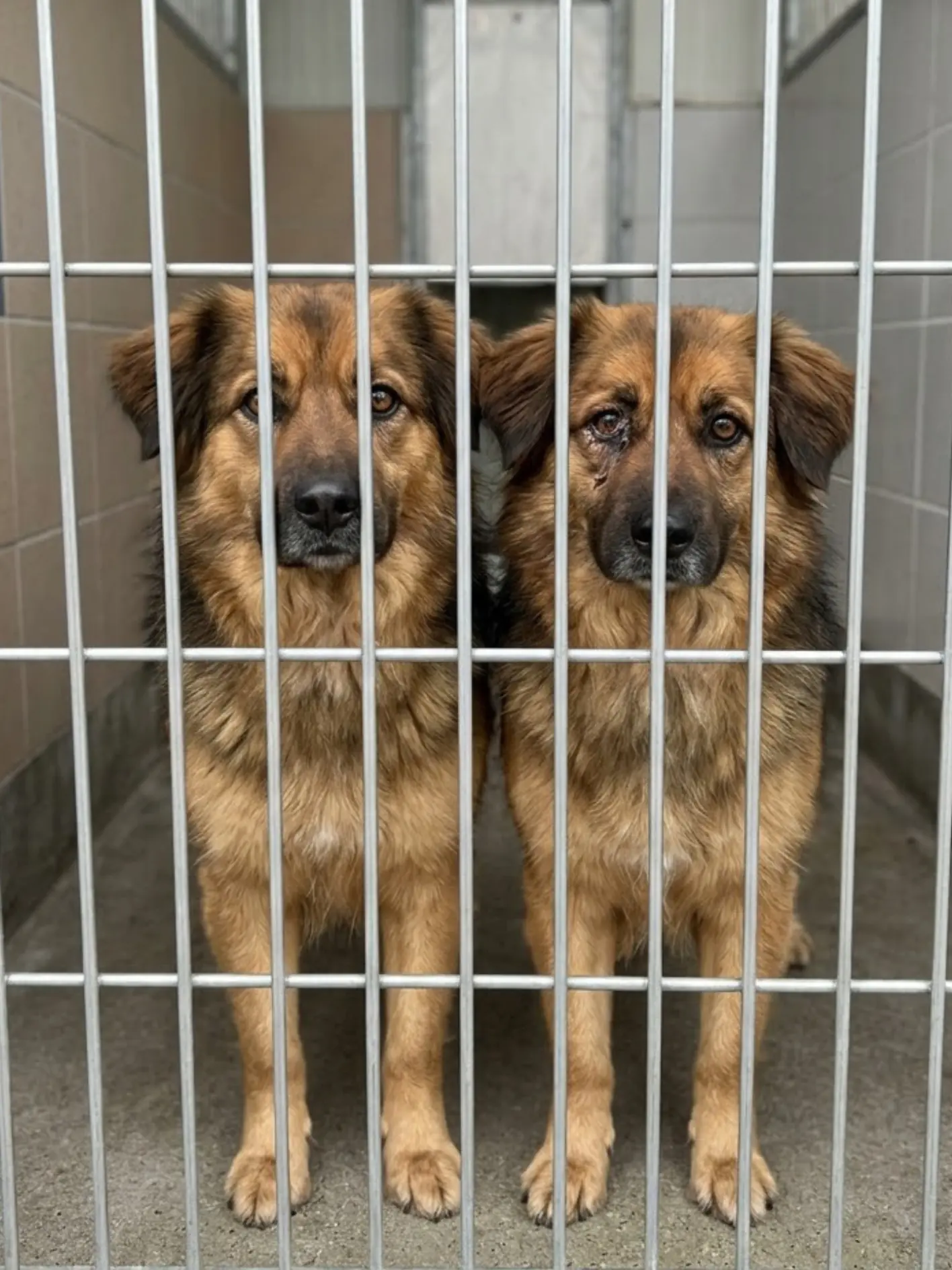
Nobody at the shelter could say exactly how the injury happened. The dogs had been found near an industrial road after a delivery driver reported seeing them sheltering beside a closed repair shop early in the morning. They had no identification that immediately connected them with an owner, and although both appeared accustomed to human contact, no one came forward during the available effort to locate a family. Noah’s eye received attention after intake, but staff were careful not to offer guarantees about the long-term outcome before appropriate follow-up could determine exactly what he would need.
The injury attracted sympathy almost immediately, yet employees soon realized that sympathy was not the same thing as placement. Visitors stopped at the kennel because seeing two nearly matching dogs standing together behind metal bars was difficult to ignore, and Noah’s eye made people ask questions that they might otherwise have saved for later. Many seemed touched by the brothers, but when the conversation moved from emotion to the practical responsibility of adopting two young dogs, the interest frequently changed.
At first, shelter workers were not particularly worried. Both dogs were young, manageable with familiar handlers, and physically healthy enough aside from Noah’s eye concern to continue being considered for placement. They showed no known bite history during their stay, and although both were cautious during their earliest interactions, neither behaved in a way that made staff believe finding a home would become unusually difficult. The assumption was that somebody looking for smaller-to-medium companion dogs would eventually see the advantage of taking two animals who already seemed comfortable together.
The first serious adopter arrived during their opening weekend. A woman named Rebecca had seen a photograph posted by a shelter volunteer and drove nearly an hour to meet them. She had owned dogs before, lived in a house with a fenced yard, and initially told staff that she was open to adopting both if the meeting went well. For almost forty minutes, everything suggested that the brothers might be leaving much sooner than expected.
Eli approached Rebecca first. He remained cautious for several minutes, then accepted treats and gradually began following her around the exercise area. Noah took longer, staying closer to the employee who had brought him outside, but eventually he also moved forward and accepted food from Rebecca’s hand. What interested her most was the way the brothers repeatedly checked where the other was whenever one wandered several feet away.
Rebecca asked whether they were considered a bonded pair. Staff answered carefully because that label can carry more certainty than a short shelter stay actually provides. Eli and Noah clearly preferred proximity and had arrived together, but employees could not responsibly claim that permanent separation would necessarily cause either dog severe distress. If a home capable of taking both appeared, keeping them together seemed worthwhile; if their only chance of surviving the shelter ultimately required separate appropriate placements, staff would have to consider that possibility too.
The conversation changed when Rebecca asked about Noah’s eye. Employees explained that he had received initial attention and remained comfortable enough to participate in normal shelter routines, but additional veterinary care could still be required. They could not promise that treatment would be simple, inexpensive, or finished immediately after adoption. Rebecca became quieter as she calculated what two sets of routine expenses plus a potentially more complicated medical issue might mean.
She eventually decided she could responsibly support one dog but was not confident she could take on two, particularly with uncertain veterinary costs. Rebecca asked whether she could adopt Eli alone. Staff discussed it with her and did not dismiss the idea, but she became uncomfortable as soon as Noah was taken several feet away during a brief trial separation. Eli remained focused on where his brother had gone and repeatedly pulled toward the doorway until Noah returned.
That behavior did not prove the dogs could never live apart, but Rebecca no longer felt comfortable choosing one. She left without either dog and told staff she hoped somebody better equipped would come soon. No one blamed her for the decision because taking on more responsibility than a household can realistically sustain is not a successful rescue, even if the decision begins with good intentions.
Eli and Noah returned to their kennel together.
During the following week, several more visitors stopped. One couple loved the brothers but already had three dogs at home and did not believe adding two more would be manageable. A family with children spent time with both dogs but became concerned about the cost of caring for two animals at once. Another person wanted Noah because she felt sorry for the injured eye but admitted that she had no interest in Eli.
Staff continued trying to balance the emotional reality of keeping the brothers together with the practical reality that asking someone to adopt two dogs naturally narrowed the pool of available homes. Two dogs meant two annual examinations, two sets of vaccinations, twice the food, two training plans, and potentially different behavioral needs once they settled. The fact that they appeared closely attached made people care about them, but it also made some households afraid that saying yes to one meant being morally obligated to take both.
A volunteer named Danielle began spending more time with the brothers outside the kennel. She discovered that Eli was the more adventurous of the two and typically moved first into unfamiliar areas, while Noah tended to watch him before following. Once both had spent several minutes outside, however, the difference became less obvious. They explored independently, responded to familiar voices, and could settle near people without needing to remain physically touching every second.
Danielle began documenting those moments because she wanted potential adopters to understand that Eli and Noah were brothers, not a single personality divided between two bodies. Eli liked carrying soft toys around the exercise yard and frequently brought one back toward whoever was sitting nearby. Noah preferred investigating smells along the fence and showed a quieter curiosity, particularly once he became comfortable with a person.
The eye injury also became only one part of Noah’s identity rather than the first thing volunteers mentioned. He needed appropriate follow-up, but he still walked, ate, played, and interacted. Danielle worried that repeatedly presenting him as “the injured brother” would cause people either to avoid him because they feared medical costs or to pursue him solely because they felt pity, neither of which was likely to produce the thoughtful long-term placement he needed.
New photographs were posted showing both dogs outdoors. One showed Eli carrying a rope toy while Noah stood nearby. Another showed the brothers sitting several feet apart rather than pressed together, something that helped challenge the idea that they could never function independently. The posts generated another round of attention, and shelter volunteers began receiving messages from people across the region.
The familiar problem returned almost immediately.
Everyone wanted to know whether they were safe.
Very few people could actually provide somewhere for them to go.
A social media post can create the illusion that a shelter animal has dozens of options. When people see hundreds of comments, they assume applications must already be waiting. When rescue organizations are tagged repeatedly, people imagine that one of them surely has enough space. Someone who could genuinely foster may decide there is no point calling because the dogs appear surrounded by potential help.
Inside the shelter, the record was much simpler.
No adopter.
No foster.
No confirmed rescue.
Eli and Noah remained in the same kennel.
Meanwhile, the building was beginning to fill. Several stray dogs arrived during one weekend, some of whom needed time for owners to locate them. Two large dogs entered after an emergency eviction, while another kennel had to be temporarily kept empty for medical isolation. Space that had appeared manageable when the brothers arrived became increasingly difficult to find.
This did not mean the shelter suddenly wanted Eli and Noah gone for reasons related to their behavior. Their daily care continued. Noah’s eye remained part of the medical plan, Danielle continued taking them outside, and staff still answered every legitimate adoption inquiry. The problem was that incoming animals did not stop because the brothers had not yet found homes.
Animal shelters function through movement. Dogs arrive, but others must also leave through reunification, adoption, foster care, or rescue transfer. When intake exceeds those safe exits, a kennel that once represented temporary housing can gradually become a limited resource that another incoming animal also needs.
Eli and Noah occupied one of those kennels together.
The shelter contacted rescue groups before their situation became critical. A small organization specializing in shepherd-type mixes expressed interest, particularly because the brothers were young, but it did not have one foster home capable of accepting both. The coordinator asked whether the dogs could temporarily go into separate foster homes.
Employees considered it.
At that point, keeping the brothers together remained preferable but could no longer be treated as more important than keeping both alive. A rescue taking each dog into a safe foster home would provide time to evaluate whether permanent separation was manageable and could prevent the brothers from remaining trapped in a rapidly filling shelter.
The problem was that the rescue had only one available foster.
It could take Eli.
It had nowhere for Noah.
Nobody wanted the decision to become a choice between the healthier dog and the dog with the injured eye. The organization continued searching for a second foster while the shelter waited.
For two days, nothing appeared.
Then a foster volunteer named Teresa agreed to consider Noah. She had no other animals and said she was comfortable handling basic medical follow-up. For several hours, it seemed that a solution had finally formed: Eli could leave with one foster, Noah with another, and both would remain under the same rescue while permanent homes were found.
The plan collapsed the following morning.
Teresa’s apartment manager informed her that temporary foster animals were subject to the same approval process as permanent pets, and management would not approve an additional dog. Without somewhere for Noah, the rescue decided it could not take Eli alone while the shelter still had a reasonable possibility of finding a joint placement.
The opportunity disappeared.
Danielle learned what had happened during her next shift. She opened the kennel and both dogs stood immediately because they recognized her. Eli moved toward the gate first, and Noah followed. Neither had any idea that hours of phone calls, forms, and messages had almost changed where they would sleep that night.
To the dogs, nothing had been promised.
The humans were the ones becoming increasingly aware of time.
Danielle took them outside.
They walked the same route they had followed several times before, but something small happened that afternoon that staff later remembered. A veterinary technician arrived to take Noah for another examination related to the eye. Eli remained behind in the exercise area with Danielle.
The separation lasted less than half an hour.
Eli did not panic, injure himself, or display behavior suggesting that separation was impossible, but he remained unusually focused on the doorway through which Noah had disappeared. He ignored the rope toy he usually carried and spent much of the time looking toward the building.
When Noah returned, Eli immediately moved toward him.
Noah approached as well.
Then, within minutes, both returned to their usual behavior.
Danielle wrote the observation down because it seemed relevant without trying to turn it into a sentimental story. The brothers clearly noticed each other’s absence. Whether that meant they should spend their entire lives together could not be determined from one brief event, but keeping them together remained the preferred outcome if somebody could realistically manage both.
Unfortunately, preference was becoming a luxury.
Another week passed.
The shelter population increased again.
Staff were informed that several dogs with longer stays needed immediate placement. Eli and Noah were among them.
The newest photographs were reposted with stronger language. This time, people were told directly that the brothers needed an adopter, foster, or rescue quickly because the shelter’s available space had become critical. Comments multiplied within hours.
Some people offered money for Noah’s veterinary care.
Others promised to cover both adoption fees.
A woman offered transportation if a rescue hundreds of miles away could accept them.
Those offers were meaningful and could help once a placement existed.
They still did not create one.
A dog cannot sleep in a donation pledge.
Transportation is useful only when there is somewhere to transport the animal.
An adoption fee being paid does not help if nobody is prepared to become the adopter.
The brothers still needed physical space.
A couple named Mark and Susan arrived after seeing the urgent post and seemed better prepared than most previous visitors. They owned their home, had no other pets, and had cared for two dogs simultaneously before. They asked practical questions about feeding separately, individual training, Noah’s eye, and whether the dogs appeared capable of functioning independently for portions of the day.
The meeting went well.
Eli approached quickly.
Noah followed after several minutes.
For nearly an hour, shelter workers quietly hoped this might finally be the answer.
Then Susan mentioned an upcoming move.
The couple had accepted jobs in another state and would be relocating within six weeks. They expected to stay temporarily with Susan’s sister while searching for housing, and her sister’s lease allowed only one dog.
Mark suggested they could adopt the brothers now and work out the housing problem later.
Staff advised against it.
Six weeks of uncertainty after a major move could easily place Eli and Noah back into another shelter in a state where nobody knew their history. Urgency did not make unstable housing stable.
The couple left.
The brothers remained.
As shelter capacity continued tightening, employees faced a discussion they had hoped to avoid. If an appropriate joint placement could not be found, they would begin actively considering separate homes rather than waiting indefinitely for somebody able to take both.
Danielle struggled with the idea but understood the reasoning.
Keeping siblings together is meaningful when the relationship is beneficial and a suitable home exists. It becomes harder to defend if insisting on a pair placement leaves both animals without any safe exit at all. The priority had to become survival and stability, even if the eventual outcome was two good homes instead of one.
Separate profiles were prepared while the joint profile remained active.
Interest increased slightly.
One person asked about Eli.
Another asked about Noah specifically after seeing his medical information.
Neither commitment reached the point of confirmed placement.
Then the shelter received another group of incoming animals.
The brothers’ status changed again.
They were now scheduled for euthanasia the following day if no adopter, foster, or rescue placement became available.
Tomorrow.
The word transformed a difficult search into a final one.
Danielle saw the update in the morning before entering their kennel. Eli and Noah greeted her much as they always did. They did not know that people outside the building were suddenly talking about hours instead of weeks. Dogs do not understand kennel capacity, rescue emails, or euthanasia schedules.
They understand the person opening the gate.
They understand food.
They understand routine.
They understand, in whatever canine way applies, that another familiar dog is standing beside them.
Danielle attached both leashes and took them outside.
She refused to turn the walk into a farewell. There was still time, and even if there had not been, the brothers would not understand why she was suddenly treating an ordinary outing like a ceremony.
Eli investigated the yard first.
Noah followed.
They walked for several minutes and eventually settled near a shaded section of the fence. Danielle sat on the ground while the brothers remained nearby.
Eli eventually lay down.
Noah stood beside him before lowering himself too.
Nothing about the moment was dramatic.
That made it worse.
The dogs were behaving exactly as they had the week before, while Danielle knew tomorrow might not exist for them unless somebody created a place where they could go.
She stayed outside longer than usual.
Then she returned them to the kennel.
The bars closed again.
Their final urgent post went online.
The message was direct: Eli and Noah had until tomorrow. One brother still needed follow-up for an injured eye. The shelter would consider adoption, foster, or qualified rescue placement, together if possible, separately if necessary.
People were asked not to assume the dogs were safe simply because the post had been shared hundreds of times.
The response was immediate.
One person wanted Eli only but could not arrive until two days later.
Another offered to take Noah but lived in a household with several large dogs and had no safe method of gradual introduction.
A woman offered to foster both in her garage.
That was not considered appropriate housing.
A man said he could take the pair immediately but planned to keep them outdoors permanently on a rural property without secure fencing.
Staff declined.
A deadline does not turn an unsafe placement into a rescue.
By late afternoon, there were more comments under the brothers’ photograph than at any point during their stay.
There was still no confirmed exit.
Then one of Danielle’s earlier videos reached a local dog boarding business owned by a man named Thomas Reed.
Thomas was 56 and had spent more than twenty years running a small boarding and training facility outside town. His business was not a rescue, and he had learned years earlier not to volunteer space casually because one temporary dog could easily become a permanent responsibility. He already worked with several regional rescues by providing occasional discounted boarding during emergencies.
What made Eli and Noah’s situation different was that one quarantine room in an older section of the facility had become available that morning after a rescue dog was transferred to foster care.
Thomas watched the video twice.
He was not prepared to adopt the brothers.
He could potentially give them time.
He called a rescue organization he had worked with before and asked whether it was following their case.
It was.
The same rescue had previously considered Eli and Noah but had been unable to find fosters.
Thomas proposed something different.
If the rescue assumed responsibility, he could provide short-term boarding for both dogs in the same room while foster or adoption placement was arranged. He could not promise months, but he could give them several weeks and maintain them together during the transition.
The rescue coordinator immediately contacted the shelter.
For the first time in days, the conversation was not about another possible adopter who needed to check with a landlord or think overnight. An established organization was discussing responsibility with a business it already knew.
There were still details to verify.
Noah’s eye care needed to continue.
Transportation had to be arranged.