Every afternoon at exactly 4:17, the windows on the quiet Cedar Rapids street began to tremble.
The sound always arrived first.
A deep mechanical thunder rolled somewhere beyond the corner, bounced between the modest two-story houses, rattled porch railings, and sent small dogs barking behind fences.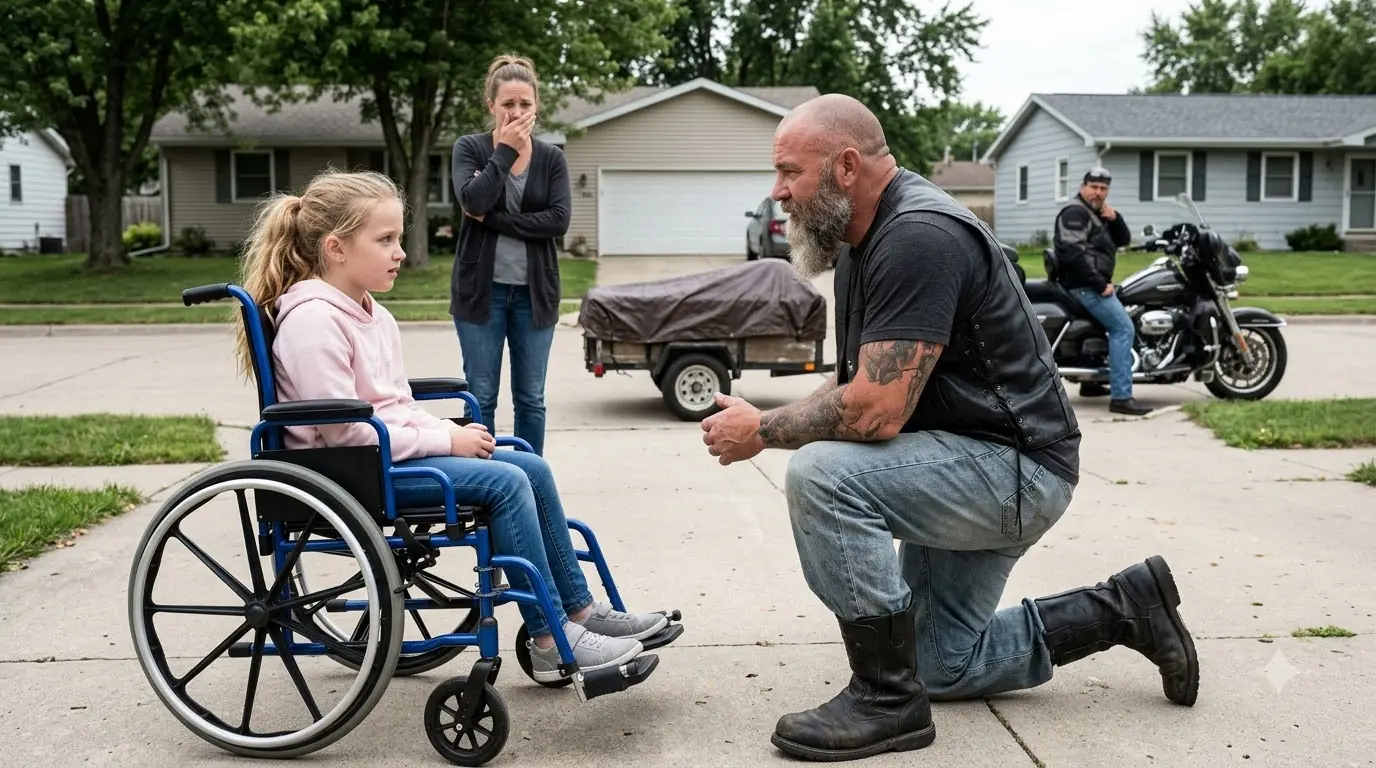
Then the motorcycle appeared.
Black.
Heavy.
Loud enough that conversations stopped when it passed.
And on it sat the man everyone on the street had already decided to fear.
He was enormous.
Well over six feet tall, with shoulders that seemed too broad for the sleeveless black leather vest he wore almost every day. His head was shaved close. A thick salt-and-pepper beard covered his jaw. Tattoos wrapped both arms from shoulders to wrists, disappearing beneath black leather guards around his hands.
He wore steel rings.
Heavy riding boots.
Dark jeans.
And an expression that rarely changed.
No smile.
No wave.
No acknowledgment when neighbors stared.
He simply rode down the street every afternoon at 4:17, turned at the dead end, and disappeared again.
By the third week, the neighborhood had invented a dozen explanations.
One woman insisted he was checking houses for a burglary crew.
Another said he belonged to a dangerous motorcycle gang.
A retired teacher claimed she had seen him meeting “suspicious people” behind a diner, though nobody could agree what made the people suspicious beyond the fact that they also owned motorcycles.
A father two doors down started calling his children inside when the engine became audible.
Someone posted the biker’s photograph in a neighborhood group.
Anyone know who this is?
Twenty-seven comments appeared in an hour.
Nobody actually knew.
That did not stop anyone from answering.
The mother living in the small beige house near the middle of the street read every comment.
Then she closed the neighborhood page and tried not to look through the curtains the next afternoon.
She lasted until 4:16.
Her eight-year-old daughter was already at the front window.
The little girl sat in a blue manual wheelchair, both hands resting on the sill while she stared toward the corner.
Long blonde hair fell in a loose ponytail down the back of her pale pink sweatshirt.
Her mother stopped behind her.
“You waiting for him?”
The girl did not turn.
“He always comes now.”
“I know.”
“Why?”
“I don’t know.”
The girl pressed one palm against the glass.
A second later, the distant rumble arrived.
Her face brightened.
The mother’s stomach tightened.
The motorcycle appeared.
The biker passed slowly enough for the girl to see him clearly.
For the first time, the mother noticed something strange.
As he reached their house, he turned his head.
Not toward the mother.
Toward the front window.
Toward the little girl.
The mother stepped forward instinctively.
The biker looked away immediately.
His motorcycle continued toward the end of the street.
The girl whispered:
“He saw me.”
The mother closed the curtain.
“That doesn’t mean anything.”
“But he did.”
“Yes.”
“Do you think he knows me?”
“No.”
The answer came too quickly.
The girl looked back.
Her mother forced a smile.
“No, sweetheart.”
“You’ve never met him.”
“How would he know you?”
The girl seemed to accept that.
Her mother did not.
Because she had seen something in the biker’s face.
Not menace.
Something almost worse because it made less sense.
Recognition.
That night, after her daughter went to sleep, the mother sat at the kitchen table staring at a photograph she kept inside a drawer.
Three people.
Herself.
Her husband.
Their daughter, then five years old, standing between them with her father’s hands beneath her arms.
The little girl had been standing in the photograph.
That was before the illness.
Before the hospital.
Before the words acute spinal inflammation.
Before the wheelchair.
Before months of therapy taught all three of them that hope and acceptance were not opposites.
Before her husband learned how to lift a folding chair into the back of an old station wagon without waking his daughter.
Before he built a plywood ramp himself because insurance refused to cover the one they needed.
Before their house filled with grab bars, medical equipment, therapy bands, and the stubborn laughter of a little girl determined to keep doing everything people assumed she could no longer do.
And before the morning, eighteen months earlier, when the mother received a telephone call telling her that her husband would never come home again.
He had not died on a motorcycle.
That was what strangers later assumed.