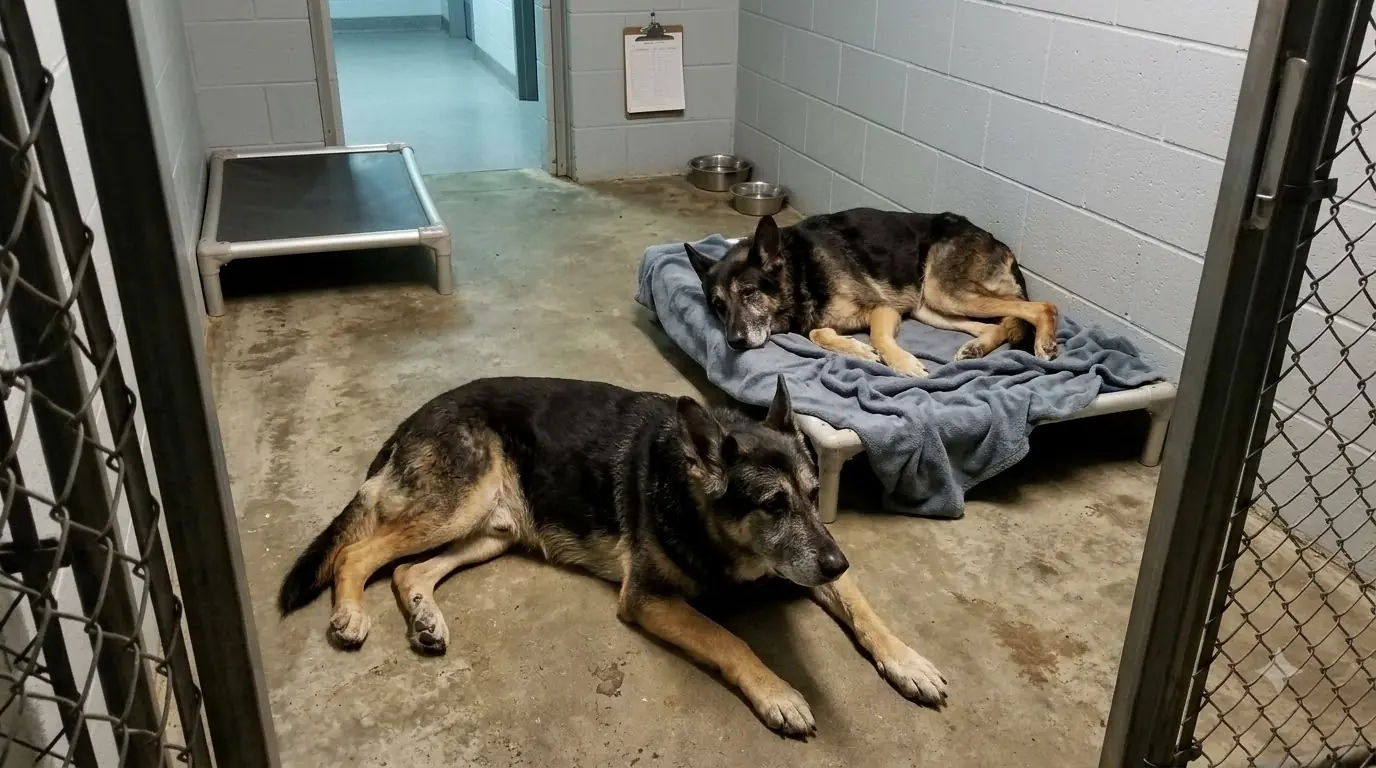
Long after the shelter hallway becomes quiet, Rex gets up.
The senior German Shepherd has an orthopedic bed of his own. His body is no longer young, and after years of work followed by years of retirement, rising from a comfortable bed takes noticeably more effort than it once did.
Still, the overnight camera keeps recording the same routine.
Rex pushes himself onto his feet and walks across the shared kennel toward Duke.
He pauses beside the other German Shepherd’s bed.
Duke does not get up to meet him. A progressive neurologic disease has left his hind legs so weak that standing is now nearly impossible without assistance.
Rex remains there for a while.
Then he lowers himself onto the floor directly in front of Duke’s bed, positioning his body across the open side of it.
His head stays up for a time.
And almost always, it is pointed toward the kennel door.
By morning, staff often find Duke still resting behind him.
For two dogs who spent years serving in the same K-9 unit, it is a small behavior that is impossible not to notice.
Especially because nobody taught Rex to do it here.
They Had Spent Years Working Side by Side
Rex and Duke had a life together long before they entered rescue.
Both German Shepherds had served for years in the same K-9 unit before eventually retiring.
After their working careers ended, they remained with their former handler.
The equipment and assignments were gone, but the familiar relationship between the dogs remained.
Then their handler died.
Suddenly, two elderly working dogs who had spent much of their lives within a predictable structure needed somewhere else to go.
Rescue intake can be disorienting for almost any senior dog. The environment is unfamiliar. Floors smell different. Doors open at different times. New people provide meals, medications and walks.
For Rex and Duke, staff tried to preserve one familiar part of their lives.
They kept the dogs together.
That decision became even more important once Duke’s medical condition was fully evaluated.
Duke Could Barely Support His Hindquarters
Duke’s problem was not simply the ordinary stiffness expected in an aging large-breed dog.
His neurologic disease had progressively affected his rear limbs.
His front legs could still do much of their job, but the communication and control needed for his hindquarters to support him had deteriorated severely.
When Duke attempted to rise, his front end might come up while his rear legs failed to follow.
A paw could turn or drag instead of planting normally.
Sometimes he could shift his position using mostly his front legs. Standing and walking, however, required much more support.
That made Duke a high-needs senior dog.
Staff had to think about far more than whether he could take a few steps.
They needed to protect his skin from dragging and prolonged pressure. They needed to keep his bedding clean and dry, monitor his ability to eliminate comfortably, and make sure he could change position often enough.
When movement was appropriate, a support harness could help stabilize his hindquarters.
And because progressive neurologic disease may not have a curative treatment, his veterinary plan had to remain grounded in what could realistically be achieved.
Comfort.
Safety.
Mobility assistance.
And careful monitoring of his quality of life.
Rex Was Aging, Too
It would have been easy to make Duke the center of every decision.
His disability was the most obvious.
But Rex was a senior dog as well.
He moved more slowly than he once had. After resting for several hours, his first steps could be stiff. Hard flooring was not ideal for his aging joints, which was one reason staff had provided him with an orthopedic bed.
During the day, Rex used it.
At night, however, something kept changing.
Staff reviewing the kennel camera noticed Rex leaving the bed.
At first, there was nothing particularly remarkable about that. Dogs reposition themselves throughout the night.
Then they noticed where he went.
Duke’s bed.
Again.
And again.
He Wasn't Climbing Into Duke's Bed
Rex did not appear to be trying to take Duke’s comfortable sleeping spot.
He did not crowd the disabled Shepherd or repeatedly wake him.
Instead, Rex usually approached the bed and stood beside it briefly.
Sometimes Duke remained completely settled.
Sometimes he lifted his head or shifted his front paws.
Rex then moved into a position near the front of the bed and lay down.
The detail that caught staff’s attention was his orientation.
His body was between Duke and the open side of the kennel.
His head faced the door.
It resembled a posture that would be familiar in a dog accustomed to years of alertness and structured work: resting while remaining oriented toward the direction from which activity was most likely to come.
It was tempting to call it a night watch.
But staff could not know whether Rex was consciously recreating an old working routine.
They could only describe what the cameras showed.
Every night, Rex voluntarily left a softer place.
He moved beside Duke.
And he repeatedly rested facing the entrance.
The Cameras Showed What Staff Couldn't See During the Day
During normal shelter hours, the kennel was rarely completely quiet.
People walked past.
Doors opened.
Meals arrived.
Duke needed assistance.
Rex went outside and interacted with staff.
Overnight footage offered something different.
There was little happening for Rex to respond to.
That made the consistency of his behavior more noticeable.
On some nights, he remained on his own bed longer.
On others, he moved to Duke relatively early.
He did not stand rigidly for hours. He did not remain constantly alert. Like any elderly dog, Rex eventually rested his head and slept.
But his chosen sleeping position repeatedly brought him back to the same place.
In front of Duke.
Facing outward.
Staff Did Not Want Rex Sleeping on Hard Concrete
The behavior might have been moving, but there was a practical problem.
Rex needed supportive bedding too.
An elderly German Shepherd repeatedly choosing the floor was not ideal, particularly if arthritis or other orthopedic changes were already making movement uncomfortable.
So staff adjusted the kennel rather than trying to stop the behavior.
A padded resting surface was placed near the front of Duke’s bed, where Rex tended to settle.
The goal was simple: if Rex continued choosing that location, he should not have to sacrifice his own physical comfort to do it.
Duke’s area remained heavily padded and easy for staff to access.
Traction was added where needed so Rex could rise more safely and so Duke would have a more stable surface during assisted movement.
The layout also had to leave enough room for caregivers to reach Duke with a mobility harness without stepping over Rex or forcing either dog into an awkward position.
They were not trying to preserve a sentimental scene.
They were adapting the kennel around behavior the dogs were already showing.
Duke's Care Became More Hands-On
As Duke’s rear-leg function declined, ordinary daily tasks required increasing assistance.
Getting outside could no longer be treated like a normal leash walk.
Staff could support his hindquarters with an appropriate harness while allowing his front legs to contribute as much as safely possible.
His paws and nails needed monitoring because abnormal dragging can cause wear and injury.
His skin needed regular checks.
His bedding needed frequent attention.
Staff also watched for subtler changes.
A dog with serious neurologic impairment may still be comfortable and interested in food, affection and his surroundings. Mobility loss alone does not automatically answer every quality-of-life question.
But changes in appetite, persistent distress, inability to rest comfortably, repeated injuries, loss of hygiene, uncontrolled pain or increasing difficulty performing basic functions all matter.
For Duke, those assessments would have to continue.
There was no promise that rehabilitation would make his hind legs work normally again.
His care had to follow the disease he actually had, not the ending people wished for him.
Rex Could Not Become Duke's Caregiver
There was another boundary staff had to protect.
Rex could remain beside Duke.
He could sleep near him.
He could investigate when Duke shifted.
But he could not be expected to support Duke physically.
If Duke tried to rise, staff needed to provide the actual assistance.
If Duke required repositioning, medication, hygiene care or veterinary attention, those were human responsibilities.
This mattered for Rex’s welfare as much as Duke’s.
The senior Shepherd had already spent years working.
Retirement and old age meant he deserved comfort too.
So staff continued giving Rex time away from the medical kennel, appropriate gentle activity, individual attention and opportunities to rest without interruption.
Interestingly, when he was returned to the shared space, he still often chose Duke’s side.
Losing Their Handler Had Already Changed Enough
No one could know precisely how Rex and Duke understood the loss of the person who had cared for them.
Dogs can respond to major changes in household members and routine, but assigning a complex human understanding of death to their behavior would go beyond what staff could observe.
What was obvious was that their environment had changed dramatically.
Their longtime handler was gone.
Their home was gone.
Their daily schedule was different.
The people caring for them were different.
And Duke’s physical abilities were continuing to decline.
Keeping the pair together preserved something stable amid all of those changes.
They still ate within sight of each other.
They still rested in the same room.
Rex could still hear Duke shifting on his bed.
Duke could still wake with Rex nearby.
For senior dogs facing that much disruption, familiarity mattered.
Their Future Could Not Be Built Around a Perfect Recovery
Duke’s condition made planning complicated.
Any long-term foster or rescue placement would need to be prepared for a large dog with severe hind-end disability.
That meant accessible flooring, mobility assistance, appropriate bedding and the physical ability to help Duke safely.
It also meant understanding that his disease could progress.
At some point, his care might become primarily palliative.
If that happened, the question would not be how aggressively people could keep treating him.
It would be whether Duke remained comfortable enough to enjoy the things still available to him.
Food.
Fresh air.
Human contact.
Rest without distress.
And the presence of a familiar dog.
Rex would need senior care of his own, including joint support, comfortable surfaces and monitoring as his mobility changed.
Their needs were different.
But after so many years together, staff also understood why preserving their relationship was worth considering whenever medically possible.
The Night Watch Looks Different Now
Years ago, Rex and Duke were working dogs.
Their bodies were stronger then.
There were handlers, commands, vehicles, equipment and assignments. Alertness had a purpose attached to it.
None of that exists inside their quiet rescue kennel.
Duke cannot get up and work beside Rex anymore.
Some nights, he can barely reposition his own hindquarters.
Rex cannot move the way he once did either.
Now, when the hallway grows quiet, the senior Shepherd rises slowly from his orthopedic bed.
He crosses only a few feet.
He stops beside Duke.
Then he lowers himself onto the padded area staff placed in the spot he kept choosing for himself.
Duke remains behind him on his bed.
Rex faces the door.
Eventually, his head lowers and he sleeps too.
Nobody at the rescue can say whether Rex believes he is guarding his old partner. Nobody can know whether the posture means to him what it once meant during their years of K-9 work.
They do not need to.
The camera records something much simpler every night.
Duke can no longer take his place beside Rex.
So Rex keeps taking his place beside Duke.