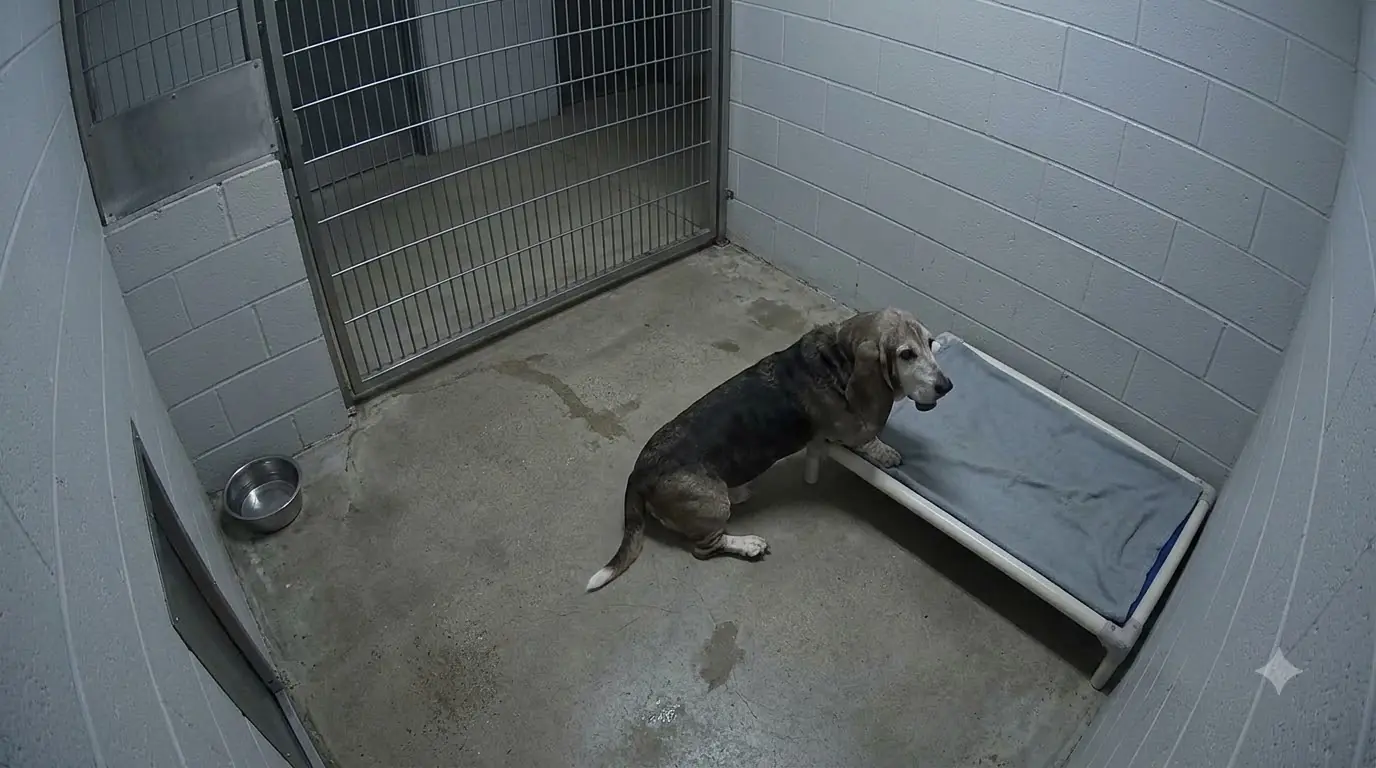
The cot was only a few inches off the floor.
For most dogs, it would not have been much of a climb.
For the senior Basset Hound, it had become something else entirely.
Every evening, staff watched her make the same attempt.
She would approach the raised cot slowly, her long body moving close to the ground. Her front legs still carried her with reasonable control, but her hindquarters lagged behind. Both rear legs were weak, and the way she walked made her abdomen seem almost to skim the kennel floor.
When she reached the cot, she stopped.
Then she placed both front paws on top of it.
Her shoulders came up.
Her chest lifted.
For a moment, it looked as though the rest of her body might follow.
She pushed.
Her hind feet tried to gain enough traction to drive her forward.
Nothing happened.
She paused.
Then tried again.
The front half of her body rose higher.
The rear half stayed down.
After several efforts, her back legs began to slip.
Eventually, she gave up.
But she did not walk away.
Instead, she lowered herself onto the floor directly beside the cot.
Her body stayed on the hard surface.
Her head did not.
She rested her chin on the edge of the raised bed and closed her eyes.
The mattress was close enough for her face.
Not close enough for the rest of her.
At first, staff assumed she simply needed more time to adjust to the kennel.
Then they watched her try again the next night.
And the next.
The cot was not unfamiliar.
She knew exactly where she wanted to sleep.
Her body just could not get there.
Her Shape Made the Problem Look Smaller Than It Was
Basset Hounds are naturally low to the ground.
Their long backs, short legs, heavy bodies, and loose skin can make changes in mobility difficult to recognize from a distance.
A dog who already moves close to the floor can appear merely slow when the real problem is more serious.
With this senior, the weakness behind her was unmistakable once staff watched her carefully.
Her hind stride was shortened.
Her rear feet did not always land with the same confidence as the front.
She had trouble generating enough force to lift the back half of her body.
Turning took longer.
Standing after rest required effort.
And when she walked, her abdomen hung so close to the ground that staff worried about skin irritation if she began dragging more heavily.
The raised cot exposed the problem in the simplest possible way.
Her front end could reach it.
Her back end could not.
The Medical Team Looked Beyond Ordinary Senior Stiffness
Age alone was not a diagnosis.
The rescue did not assume she was simply old and therefore expected to struggle.
Senior dogs can develop arthritis.
They can lose muscle.
They can experience orthopedic pain.
They can also develop neurologic disease that changes strength, coordination, and awareness of where the limbs are positioned.
Her long spinal anatomy made a neurologic evaluation especially important.
The veterinary team observed her gait.
They examined the spine for discomfort.
They assessed joint range of motion.
They checked paw placement and proprioceptive responses.
Reflexes were evaluated.
Muscle tone and symmetry were noted.
The pattern supported chronic degenerative changes affecting her spine along with significant hind-end weakness.
The goal was not to attach the most dramatic possible label.
It was to understand what part of the problem could be managed and what limitations were likely to remain.
Her Spine Was Not Going to Become Young Again
Degenerative spinal disease does not simply disappear with rest.
Management can improve comfort and preserve function.
It can reduce pain.
It can slow the cycle of inactivity and muscle loss.
But there was no honest version of her story in which a senior Basset Hound with chronic spinal degeneration suddenly regained the hind-end strength of a young dog.
That shaped the plan.
Pain control was considered based on her examination.
Her body weight mattered greatly.
Extra weight increases strain on both joints and the spine, especially in a long-backed dog.
Muscle preservation mattered too.
Complete inactivity might protect her from falls in the short term but could worsen weakness over time.
So staff had to find the middle ground.
Enough movement to maintain function.
Not enough to exhaust or destabilize her.
The Cot Became a Daily Test She Never Needed to Take
The problem was that the dog kept trying.
No one asked her to.
She had other resting options.
Soft bedding was available on the floor.
Blankets were placed near the cot.
Yet every evening, she returned to the raised bed.
Front paws up.
Push.
Pause.
Push again.
The routine was not harmless.
Repeated failed climbing could cause her to slip.
If her hind legs collapsed sideways, her long spine could twist.
If she fell backward, she could injure herself.
The effort itself could leave her fatigued.
Staff realized that leaving the cot in place simply because it was standard kennel furniture no longer made sense.
The environment needed to change around the dog.
Not the other way around.
At First, They Lowered It
The simplest adjustment was reducing the height.
The cot was repositioned as low as safely possible.
Staff hoped the smaller step might make enough difference.
That evening, the Basset Hound approached.
Front paws up.
Push.
Her chest made it farther.
Her hindquarters still did not.
One rear foot slipped sideways.
A caregiver intervened before she could lose balance.
The dog was guided back down.
She rested.
Then, a few minutes later, she tried again.
That answered the question.
Even a low raised surface was too much right now.
They Put a Bed on the Floor
The next setup was simpler.
A thick orthopedic-style mattress was placed directly on the kennel floor.
No step.
No climbing.
No need to lift the hindquarters over an edge.
It was positioned exactly where the cot had been.
Staff expected the Basset Hound to use it immediately.
She approached.
Sniffed.
Put one front paw onto it.
Then walked past.
She returned to the cot.
The old routine began again.
That was when caregivers understood that the issue was not only softness.
Location and familiarity mattered too.
The Raised Cot Had Become Part of Her Routine
Dogs often develop specific resting preferences.
Some prefer elevated surfaces.
Some like corners.
Some want their backs against walls.
Some sleep near the kennel gate.
Some choose exactly the same spot every night.
The Basset Hound seemed to associate the cot with sleeping.
That did not mean staff should preserve an unsafe challenge.
But it did mean that simply offering a different bed in another spot was not enough.
So they changed the room more thoughtfully.
The floor-level mattress was moved directly beneath and beside the cot.
Then the raised frame was removed entirely.
The soft bed stayed in the same footprint.
The place remained familiar.
Only the obstacle disappeared.
That Night, She Still Tried to Climb
Habit can outlast the object that created it.
The Basset Hound walked to the same area.
Her front paws lifted slightly as though expecting the cot edge.
They landed on the flat mattress instead.
She paused.
Looked down.
Then stepped forward.
Her hind legs followed.
No push.
No failed climb.
No sliding backward.
She turned slowly.
Then lowered herself.
For the first time since staff had been watching the routine, her entire body rested on the bed.
It looked like the obvious solution.
But the change did not hold every night.
Some Nights She Still Chose the Floor
That was important too.
A dog with chronic spinal discomfort may prefer different surfaces at different times.
The floor can feel cooler.
A mattress can sometimes make repositioning harder if it is too soft.
On some evenings, the Basset Hound lay beside the floor bed instead.
But even then, the old posture returned.
Body on the floor.
Head on the edge.
The difference was that now the edge was only an inch or two above her.
She did not need to climb to reach it.
Staff left the choice alone.
The Original Behavior Had Already Told Them What She Needed
She wanted elevation near her head.
She wanted a familiar sleeping location.
She did not have enough hind-end power to climb.
That combination shaped the rest of her kennel setup.
A thin wedge of supportive bedding was used near her head while the body surface remained low.
Blankets were arranged so there were no thick folded edges her hind feet needed to cross.
The floor around the bed had traction.
Her route to water was clear.
The doorway did not require a tight turn.
Everything became easier.
Her Hind Legs Were Managed Like a Limited Resource
The rescue began treating her strength as something to conserve.
She could walk.
But she could not waste steps.
Bathroom trips were short.
Long, slick hallways were avoided.
A support harness could be used on weaker days.
If she paused, staff did not pull her forward.
If her rear legs began to wobble, the outing ended.
Exercise remained controlled.
The goal was to preserve movement without repeatedly pushing her into failure.
Her Belly Needed Protection Too
Because her body traveled so close to the ground, staff monitored the skin along her abdomen.
Repeated contact with rough surfaces could create irritation.
Moisture could become trapped in folds.
Long-bodied, low-set dogs can develop skin problems in areas that remain close to the floor.
Keeping bedding dry mattered.
Hygiene mattered.
Nails mattered.
Paw fur between the pads could affect traction.
Every small detail influenced whether she could move safely.
She Had Better Hours and Worse Hours
Morning stiffness could be noticeable.
After resting, standing sometimes took longer.
Later, after a few controlled movements, she might appear looser.
Then fatigue could return by evening.
Some nights she approached the bed with enough strength to step onto it easily.
Other nights, even the flat mattress seemed to require concentration.
Staff did not treat those changes as inconsistency.
Chronic spinal and joint disease often fluctuates.
The important thing was to watch the overall trend.
She Began Using a Rear Support Harness
The harness was introduced gradually.
The Basset Hound did not immediately understand why something was touching her hindquarters.
Staff paired the equipment with calm handling and food when appropriate.
No sudden lifting.
No dragging.
The harness supported only as much as necessary.
On better days, it functioned almost like a safety net.
On weaker days, caregivers provided more assistance.
This allowed her to keep using her front legs naturally while reducing the risk of her rear end collapsing.
The Raised Cot Never Came Back
Not for her.
The rescue had no reason to reintroduce an obstacle she had already shown she could not manage safely.
There was no benefit in seeing whether she could eventually “conquer” it.
Rehabilitation is not a competition with furniture.
A dog does not need to prove independence by climbing onto a bed that can simply be placed lower.
The success was not getting her back onto the cot.
The success was making the cot unnecessary.
Her Daily Life Became Quieter
Once the repeated failed climbing stopped, evenings changed.
The Basset Hound no longer spent several minutes attempting to lift her hindquarters.
She approached the floor bed.
Turned.
Lowered herself.
Sometimes her head rested fully on the mattress.
Sometimes she left it at the edge.
Her breathing settled faster.
The muscles along her back appeared less tense once she was down.
The difference was not dramatic enough for a viral video.
It was exactly the kind of improvement good care aims for.
Less struggle.
Less risk.
More rest.
Staff Began Watching How She Rose From the Bed
Getting down had never been the only issue.
Standing from a soft surface could also be difficult.
If a bed was too plush, her paws sank.
Her front legs might push while the rear feet slid.
So the team tested different firmness levels.
The best option was supportive but stable.
Enough cushion to protect joints.
Enough resistance to let her feet push against something solid.
That mattered especially in the morning.
Her First Successful Rise Without Sliding Was a Real Milestone
One morning, a caregiver opened the kennel.
The Basset Hound lifted her head.
Her front paws moved forward.
She gathered her hind legs.
Then pushed.
Her rear feet stayed underneath her.
No sideways slide.
No collapse.
She stood.
The movement was slow.
But controlled.
She took several careful steps toward the door.
That was far more important medically than whether she could ever climb onto a raised cot again.
Her World Expanded Without Getting Taller
This became the philosophy of her care.
More choices.
Not more elevation.
She could explore a quiet room.
She could walk on nonslip runners.
She could rest in several low beds.
She could sniff outside.
She could spend time with caregivers.
Nothing required stairs.
Nothing required jumping.
Nothing required her to lift a long senior body higher than her back legs could manage.
She Still Looked at Raised Beds
Occasionally, during a different room setup or supervised area, she would approach a raised cot.
Staff recognized the pattern immediately.
Front paws lifted.
Her body leaned.
Before she could make repeated attempts, caregivers redirected her to an accessible bed.
Not by pulling her away.
By making the easier option obvious.
A treat could be placed nearby.
A familiar blanket could be moved.
The dog was never punished for trying.
She simply no longer had to fail.
Her Pain Plan Was Adjusted Over Time
Senior mobility changes require reassessment.
If her walking worsened, staff did not assume it was inevitable.
Pain could increase.
Muscle weakness could progress.
A new orthopedic issue could develop.
Neurologic function could change.
The veterinary team continued to monitor her.
Medication decisions were based on her health profile, examination, and response.
The aim was always the same.
Keep her comfortable enough to move safely.
Avoid overmedicating to the point that balance or alertness became worse.
Weight Became One of the Most Important Long-Term Factors
Basset Hounds can carry excess weight easily.
For this dog, extra pounds would be especially costly.
Every bit of weight had to be moved by weak hind legs and a degenerative spine.
Her food was measured.
Treats counted.
The goal was not to make her thin.
It was to keep her lean enough that movement remained as easy as possible.
That decision would matter every day for the rest of her life.
She Started Choosing to Rest Before She Was Exhausted
Early in care, the Basset Hound sometimes continued walking until her hind legs were visibly tiring.
Later, she seemed more comfortable settling sooner.
She would sniff.
Walk a short loop.
Then return to a bed.
That change could reflect improved routine, reduced stress, or simple familiarity with the environment.
Whatever the reason, staff welcomed it.
Self-selected rest reduced the chance of collapse.
Her Personality Emerged Beyond the Mobility Problem
It would have been easy for the entire story to become about her back legs.
She was more than that.
She liked slow scent exploration.
She had strong opinions about food.
She preferred certain caregivers.
She sometimes ignored people entirely if an interesting smell was nearby.
She could be stubborn in the very Basset-like way of planting herself when she did not want to move.
Those details mattered.
A disabled senior dog still needs to be allowed a personality.
She Learned the New Bed Was Hers
Over time, the floor-level mattress became familiar.
She stopped approaching it with hesitation.
She no longer looked for the missing raised frame.
At night, she walked directly onto the bed.
Turned slowly.
Lowered herself.
Sometimes she rested fully in the middle.
Other times she still positioned her head near the edge.
The behavior that had once ended in failure became ordinary.
One Evening, Staff Found Her Halfway Off
For a moment, it looked like the old problem had returned.
Her front half was on the mattress.
Her rear half was on the floor.
But this time, she was not trying to climb.
She had simply repositioned in her sleep.
Her body was relaxed.
No trembling.
No active effort.
The difference was obvious once they looked closely.
She was choosing a strange sleeping posture.
Not failing to reach a bed.
That distinction became important.
Not Every Awkward Position Needed Fixing
Senior dogs often find surprising ways to get comfortable.
If her spine was aligned reasonably, breathing was normal, skin was protected, and she appeared relaxed, staff did not constantly move her into a “better-looking” posture.
Too much handling could disturb her more than the position itself.
Care required observation, not constant correction.
Her Mobility Still Declined Slowly
Degenerative disease remains degenerative.
Even with good management, aging continued.
Some months brought more weakness.
The rear legs fatigued faster.
Longer walks became shorter.
The support harness was needed more consistently.
Her accessible environment became even more important.
Because the rescue had already removed unnecessary obstacles, those changes could be accommodated without completely changing her life again.
She Never Needed to Lose Access to Soft Bedding
That was one of the most important lessons from the cot.
Sometimes disability is treated as though the animal must accept less comfort.
In reality, accessibility can preserve comfort.
The answer to a dog who cannot climb into a bed is not no bed.
It is a bed she can reach.
The Basset Hound still had cushioning.
Still had warmth.
Still had support.
The only thing removed was the climb.
Staff Used Ramps Only Where They Actually Helped
A ramp might seem like an obvious solution for any mobility-impaired dog.
For this senior, ramps had to be considered carefully.
A steep incline could be more difficult than a small step.
Long ramps could require more endurance than she had.
If a ramp was used, it needed traction, gentle slope, and enough width for her long body to feel stable.
But inside the kennel, the simplest solution remained best.
Keep the bed flat.
She Began Sleeping More Deeply
Without the nightly struggle, her rest appeared better.
She changed positions less often.
She sometimes slept fully on her side.
Her ears relaxed.
Her breathing became slow and regular.
The bed no longer represented a problem to solve before she could sleep.
It was simply where she slept.
That was a quiet but significant change.
Adoption Planning Had to Be Honest
A future home would need to understand her limitations.
No staircase-heavy environment.
No expectation that she could climb onto couches or human beds.
Nonslip flooring would matter.
Low thresholds would matter.
Body weight would matter.
A support harness might become part of daily care.
Her mobility could decline further.
An adopter would need to be comfortable helping a long-bodied senior dog rise, move, and reposition if necessary.
The rescue did not market her as a dog who would “bounce back.”
She was not recovering from a temporary inconvenience.
She was aging with chronic spinal disease.
Comfort Was the Goal, Not Independence at Any Cost
That distinction became central.
If she could stand alone safely, staff let her.
If she needed help, they helped.
There was no virtue in making her struggle longer just so a movement could be called independent.
The same principle applied to beds.
If she could reach one easily, good.
If she could not, the bed moved.
The environment served the dog.
She Still Rests Her Head on the Edge
Even after the cot disappeared, one part of the old routine stayed.
The Basset Hound likes having her head slightly elevated.
Many evenings, she settles with her body fully supported on the low mattress but positions her chin near the reinforced edge.
Sometimes her nose hangs just beyond it.
Sometimes one ear slides onto the floor.
The pose looks almost exactly like the end of those early failed attempts.
Except now the rest of her body is on the bed too.
That Difference Is Easy to Miss
A visitor who never saw her before might not understand.
They might simply see an old Basset Hound sleeping.
Staff see something else.
They remember the front paws planted on the raised cot.
The shoulders straining upward.
The long back stretching.
The rear feet slipping.
The pause.
The second attempt.
Then the third.
And finally the slow lowering to the floor.
Head on the mattress.
Body left behind.
She No Longer Has to Choose Between the Floor and the Bed
That is what changed.
The rescue did not strengthen her enough to climb.
They did not train her harder.
They did not wait for a dramatic recovery milestone.
They removed the barrier.
Sometimes the most meaningful rehabilitation step is not asking an old body to do more.
It is asking the environment to demand less.
On Her Hardest Days, That Matters Most
There are mornings when her hind legs feel weaker.
She may need more help standing.
Her steps are shorter.
She may tire after only a brief trip outside.
On those days, the low bed remains exactly where she expects it.
No climb.
No decision.
No failed attempt.
She can walk onto it.
Turn carefully.
Lie down.
Rest.
The Old Cot Is Gone, but Staff Still Remember It
It became the clearest visual sign of what her disability was taking away.
Not running.
Not jumping.
Something much smaller.
Getting into bed.
That is often how chronic mobility disease changes life.
The losses can look ordinary.
A doorway becomes harder.
A turn becomes slower.
A food bowl feels farther away.
A bed becomes too high.
Good care notices those ordinary losses before they turn into repeated struggle.
Recently, She Approached the Mattress at the End of the Day
The kennel row had quieted.
The Basset Hound had completed her final short trip outside.
Her hind legs looked tired.
Her belly hung low as she crossed the nonslip flooring.
A caregiver watched from nearby.
The dog reached the mattress.
Months earlier, this would have been the beginning of the nightly struggle.
Front paws up.
Push.
Slip.
Try again.
Instead, she simply stepped forward.
One front paw onto the bed.
Then the other.
Her hind feet followed without needing to lift over an edge.
She turned slowly.
Lowered her chest.
Then her hips.
The long body settled.
Her head moved toward the mattress edge.
Her chin came down.
The pose looked familiar.
But nothing was left on the floor.
Her chest was supported.
Her abdomen was supported.
Her weak hindquarters were supported.
Only her nose extended slightly beyond the bed.
She closed her eyes.
Her back legs are still weak.
Her spine is still degenerative.
She still moves close to the floor.
Some days are harder than others, and nobody expects those realities to disappear.
But every night, one thing is different.
She no longer has to place her front paws on a bed she cannot reach and keep trying until her body gives up.
The bed finally comes all the way down to her.