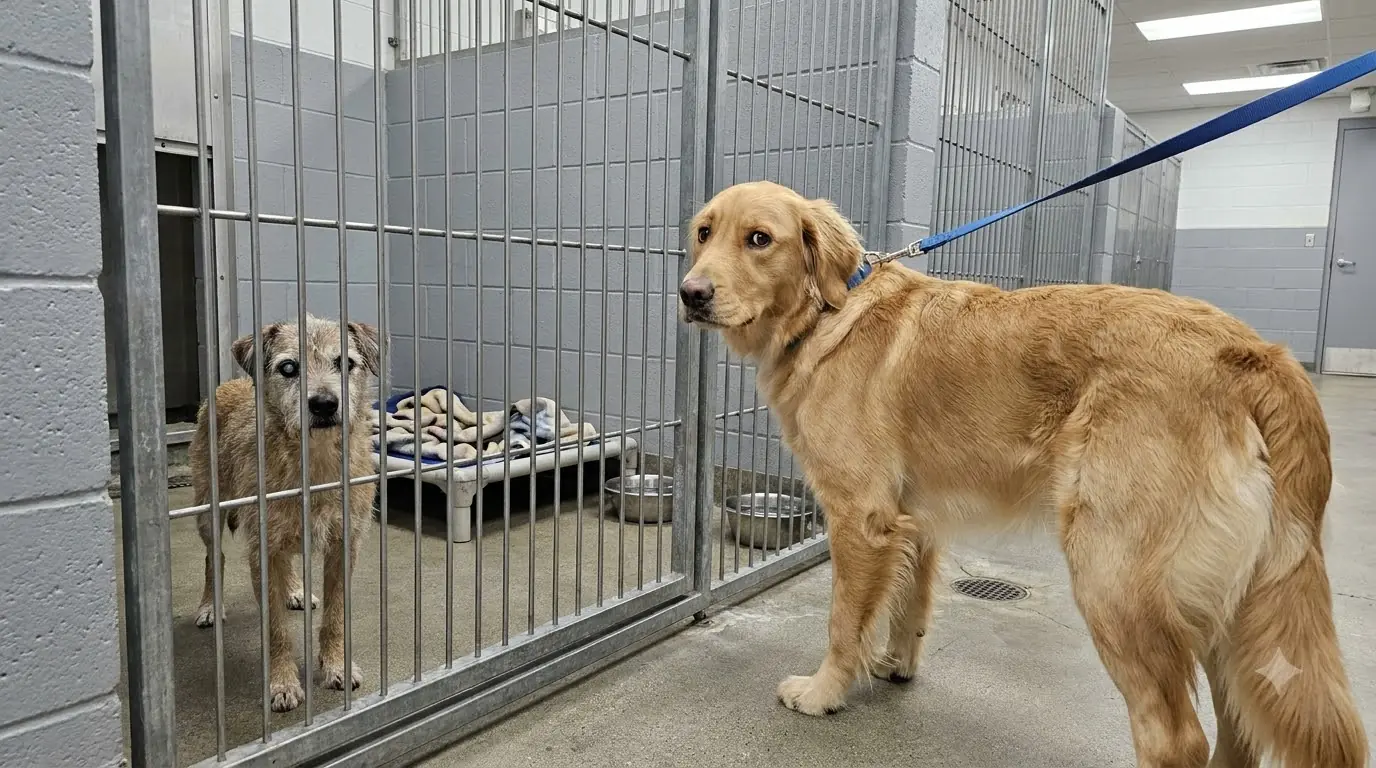
The young Golden Retriever was the dog almost everyone noticed first.
That was understandable.
She was young.
Her coat was full and golden.
Her face was open and expressive.
When visitors stopped at the shared kennel, she often stood and came forward with the easy social interest people hope to see in a shelter dog.
The smaller dog beside her looked very different.
He was a senior mixed breed with a cloudy eye, worn teeth, and several areas where his coat had never fully grown back after older skin problems.
He moved more slowly.
He did not crowd the gate.
And when people leaned toward the kennel, their questions usually began with the Golden.
“How old is she?”
“Is she friendly?”
“Can we meet her?”
“What does she know?”
Again and again, staff opened the kennel and clipped a leash to the young dog's collar.
Again and again, the senior remained behind.
The first time, staff assumed neither dog would care very much.
They had arrived together and had lived in the same home for years, but that alone did not prove they needed one another.
Dogs from the same household can be close.
They can also be perfectly comfortable apart.
The shelter needed to observe them.
So the Golden was brought into the hallway for a meet-and-greet.
She walked several steps.
Then stopped.
The handler encouraged her forward.
She looked toward the meeting room.
Then back toward the kennel.
Another few steps.
Stop.
Turn.
The leash went taut in the opposite direction.
She was not pulling toward the visitor waiting to meet her.
She was pulling back toward the senior dog.
Inside the kennel, he had moved to the gate.
He stood with his cloudy eye angled toward the hallway.
The Golden looked at him.
Then leaned backward against the leash again.
That was the first time staff wondered whether adopting only the popular dog might create a much bigger problem than anyone realized.
They Had Lived Together for Years
The two dogs had not met at the shelter.
They had shared a household long before intake.
Records and available history indicated they had lived together for years.
The exact nature of their daily relationship before the shelter was not fully known.
No one could say where each dog slept every night.
Who followed whom through the house.
Whether they ate in the same room.
Whether the Golden had always been more social.
Whether the senior had always been quieter.
The rescue did not invent those details.
What they knew was enough to pay attention.
They had come from the same home.
They arrived together.
And the separation behavior began almost immediately.
The Golden Was Easier to Market
That was the uncomfortable reality.
Young Golden Retrievers draw attention.
Breed familiarity helps.
Their appearance is widely recognizable.
People often arrive already imagining a Golden in a family room, on a hiking trail, beside children, or curled on a couch.
The young female fit many of those expectations visually.
She was attractive.
Approachable.
Social.
Her kennel card drew interest.
The senior dog's card did not.
He was smaller.
Older.
One eye was visibly cloudy.
His teeth showed years of wear.
Several areas of his coat remained thin from older dermatologic disease.
Nothing about him was dramatic enough to create immediate medical urgency.
Nothing about him was visually polished enough to make strangers stop.
So they asked about her.
And usually only her.
Staff Did Not Blame Visitors for Noticing the Golden First
The shelter understood how adoption decisions begin.
People respond to appearance.
Age.
Size.
Breed.
Energy.
Their own household needs.
That is normal.
The problem was not that visitors liked the Golden Retriever.
The problem was that almost no one was noticing what happened every time she left the senior behind.
That behavior had to become part of the placement conversation.
The Second Meet-and-Greet Looked Almost Identical
A family had asked to spend time with the Golden.
The handler entered.
Leash clipped.
The Golden stepped into the hallway.
The senior mixed breed moved toward the kennel front.
The Golden walked several yards.
Stopped.
Looked backward.
The handler waited.
She moved forward again.
Then turned so sharply that the leash crossed in front of her chest.
Her body angled back toward the kennel.
She was not panicking.
She was not screaming.
She was not throwing herself onto the floor.
The behavior was quieter.
But persistent.
Every few steps, she checked behind.
When the hallway turned and the kennel was no longer visible, she slowed even more.
The Senior Dog’s Response Was Different
He did not bark continuously.
He did not scratch frantically at the bars.
He stood.
That was significant because standing for long periods was not his usual choice.
His older body preferred rest.
But when the Golden left, he moved to the front and stayed there.
Head toward the hallway.
One cloudy eye catching the light.
The other tracking movement more clearly.
He remained until she returned.
Then his posture changed.
He sniffed her.
She sniffed him.
Both moved away from the gate.
That sequence happened often enough that staff began documenting it.
They Still Did Not Immediately Label Them a Bonded Pair
The shelter was careful with that term.
“Bonded” can affect placement dramatically.
If used too quickly, it can make both dogs harder to adopt.
If ignored when a relationship is truly important, separating animals can create avoidable stress.
So staff looked for more than one behavior.
Did they choose to sleep together?
Yes, frequently.
Did they always have to touch?
No.
Could they eat independently?
Yes.
Did the Golden enjoy individual attention?
Yes.
Could the senior rest while she was in the kennel?
Yes.
What happened during separation?
That was where the strongest pattern appeared.
The Golden Could Function Without Him — But She Kept Trying to Return
That distinction mattered.
She did not collapse in the hallway.
She accepted treats.
She could greet visitors.
She explored the meeting room.
She allowed gentle handling.
In other words, she was capable of interacting independently.
But part of her attention stayed behind.
A door opened.
She looked back.
Someone shifted near the hallway.
She oriented toward the direction of the kennel.
If the leash went slack and she was given a choice, she frequently turned toward the exit rather than farther into the room.
That was important.
She was not incapable without him.
She simply kept choosing him when the opportunity appeared.
The Senior Was More Dependent on Her Presence During Shelter Stress
His body language changed more when she left.
He became more vigilant.
Stayed closer to the gate.
Rested less deeply.
When the Golden returned, he often settled again within minutes.
That did not mean he could never live without her.
It meant the shelter environment was already difficult for him and her presence appeared to reduce some of that difficulty.
For an older dog with visual limitations and a quieter temperament, familiar social context can matter.
His Cloudy Eye Was Evaluated Separately
The rescue did not simply describe him as “half blind.”
A cloudy eye can result from several conditions.
Age-related lens changes.
Cataract.
Corneal scarring.
Other ocular disease.
The veterinary team examined him to determine whether the eye was painful and whether useful vision remained.
The important question was comfort.
If vision loss was permanent, the goal would be adaptation.
If the eye required treatment to remain comfortable, that needed attention.
His adoption profile had to reflect reality rather than appearance alone.
The Worn Teeth Told Another Story, but Not a Complete One
His teeth were heavily worn.
That could happen for different reasons.
Age.
Chewing hard objects.
Past dental disease.
Other long-term habits.
No one could know every cause just by looking.
The veterinary team evaluated his mouth for pain, fractured teeth, infection, and dental disease requiring treatment.
The dog still ate.
That was useful.
But senior dogs can eat despite significant dental discomfort.
So visible wear was not dismissed.
The Thin Fur Was Old, Not an Active Crisis
Several areas on his body had sparse coat.
The pattern was consistent with previous skin disease and incomplete regrowth.
Staff checked for active infection, parasites, inflammation, and itching.
The skin itself was relatively stable.
That mattered because appearance can make an old dog seem medically worse than he is.
He did have senior needs.
But the patchy coat was not evidence that he was currently suffering from a severe untreated skin emergency.
His biggest adoption barrier was not necessarily medical complexity.
It was simply that people were looking past him.
The Golden Was Medically Easier
Her exam was comparatively straightforward.
Young adult.
Good body condition.
Healthy coat.
No major mobility concerns.
No obvious chronic disease requiring extensive management.
That widened the gap in adopter interest even more.
One dog looked easy.
The other looked complicated.
But their behavior kept making the shelter question whether they should be considered separately.
Staff Started Bringing the Senior Into Meet-and-Greets Too
Not immediately beside the Golden every time.
They wanted information.
First, visitors would meet the Golden alone.
Then, if appropriate, staff would bring the senior dog in afterward.
The change was often immediate.
The Golden's movement became less distracted.
She stopped checking the doorway as frequently.
Her body loosened.
She explored more normally.
Sometimes she walked over to the senior, sniffed, then went back to the visitor.
That was exactly the kind of relationship staff hoped to see.
Proximity that made her more comfortable without preventing independence.
The Senior Did Not Take Over the Room
He was not especially demanding.
He usually walked in.
Checked where the Golden was.
Then found a spot.
Sometimes beside her.
Sometimes near a chair.
Sometimes a few feet away.
He accepted quiet attention.
He was not trying to climb into every lap or push the Golden away from visitors.
That made the difference in adopter interest harder to watch.
The old dog was not creating chaos.
He was simply less visually appealing to people choosing quickly.
Some Visitors Still Asked to Take Only the Golden
That was the most difficult part.
They liked the senior dog.
They might pet him.
Call him sweet.
Comment on his cloudy eye.
Then return to the practical question.
“Can we adopt just her?”
The shelter did not answer emotionally.
They explained what staff had observed.
The dogs had lived together for years.
The Golden repeatedly tried to return during separation.
The senior became more vigilant when she left.
Both settled more easily together.
The rescue was still evaluating whether joint placement was necessary or strongly preferred.
That was the honest answer.
One Family Said They Only Wanted a Young Dog
That was understandable.
Senior care was not part of their plan.
The shelter did not shame them.
A reluctant adopter is not a good solution for an old dog.
If someone agrees to take a second animal only because they feel pressured, resentment or another surrender can follow.
The placement had to work for both dogs.
So the family continued meeting the Golden.
Staff continued observing.
The Golden continued turning toward the door.
At One Point, She Refused to Follow the Visitor Farther
This was one of the clearest moments.
The family had walked with her into a larger room.
The handler loosened the leash.
The Golden approached the people.
Accepted petting.
Then someone moved toward the opposite end.
The dog followed several steps.
Stopped.
Turned.
Walked back toward the doorway.
The visitor called softly.
She looked.
Then faced the hall again.
No panic.
No collapse.
Just a consistent preference.
When the door opened slightly, she tried to move through.
The senior dog was not visible from there.
Still, the direction was the same one she had taken back to him before.
Staff Ended the Session Instead of Testing Her Further
There was no need to keep the Golden separated longer to prove a point.
She had given enough information.
The shelter returned her to the shared kennel.
The senior was at the front.
The Golden entered.
They sniffed.
She shook off.
Then both walked toward the beds.
Within minutes, the senior lay down.
The Golden settled nearby.
That transition became another piece of the pattern.
They Slept Close, but Not Always Touching
This mattered.
A truly close pair does not need to be physically attached every second.
Some nights they shared one large bed.
Other nights the Golden used a separate mat.
Sometimes their backs touched.
Sometimes several feet separated them.
The important part was choice.