When Milo and Jasper first arrived at the shelter, employees assumed the two scruffy brown brothers would attract attention quickly. They were similar enough that visitors often needed several minutes to tell them apart, with the same rough coat, dark expressive eyes, and slightly oversized paws, but staff soon learned that their personalities were different. Milo, the larger brother, usually stepped forward first when something unfamiliar happened, while Jasper tended to remain half a step behind him and watch before deciding whether to follow.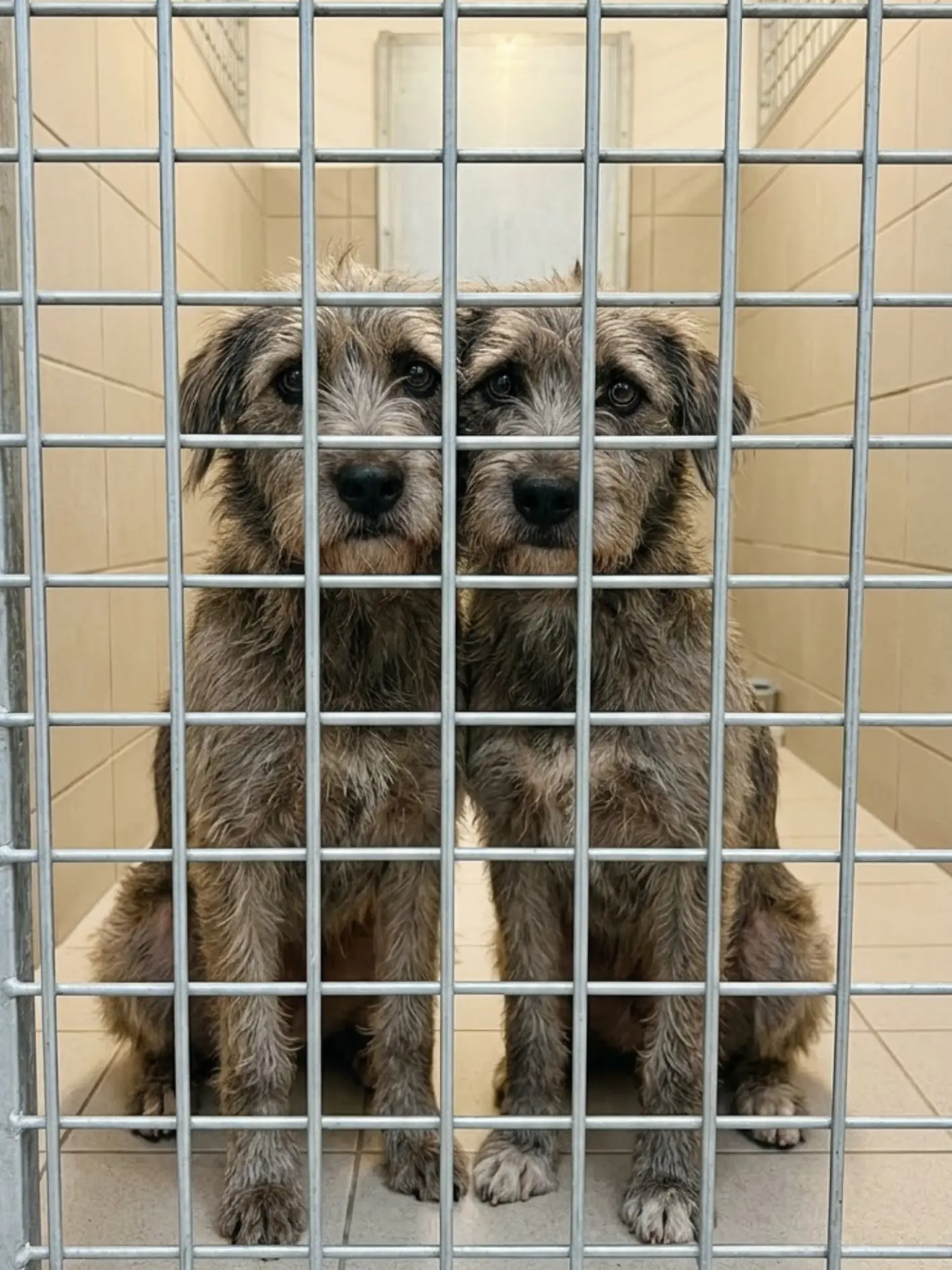
The two dogs had been found together near a residential neighborhood after several people reported seeing them wandering along the same stretch of road. No owner was nearby, and neither dog carried identification that immediately connected him to a family. Shelter workers could not know how long they had been together before that day or exactly what circumstances had left them outside, but their behavior suggested that being beside each other was familiar.
During intake, Milo remained close whenever Jasper was handled. When employees moved one brother several feet away for an examination, the other watched until he returned. Staff avoided turning those observations into a dramatic claim that the dogs could never be separated, because a brief shelter stay cannot reveal everything about a relationship between two animals. What they could say with confidence was simpler: Milo and Jasper arrived together, appeared comfortable together, and seemed to use the other’s presence as something predictable in an otherwise unfamiliar environment.
That familiarity followed them into the kennel.
They often sat close enough that their shoulders touched. If Milo stood to investigate footsteps in the hallway, Jasper usually stood soon afterward. When unfamiliar visitors leaned toward the bars, Milo tended to remain in front while Jasper watched from slightly behind him. At night, staff frequently found them resting within inches of one another even though there was enough room to sleep separately.
The sight of two brothers sitting together behind the gate attracted plenty of attention.
People stopped.
They photographed them.
They asked whether they were related.
Some immediately said they hoped the dogs would be adopted together.
During the first several days, those reactions made employees optimistic. The brothers were young adults, appeared healthy enough for adoption, accepted routine handling, and showed no known bite history during their shelter stay. Their rough, almost terrier-like coats gave them an appearance many visitors described as charming, and their manageable size seemed likely to appeal to people who wanted something between a small companion dog and a much larger working breed.
The first weekend came with several inquiries.
None became an adoption.
A couple in their thirties spent nearly an hour with both dogs and initially seemed prepared to consider taking the pair. They owned a house, had a fenced backyard, and had previously lived with two dogs at the same time. Milo approached them fairly quickly during the meeting, while Jasper needed more time before accepting a treat from the woman.
The couple liked what they saw.
Then they began discussing cost.
Two adoption fees were not the issue. They were thinking beyond the first day. Two dogs meant two annual veterinary examinations, two sets of preventive medications, twice the food, two potential emergency bills, and the possibility that each animal might require individual training.
They had expected to adopt one dog.
They realized that two could stretch their monthly budget considerably.
The shelter employee working with them did not pressure them to continue. Bringing both dogs home while already worried about basic expenses could create a future crisis for the family and another surrender for the brothers.
The couple left without either dog.
Milo and Jasper returned to the kennel.
Several days later, another visitor arrived after seeing their photograph online. She had specifically asked whether the brothers needed to stay together because she had room for only one dog. Staff explained that keeping them together would be wonderful if the right household appeared, but they were still learning whether permanent separation would be appropriate.
The woman met Milo first.
He followed her outside, investigated the exercise area, and gradually became comfortable enough to stand beside her while she spoke with a volunteer. From a placement standpoint, the meeting appeared promising.
Then Milo was returned to the kennel while Jasper remained outside with another handler.
Milo immediately moved toward the gate and watched the hallway. Jasper also remained unusually focused on where his brother had gone. Neither dog panicked, and neither displayed behavior suggesting separation was impossible, but both were noticeably less relaxed.
When they were reunited, the tension faded quickly.
The woman watched the interaction and changed her mind.
She said taking one while leaving the other felt wrong.
Staff reminded her that adopting only one dog was not automatically cruel if each animal could ultimately thrive in an appropriate home, but the woman no longer felt comfortable making the choice.
She left.
Both brothers stayed.
That became one of the central difficulties of their adoption search.
Visitors who wanted one dog sometimes felt guilty taking only Milo or Jasper. Visitors who loved the idea of keeping the brothers together often realized that adopting two animals at once was more responsibility than they could reasonably accept.
The relationship that made people stop at the kennel also made them hesitate.
A shelter volunteer named Amy began working with the brothers regularly and tried to understand whether they truly needed to remain together. She took Milo for short walks without Jasper and then reversed the arrangement on another day. Both dogs noticed the separation, particularly during the first minutes, but each could eventually engage with the environment and the person handling him.
That suggested something important.
The brothers were attached.
They were not necessarily incapable of functioning independently.
Amy documented the observations carefully because she did not want sentimentality to reduce their options. If the perfect household capable of adopting both appeared, keeping them together would be an excellent outcome. If two appropriate individual homes appeared instead, insisting on a joint adoption might unnecessarily leave both dogs waiting.
The shelter began promoting them both ways.
Milo and Jasper could be considered together.
Qualified individual homes could also inquire.
The change produced more messages.
It still did not produce an adoption.
A retired man met Milo twice and liked him, but after discussing the dog with his daughter, he became concerned that Milo’s energy might be more than he wanted to manage. Another household asked about Jasper but already had three cats, and the shelter had no reliable information about how either brother behaved around them. Staff would not guarantee compatibility they had never observed.
One family considered both dogs until they learned their homeowners association limited households to a single pet.
Another couple loved Jasper but wanted a dog that could immediately accompany them to crowded outdoor restaurants and weekend events. Staff explained that Jasper was initially cautious with unfamiliar people and might need a quieter adjustment period before anyone knew whether he would enjoy that lifestyle.
Again, people left.
Again, the brothers remained.
By their second week, Milo and Jasper had become familiar faces inside the shelter. Employees could distinguish them instantly. Milo was slightly more confident around new people and often approached the kennel gate before Jasper. Jasper took longer to trust but frequently became more affectionate once the introduction stopped feeling new.
Those differences became clearer outside the kennel.
Milo loved investigating everything. His nose seemed to find every old scent along the fence, and he walked with enough enthusiasm that inexperienced handlers sometimes needed a few minutes to find a comfortable rhythm. After exercise, however, he could settle quietly beside someone.
Jasper moved more cautiously. He often stayed closer to the person holding the leash and seemed particularly interested in watching whatever Milo was doing. When walked alone, he was initially less confident but gradually became curious once he realized his brother was not the only source of security available to him.
Neither dog behaved perfectly.
Neither appeared impossible.
They were simply two young shelter dogs whose complete history was unknown.
Amy began photographing them individually as well as together. She wanted people to see the brothers as two potential companions rather than only as a matching pair behind bars. One photograph showed Milo sitting outside with his ears slightly raised and his rough coat moving in the wind. Another showed Jasper resting near Amy’s shoes after a walk.
The shelter posted both.
The reaction was enormous.
People commented that they were beautiful.
Others said the brothers should never be separated.
Several asked why nobody had taken them yet.
One person offered to pay both adoption fees.
Another said she would donate toward veterinary expenses if someone adopted them together.
A local community page shared the post, exposing the brothers to thousands of additional viewers.
For several days, Milo and Jasper seemed more popular than ever.
They were still sleeping in the shelter.
This gap between attention and placement is one of the most difficult realities in animal rescue. A photograph can travel across thousands of phones while the dog in that photograph remains physically in the same kennel. Comments create visibility, but they can also create the assumption that somebody else must already be helping.
A viewer sees dozens of people asking whether the dogs are available and assumes applications must already exist.
Another sees rescue organizations tagged repeatedly and believes one of them is probably arranging a transfer.
Someone who genuinely has room for a foster decides not to call because the dogs appear surrounded by options.
The public sees activity.
The shelter still sees two dogs without a destination.
That was exactly what was happening with Milo and Jasper.
A rescue organization eventually contacted the shelter after seeing their posts. The group was interested in helping but operated entirely through foster homes and did not have one family capable of taking both dogs.
It did, however, have a foster who could potentially take Jasper.
The possibility created another difficult decision.
Should the shelter separate them?
Staff and volunteers discussed what they had observed. The brothers clearly preferred being together, but both had demonstrated an ability to function individually after an adjustment period. If separating them created two real chances at permanent homes instead of one increasingly difficult joint placement, it deserved serious consideration.
The rescue scheduled a meeting.
Jasper did well enough that the foster agreed to take him.
For the first time, one brother had an actual way out.
Then the foster’s circumstances changed.
Her landlord had previously approved one temporary dog but refused permission for another after a neighbor complained about pets in the building.
The rescue lost the foster space before Jasper ever left.
Another possibility disappeared.
Amy learned about the change while preparing to take the dogs outside. Milo stood when she approached. Jasper followed.
Neither knew how close one of them had been to leaving.
The humans carried the disappointment.
The dogs carried on with their routine.
As days became weeks, the shelter environment gradually affected both brothers. Milo became louder during busy periods, particularly when unfamiliar dogs passed close to the kennel. Jasper sometimes moved farther back when groups of visitors stood outside for too long.
Outside, both usually settled.
This distinction became part of their updated profiles.
The shelter did not want people to interpret kennel stress as a complete personality assessment. Dogs are living inside restricted, noisy, unfamiliar environments. Some become increasingly excited. Others become withdrawn. A dog barking behind bars may become surprisingly quiet after several weeks in a home, while an apparently calm shelter dog may reveal far more energy once comfortable.
Milo and Jasper needed someone willing to meet them beyond the gate.
Another family tried.
They had two teenage children and wanted both dogs. They visited on a Saturday morning and spent nearly two hours at the shelter. The teenagers walked Milo and Jasper separately, and the parents asked sensible questions about food, training, veterinary care, and how to avoid the brothers becoming overly dependent on each other.
Amy believed this was the strongest possibility yet.
Then the family’s circumstances changed before the adoption could be finalized.
The father had recently accepted a new position that would require the family to relocate within several months. Their temporary housing during the move would allow only one pet.
The parents considered adopting anyway and solving the problem later.
Shelter staff advised against it.
A move is stressful enough without entering it already knowing that housing rules may force another surrender.
The family left.
Milo and Jasper remained.
By then, some online followers had begun describing them as unwanted.
Amy hated the word.
It was not accurate.
People wanted them.
People liked them.
People stopped specifically to see them.
The problem was that wanting a dog emotionally and having a household capable of supporting that dog are different things.
The couple who could afford one dog could not comfortably afford two.
The woman interested in one brother felt guilty separating them.
The foster lost landlord approval.
The family willing to take both was moving into housing that would not permit them.
None of those outcomes meant the brothers had no value.
They meant that the right arrangement had not appeared.
That difference mattered because shelter stories are often reduced to simple emotional narratives. A dog sits behind bars, someone must be ignoring him, and therefore the public assumes nobody cares.
Reality is frequently less dramatic and more frustrating.
Housing restrictions matter.
Work schedules matter.
Existing animals matter.
Finances matter.
Family agreement matters.
Timing matters.
Milo and Jasper needed those circumstances to align for either one household or two.
Weeks passed without that happening.
Shelter staff broadened rescue outreach. Rather than looking only for an organization capable of taking both, they contacted groups willing to consider each brother independently if necessary. One organization liked Milo but had no open foster. Another believed Jasper could be a good candidate for a quieter home but already had several dogs waiting for placement.
The answers came back repeatedly.
Full.
No foster.
Can share.
Will keep looking.
Those messages represented genuine concern.
They did not open the kennel door.
Meanwhile, Milo and Jasper continued becoming more comfortable with familiar staff. Milo began greeting Amy enthusiastically enough that she occasionally had to wait for him to calm before attaching the leash. Jasper developed a habit of standing slightly behind Milo, then stepping forward as soon as Amy spoke to him.
One afternoon, she decided to spend an entire session with them separately.
Milo went first.
For the first several minutes, he looked back toward the shelter entrance, but eventually his attention shifted toward the walk. He explored, accepted treats, and played briefly with a rope toy.
Then Jasper had his turn.
He was more hesitant initially but gradually relaxed as Amy moved slowly and allowed him to investigate. By the end, he walked beside her without constantly checking behind them.
The exercise reinforced what the shelter had been beginning to believe.
The brothers loved being together.
They could also learn to live independently.
The shelter updated the adoption post again.
Together would be wonderful.
Separate appropriate homes were welcome.
That wording finally brought a serious individual application for Jasper.
A woman named Denise lived about thirty minutes away, owned her home, and had recently lost a senior terrier mix. She had followed the brothers online but initially assumed she could not help because she was able to adopt only one dog.
The revised post changed that.
Denise asked specifically about Jasper because his quieter personality sounded similar to dogs she had previously owned. She visited twice and never tried to force an immediate connection. During the second meeting, Jasper approached her much sooner and eventually rested close enough that she could gently stroke his shoulder.
The adoption began looking realistic.
Then Denise asked the question everyone knew would come.
“What happens to Milo if I take Jasper?”
Staff answered honestly.
Milo would remain available.
He would continue receiving care.
They would continue searching.
There was no guarantee his home would arrive at the same time.