The adult Bald Eagle did not try to fly when Evan Miller stopped his truck.
That was the first thing that made him uneasy.
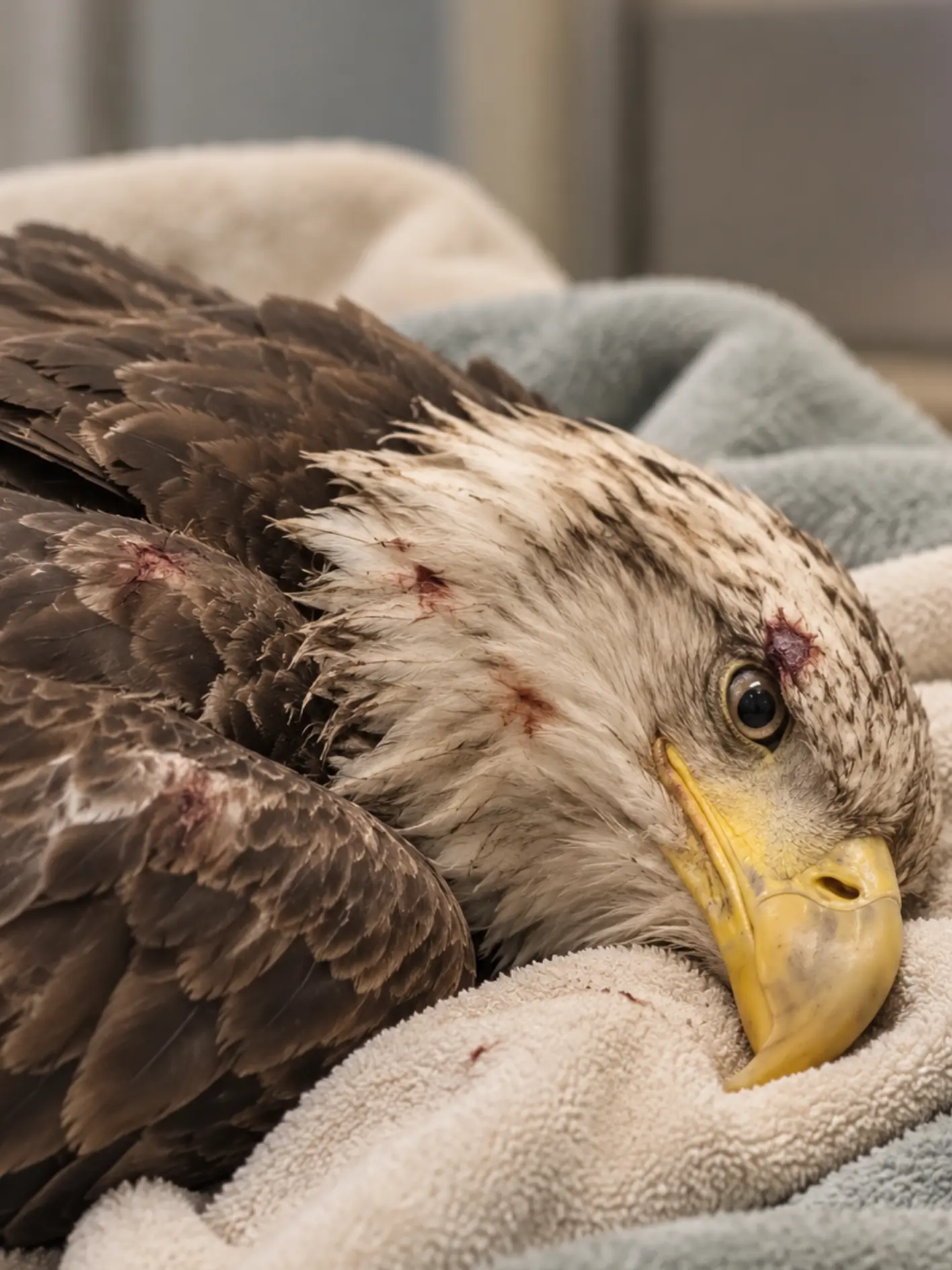
Miller had been driving along a narrow county road near the Mississippi River in southern Wisconsin shortly after sunrise when he noticed the white head of an eagle above the brown grass bordering a harvested field. Bald Eagles were common enough along the river that he normally would not have stopped. During colder months, he often saw them perched in cottonwoods, moving between open water and agricultural land, or feeding on carcasses in fields.
This bird looked different.
It was sitting unusually low.
The wings were folded, but the chest almost touched the ground. The eagle’s white head feathers were dirty and uneven, and several small areas around the forehead and shoulder appeared stained from superficial abrasions. At first, Miller assumed the bird had recently been in a fight or had struck something.
He slowed the truck.
The eagle turned its head toward him.
It did not move away.
Miller continued several hundred feet, pulled safely onto a gravel turnout, and watched through binoculars.
For nearly ten minutes, the eagle remained in the same position.
A healthy adult Bald Eagle might remain on the ground while feeding, but there was no obvious carcass beneath this bird. More importantly, when a passing pickup came closer, the eagle did not launch into the air.
It tried to stand.
The legs extended slowly.
For several seconds, the eagle managed to lift its body. Then the head drooped, the bird lost balance, and one wing opened slightly against the grass before it lowered itself again.
Miller felt the situation change from unusual to urgent.
He stayed inside his truck and called the regional wildlife office.
The dispatcher asked him to describe exactly what he was seeing.
Was there a broken wing?
Not that he could tell.
Was the eagle bleeding heavily?
No.
Was it conscious?
Yes, but weak.
Could it fly?
It had not even tried.
The dispatcher instructed Miller not to approach. A debilitated eagle may appear passive until someone gets close enough to trigger a defensive response, and its talons can remain dangerous even when the rest of the body is failing.
A conservation officer and a licensed raptor responder were sent to the location.
Miller remained parked well away from the bird.
The more he watched, the more concerned he became.
The eagle repeatedly lowered its head toward the ground, then raised it again with visible effort. Once, it opened its beak and made a swallowing motion several times in succession. It shifted its feet but could not remain fully upright.
There was something profoundly wrong with the bird, but Miller could not see an injury serious enough to explain it.
Conservation Officer Rachel Greene arrived twenty-five minutes later.
She watched the eagle from the roadside before approaching.
The bird noticed her immediately.
Its eyes remained open and responsive, but its reaction was slow.
Greene moved several steps closer.
The eagle attempted to stand.
It spread both wings.
For a moment, she expected it to fly.
Instead, the bird flapped once, rose only slightly, and dropped back into the grass.
Both wings moved.
Neither appeared mechanically broken.
The problem seemed to involve the entire body.
Greene called the fictional Driftless Raptor Rehabilitation Center and described the signs.
Adult Bald Eagle.
Grounded.
Severe generalized weakness.
No obvious major fracture.
Reduced defensive behavior.
Possible neurologic involvement.
The center advised immediate transport.
A trained responder arrived with heavy gloves, a towel, and a padded carrier. The capture itself was disturbingly easy.
The eagle raised one foot when the responder approached, but there was little force behind the movement. A healthy adult Bald Eagle can make capture difficult even with a damaged wing. This bird simply did not have the strength.
The responder placed a towel over the eagle, secured the legs above the feet, supported the body, and lifted it into the carrier.
Up close, they found several small abrasions around the head, shoulder, and wing. None appeared deep. There was no major external bleeding. The white feathers were dirty, and the body condition felt poorer than expected for an adult bird.
The feet were warm.
The grip was weak.
During transport, the eagle remained awake but spent most of the ride with its head resting low.
Dr. Allison Grant, the attending veterinarian at Driftless Raptor Rehabilitation Center, met the carrier in the treatment room.
She immediately recognized that the bird’s condition was more serious than the superficial wounds suggested.
The eagle could not maintain normal posture for more than short periods. Its chest muscles were reduced. Hydration was poor. Grip strength in both feet was diminished, though sensation remained present. The bird’s head repeatedly lowered toward the towel whenever restraint relaxed.
Grant began with a full trauma examination.
The wings were palpated from shoulder to wrist.
No obvious fracture was detected.
The shoulder joints remained aligned.
The humeri felt intact.
The radius and ulna of both wings did not show gross instability.
The spine did not appear fractured.
Both eyes reacted to light.
The small wounds around the head and shoulder were real, but they did not explain why the eagle could barely hold itself upright.
“That is when you stop looking only at the visible injuries,” Grant later said. “A bird can arrive with scratches from being on the ground, but those scratches may be a consequence of the underlying problem rather than the cause.”
Radiographs were obtained once the eagle had received initial fluid support.
The images confirmed what the physical examination suggested.
There was no major wing fracture.
No obvious spinal fracture.
No severe chest trauma.
Then Grant noticed several tiny bright densities in the gastrointestinal tract.
They were small.
Easy to overlook.
But on an X-ray, metallic material can appear markedly radiopaque compared with surrounding tissue.
Grant enlarged the images.
Several irregular fragments were present.
The finding immediately changed the direction of the case.
A blood sample was collected for lead testing.
Until that result returned, the veterinary team continued supportive care.
The eagle was dehydrated enough to require fluids.
Its body temperature was slightly low.
The bird showed poor appetite and intermittent gastrointestinal discomfort.
Staff placed it in a quiet intensive-care enclosure with thick towels across the floor. There was no perch. At that stage, the bird could not safely remain on one.
The blood lead result came back quickly.
It was dangerously elevated.
The number was high enough that Grant no longer had to wonder whether lead exposure might be contributing to the bird’s weakness.
The eagle was experiencing severe lead toxicity.
The superficial wounds had been misleading.
The primary problem was inside the body.
Lead poisoning in raptors can affect multiple systems simultaneously. Neurologic function may deteriorate. Muscles weaken. Gastrointestinal movement can become abnormal. Red blood cell production and survival can be affected. Kidney function may become compromised. Severely poisoned birds can become unable to stand, unable to fly, or unable to feed normally.
The eagle’s weakness finally had an explanation.
“When we saw the blood result, the clinical picture made sense,” Grant said. “The loss of strength, the poor coordination, the gastrointestinal signs and the inability to remain upright were all consistent with significant lead exposure.”
The presence of metallic fragments on radiographs provided another clue.
The center could not determine exactly where the eagle had encountered the lead.
It could not identify a particular carcass.
It could not identify a hunter.
It could not establish the exact date of exposure.
But one well-recognized pathway for Bald Eagles is ingestion of lead fragments while scavenging animal remains.
A rifle projectile can fragment when it passes through tissue. Some of those fragments may remain in a carcass, gut pile, or unrecovered animal. Scavenging birds can consume them along with meat.
The eagle does not need to be shot.
It only needs to swallow the fragment.
Once inside the digestive tract, stomach acids can gradually dissolve lead from the metal. The absorbed lead then enters the bloodstream and can interfere with normal cellular and neurologic processes.
A fragment does not need to be large to matter.
That was one of the most difficult things for the public to understand when the center later discussed the case.
The metallic densities visible on the X-ray were tiny.
The clinical effect was not.
“The bird never had to encounter a bullet in flight,” Grant explained. “The danger began after the shot was over, when a fragment entered the food chain.”
Treatment began immediately.