When twenty-four-year-old Della Marsh inherits three hundred acres of exhausted Mississippi cotton land after her father’s death, she inherits far more than property. She inherits unpaid equipment notes, aging irrigation pumps, declining soil, and the expectations of neighbors who assume a young woman cannot possibly keep the farm alive without following the same expensive methods everyone else uses.
The county’s fertilizer suppliers offer Della the obvious solution: borrow heavily, pour synthetic nutrients into the ground, push the cotton through one more season, and hope the harvest is large enough to cover the debt.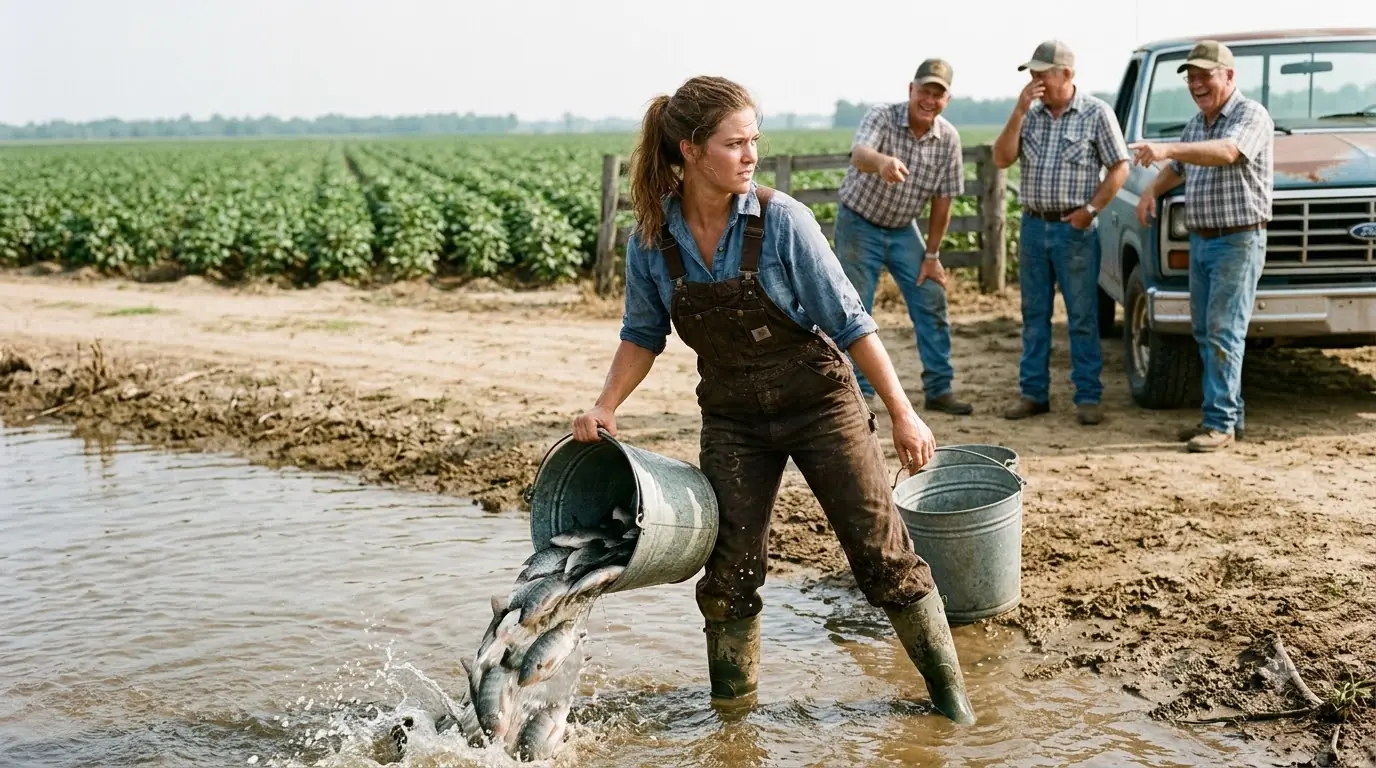
Della refuses.
Her father spent years quietly studying why their soil became harder and less productive even as fertilizer use increased. Inside his battered journals, Della discovers sketches of a system he never had enough money to complete: interconnected irrigation ditches, settling ponds, pumps, and fish living directly inside a recirculating water network.
His idea was unconventional but simple.
Instead of treating irrigation water and fertility as separate problems, the fish would enrich the water naturally. Pumps would circulate that nutrient-rich water through the cotton rows, while carefully managed plant residues and biological activity could gradually improve soil condition instead of merely forcing another crop from exhausted ground.
Della decides to finish what her father started.
She spends nearly every dollar she has repairing old ditches and buying pumps, screens, pipe, aeration equipment, and thousands of live tilapia. When the fish truck arrives before sunrise, neighboring farmers gather along the road simply to watch what they consider the final proof that Della has lost her mind.
They laugh as she dumps buckets of fish into irrigation channels.
They joke that she is raising dinner instead of cotton.
They predict the fish will die, the ditches will stink, and the farm will be bankrupt before harvest.
Della says almost nothing.
She works.
For weeks she wakes before daylight to test water, clean screens, repair pumps, feed fish, measure soil moisture, and inspect cotton plants. At first there is no visible miracle.
Then the leaves darken.
The plants strengthen.
Root systems begin penetrating soil that had previously been hard and compacted.
By flowering season, farmers who used to laugh are slowing their trucks beside Della’s fence.
By boll development, some of them are quietly asking questions.
Harvest produces the shock no one expected.
The first rows come in heavy.
Then heavier.
When the final certified numbers are calculated, Della Marsh’s cotton has produced the highest average yield in the entire county.
But the harvest record is only the first surprise.
A county agronomist comparing pre-season and post-season soil samples discovers substantial increases in biological activity, improved aggregation, better water infiltration, and rising organic nutrient availability in the areas receiving Della’s circulating system.
Her father’s experiment has not merely helped produce an exceptional crop.
It appears to be helping restore soil everyone believed was permanently worn out.
The revelation attracts universities, agricultural companies, investors, and reporters.
It also attracts people who want to own the system.
A fertilizer corporation offers Della enough money to erase every family debt in exchange for exclusive rights to her father’s notebooks.
She refuses.
Then she discovers that her father’s design contains something even more important than the fish: years of careful measurements proving he never intended the method to become a secret commercial product.
He wanted struggling farmers to be able to build affordable versions themselves.
Della must choose between becoming wealthy by selling the idea or protecting the purpose behind it.
She chooses the farm.
Years later, the irrigation ditches where neighbors once laughed become the center of an agricultural training cooperative serving small farms across the region.
And the people who remember the first fish truck understand that Della’s greatest harvest was never cotton.
It was proving that exhausted land, old ideas, and underestimated people can all become productive again when someone refuses to accept that their best years are already behind them.
The first truck arrived at Marsh Farm at 4:52 in the morning.
Its headlights moved slowly down the gravel road, cutting through low Mississippi fog before turning beneath the rusted steel arch that still carried the name Della’s grandfather had welded there in 1968.
MARSH FARM.
Cotton & Cattle.
The cattle had disappeared twelve years ago.
The cotton remained.
Barely.
Della Marsh stood beside the equipment shed wearing rubber boots, faded jeans, and one of her father’s old work shirts with the sleeves rolled past her elbows.
She had been awake since three.
Not because there was that much preparation left.
Because she had been too nervous to sleep.
The truck stopped beside the first irrigation reservoir.
The driver climbed down.
“You Della?”
“Yes.”
He looked at her.
Then at the property.
Then back at her.
“You sure you want all these here?”
Della almost laughed.
“You drove four hours to ask me that?”
“I drove four hours because you paid a deposit.”
“That sounds more reasonable.”
The driver grinned.
“Good. Because I’ve got eight thousand fish in the back, and they’re becoming your problem in about fifteen minutes.”
Della walked toward the truck.
The tanks were large rectangular containers mounted behind the cab, each fitted with oxygen lines and temperature gauges.
Inside, thousands of tilapia moved through the dark water like liquid silver.
Della stared.
For months, they had existed only as numbers.
Stocking density.
Feed conversion.
Oxygen requirement.
Expected nutrient load.
Survival rate.
Projected growth.
Now they were alive.
Thousands of moving decisions.
Thousands of dollars swimming in circles.
Della put one hand against the tank.
Cold condensation coated her fingers.
The driver said, “Water temperature?”
“Seventy-six at reservoir one.”
“Dissolved oxygen?”
“Seven-point-one last night.”
“pH?”
“Seven-four.”
He nodded.
“You’ve done homework.”
“I’ve done nothing else for three months.”
The first pickup arrived before the unloading hose was connected.
Della heard it.
She did not need to look.
She knew that engine.
Rayburn Cole.
Sixty-one years old.
Farmed six hundred acres two miles east.
Thought almost every idea invented after 1985 was evidence civilization had lost discipline.
He parked beside the gate and climbed out holding coffee.
“Morning, Della.”
“Rayburn.”
He looked at the truck.
“What’s that?”
“You know what it is.”
“Was hoping the rumor was wrong.”
Della turned back toward the driver.
Rayburn came closer.
“You really bought fish.”
“Yes.”