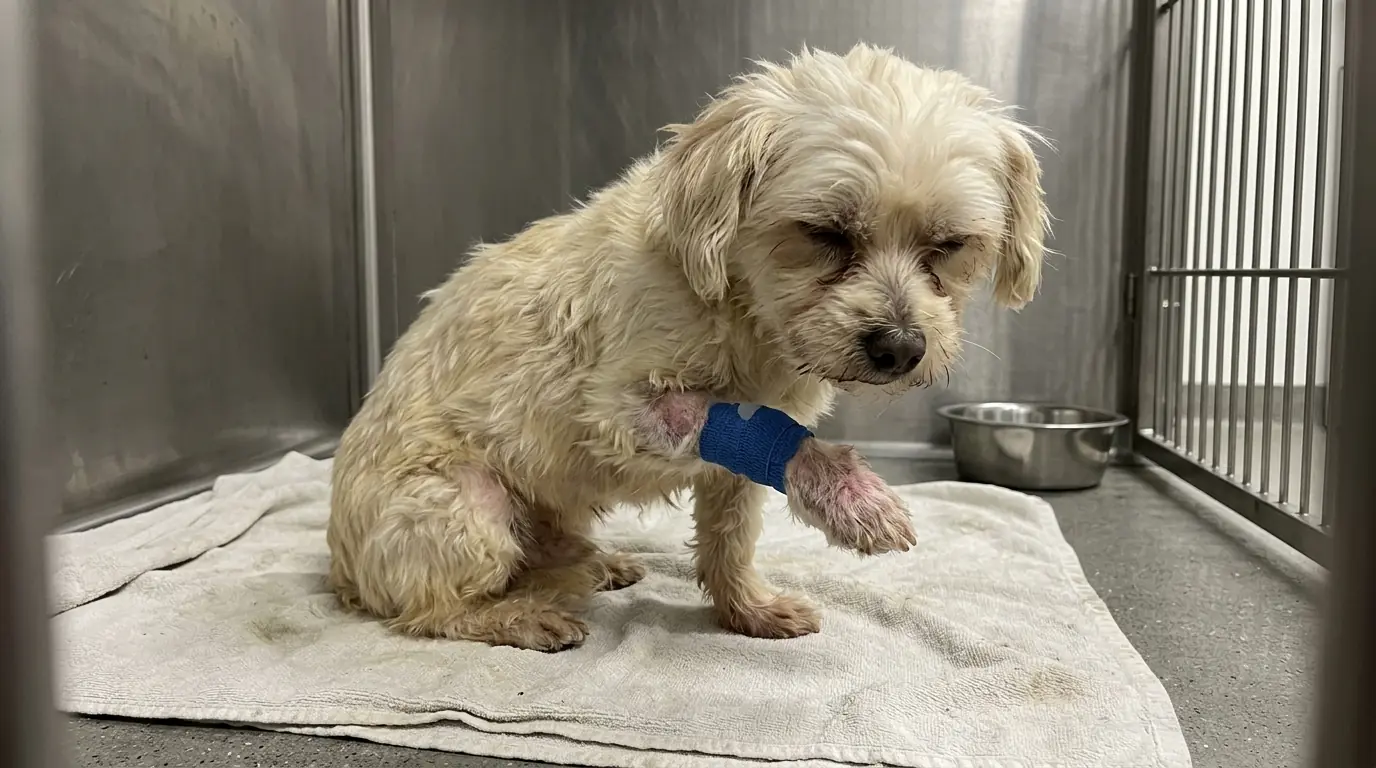
Gizmo is exhausted enough that he can barely keep his eyes open.
The eight-year-old Maltese mix sits hunched inside his medical kennel, surrounded by clean bedding that should give him somewhere comfortable to rest.
But Gizmo will not lie down.
One front paw is swollen, missing much of its fur, and wrapped as part of ongoing treatment. Instead of placing it beside the other paw, Gizmo holds the injured leg bent against his chest.
Minutes pass.
His eyelids grow heavier.
His head begins to droop.
Eventually, Gizmo falls asleep sitting upright.
The injured paw remains suspended in the air.
Then his body relaxes just a little too much.
The paw slowly drops.
It touches the floor.
Gizmo jolts awake.
Immediately, he pulls it back against his chest.
And within minutes, his eyes begin closing again.
Gizmo Treats the Floor Like Something His Paw Cannot Touch
When Gizmo is awake, the pattern is obvious.
He moves on three legs.
The injured front paw stays elevated.
If he needs to turn, he pivots carefully.
If he needs to move forward, the healthy front leg takes more of his weight.
The injured paw may hover only inches above the floor, but Gizmo refuses to use it.
Even standing still, he keeps it tucked upward.
The Problem Becomes Harder When He Gets Tired
Avoiding a painful paw while awake is one thing.
Maintaining that position while falling asleep is another.
Muscles relax during sleep.
Posture changes.
The head becomes heavy.
The body begins surrendering conscious control.
For Gizmo, that creates a conflict.
His body desperately wants to rest.
His injured paw still cannot tolerate contact.
He Doesn't Need to Step on It to Wake Up
Sometimes Gizmo's paw barely brushes the bedding.
There is no full weight placed through the limb.
He is not trying to stand on it.
The bandaged foot simply drops low enough to make contact.
That can be enough.
His eyes snap open.
His leg pulls upward.
His body becomes tense again.
Then He Starts Falling Asleep Almost Immediately
That is what makes the scene so difficult to watch.
Gizmo does not wake because he is finished resting.
He wakes because something hurt.
Within moments, his eyes are heavy again.
His head begins to lower.
He remains sitting because sitting allows him to keep the injured paw away from the ground.
Then the cycle repeats.
The Suspended Paw Is Only the Most Visible Part of the Problem
Severe injury to a foot can affect much more than walking.
Dogs use their front limbs when standing, lowering themselves, rising, turning, balancing, and repositioning during sleep.
A dog cannot simply “ignore” one front paw.
If Gizmo refuses to use it, the rest of his body has to compensate.