At 11:34 p.m., Elijah Carter had twenty-six minutes left to live.
He knew because the clock hung directly across from him.
The second hand moved with an ordinary little jerk every time another piece of his life disappeared.
Nobody had thought to remove it.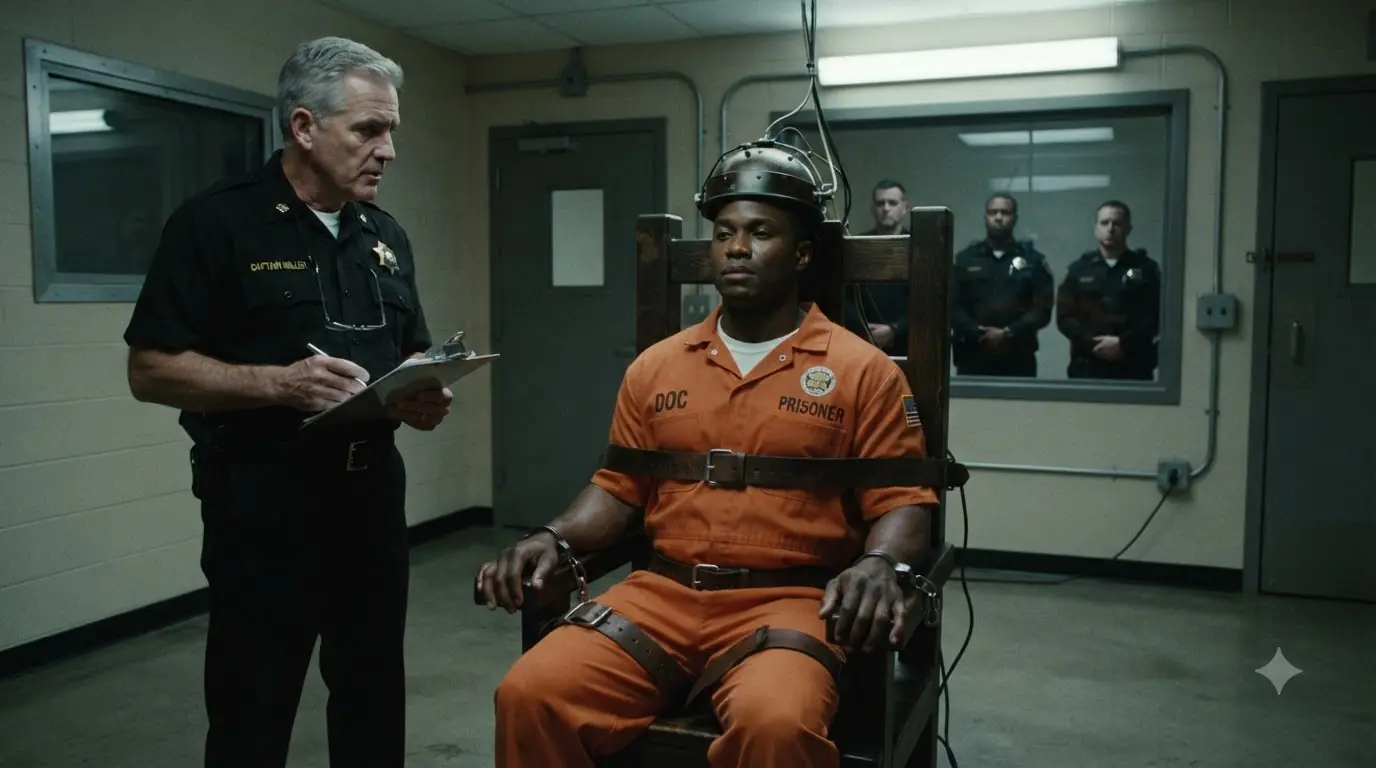
Maybe nobody ever did.
Maybe men waiting to die were expected to know exactly how much time remained.
Elijah sat in a heavy wooden execution chair beneath fluorescent lights that made everything look colder than it was. An orange prison jumpsuit covered his broad frame, and thick leather restraints crossed his chest, thighs, and ankles. His wrists were secured against the wooden armrests.
A metal electrode helmet waited above his head.
It had not been lowered yet.
That small mercy seemed almost ridiculous.
Beyond the thick observation window stood witnesses, correctional officers, two reporters, the state’s designated representative, and three empty chairs reserved for members of the victim’s family.
Nobody from Elijah’s family was there.
His mother had died seven years earlier.
His father had never been part of his life.
His younger half-brother lived somewhere in Texas and had stopped answering letters after Elijah’s second appeal failed.
His attorney was in another room making one final call he no longer expected to matter.
Elijah had spent twelve years learning what hope looked like when it became smaller every season.
At first, hope had been enormous.
A new trial.
DNA testing.
A witness recanting.
A judge reading the record carefully.
Then hope became narrower.
A procedural appeal.
A governor’s review.
A stay.
A one-hour delay.
Eventually, hope became something even smaller.
He hoped the straps would not hurt.
He hoped he would not panic.
He hoped nobody would remember him only from the photograph the newspapers used after his arrest, the one where he looked furious because a detective had shoved his face toward the camera.
He hoped his last thought would not be hatred.
Execution Captain Thomas Briggs stood beside the chair holding a clipboard.
Briggs was fifty-six, white, tall, rigid through the shoulders, and had worked inside prisons long enough that his face seemed permanently composed.
He checked the clock.
11:35.
Then he looked down at Elijah.
“The governor’s office has not issued a stay.”
Elijah nodded.
Briggs continued.
“Your counsel has been notified.”
Another nod.
“You understand the sentence is scheduled to be carried out at midnight?”
“Yes.”
His voice sounded strange to him.
Too normal.
Briggs looked at the form.
“There is a final request procedure.”
Elijah looked up.
The captain had probably asked this question before.
Special meal.
Chaplain.
Scripture.
A final call.
Maybe silence.
“What is your last request?”
Elijah did not answer immediately.
For twelve years, he had imagined what he would say if this moment arrived.
He had considered asking for his mother’s favorite peach cobbler.
He had considered asking for old Motown records.
He had once joked with another condemned man that he would request a cheeseburger from a restaurant two hundred miles away just to inconvenience everyone.
None of that mattered now.
The memory that came instead was a cafeteria in 1997.
A boy in a shirt worn three days in a row.
A teacher pretending not to notice that he had no lunch.
Elijah looked at Briggs.
“Can you bring my fifth-grade teacher?”
The captain lowered the clipboard.
“What?”
“My teacher.”
Briggs studied him as if he had misheard.
“Do you mean a chaplain or—”
“No.”
Elijah swallowed.
“Mrs. Ruth Thompson.”
The room behind the glass had gone quiet.
One officer shifted his weight.
Briggs looked toward the clock.
“Mr. Carter, you have twenty-four minutes.”
“I know.”
“You haven't had contact with this person listed in your approved visitors.”
“I know.”
“Do you know where she lives?”
“Last I knew, outside Columbia.”
Briggs stared.
“Why?”
Elijah’s eyes burned.
He hated that tears were coming now.
Not because crying embarrassed him.
Because he had fought them all day.
“I just want to thank her.”
Briggs’s expression did not change, but something behind it did.
“For what?”
Elijah looked down at his cuffed hands.
“When I was nine, I didn't have food.”
“My mother was sick.”