When Bruno first arrived at the shelter, employees believed his stay would be short. The young brown mixed-breed dog had a gentle face, soft eyes, and a calm presence that made visitors stop whenever they walked past his kennel. He was not the loudest dog in the building, not the one jumping against the bars or demanding attention. Instead, Bruno simply stood quietly and watched, as if waiting for someone to decide that he was worth a closer look.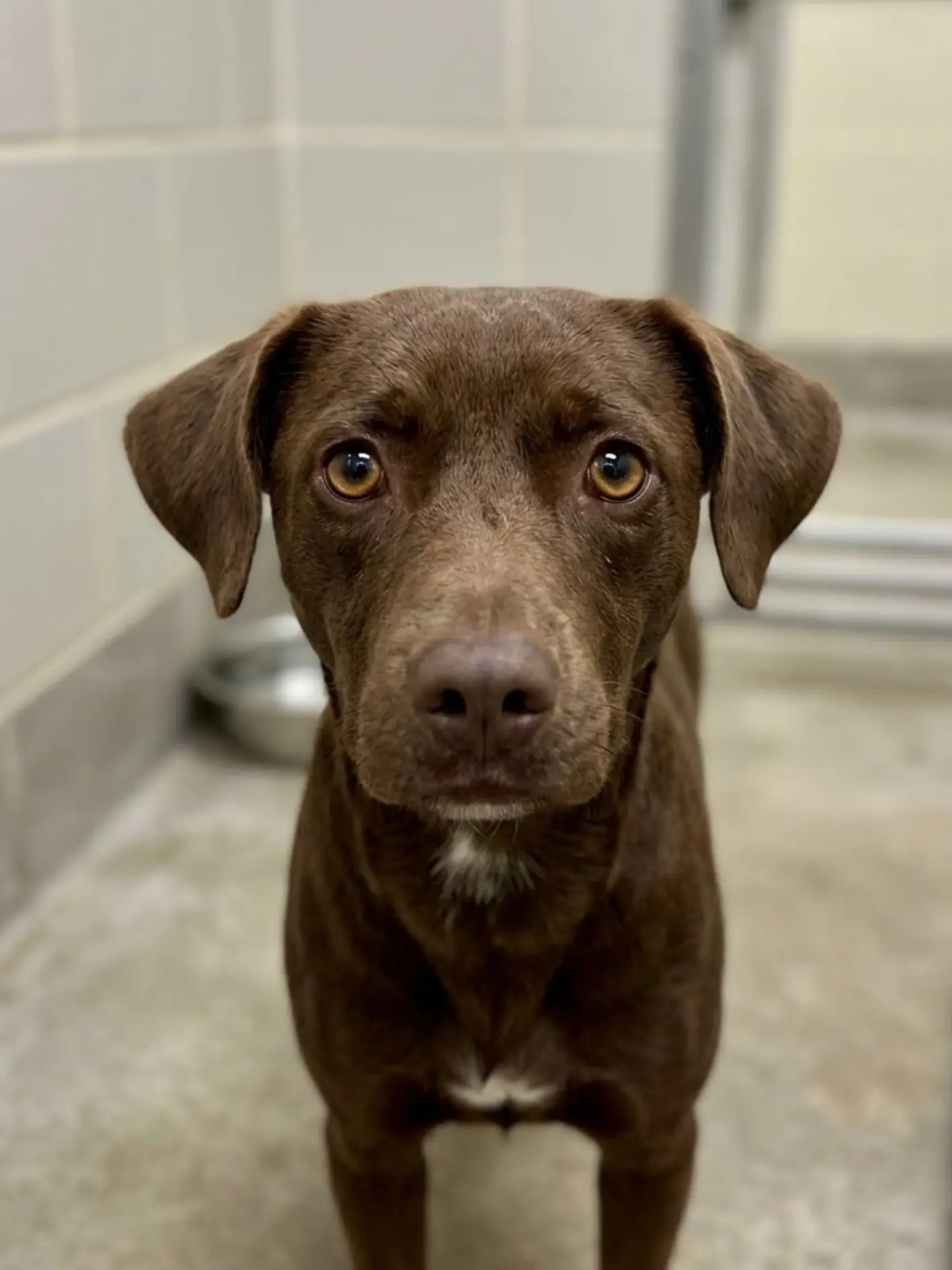
At first, that seemed like it would be enough.
Visitors noticed him almost immediately. Some stopped to admire his chocolate-colored coat. Others commented on his kind expression and asked whether he was already adopted. Several people said that a dog like Bruno would surely find a home quickly.
But days passed.
Then more days.
And Bruno remained.
He had entered the shelter after being found alone near a quiet neighborhood street. There was no owner nearby, no identification attached to his collar, and no one arrived during the search period to claim him. Staff could not know exactly how he ended up alone or whether he had once belonged to someone who could no longer care for him.
What they did know was the dog standing in front of them.
Bruno accepted people slowly but consistently. He allowed routine handling, walked with staff, and showed no known bite history during his stay. He was cautious when meeting strangers but never gave employees a reason to believe he was unsafe. The more familiar a person became, the more relaxed he seemed.
The problem was that most visitors only saw the first few minutes.
Inside a shelter kennel, first impressions happen quickly. The barking from nearby dogs, unfamiliar smells, metal doors opening and closing, and constant movement can change how an animal behaves. Some dogs become louder. Others become quieter.
Bruno became quieter.
When people approached his kennel, he often stayed near the back or stood calmly without pushing forward. He watched their movements before deciding whether he felt comfortable. While some visitors found that peaceful, others interpreted it as a lack of interest.
They wanted a dog who immediately ran toward them.
Bruno needed someone willing to wait.
The first family who seriously considered him arrived after seeing his photograph online. They liked his calm appearance and thought he might fit well into their home. During their meeting outside the kennel, Bruno slowly became more comfortable. He explored the area, accepted treats, and eventually stood close enough for them to touch his shoulder.
The family liked him.
Then they started discussing their daily routine.
They worked long hours, traveled occasionally, and had hoped to find a dog who would naturally adapt to being alone for extended periods. Staff explained that Bruno’s history was unknown and that a shelter dog entering a new home might require time, patience, and a gradual transition.
The family appreciated the honesty.
They decided they were not ready for that commitment.
They left without him.
Nobody had done anything wrong.
A responsible adoption is not about taking the first dog that creates an emotional reaction. It is about creating a situation where both the people and the animal can succeed after the shelter doors close behind them.
For Bruno, however, every responsible decision ended the same way.
He returned to his kennel.
A second visitor came several days later. She had experience with rescue dogs and specifically liked animals that were quieter than typical puppies. She spent nearly an hour with Bruno and noticed that he became much more affectionate once he understood she was not going to rush him.
For the first time in weeks, employees thought a match might finally happen.
Then she mentioned that she already had two cats.
The shelter had no reliable information about Bruno’s behavior around cats. Staff could not promise that he would immediately adjust safely, especially in a new environment where everything else would already be unfamiliar.
The woman understood.
She chose not to risk creating a stressful situation for the animals already in her home.
Again, Bruno stayed.
As the weeks continued, a volunteer named Rachel began spending extra time with him. She noticed something that many visitors never saw. Outside the kennel, Bruno was not the withdrawn dog from the photographs.
He was curious.
He enjoyed slow walks.
He liked exploring new smells.
And once he trusted someone, he often stayed close.
Rachel began taking him outside whenever possible and recording small moments that showed his personality. Bruno was not a dog who demanded attention from everyone. He was a dog who offered trust after someone earned it.
The shelter shared those moments online.
The response was immediate.
People commented on how sweet he looked.
They asked why nobody had adopted him.
They tagged friends.
They shared his photo.
Some even wrote that they hoped someone would save him soon.
But Bruno was still there.
This is one of the hardest realities of shelter animals. Being seen is not the same as being safe. A dog can receive thousands of views online while still having no confirmed place to go.
People often assume that someone else has already stepped forward.
Someone else will apply.
Someone else will foster.
Someone else will drive there.
Meanwhile, the dog remains behind the same kennel door.
That was Bruno’s reality.
While attention around him grew, the shelter itself became more crowded. New animals continued arriving. Stray dogs needed temporary housing. Families facing emergencies surrendered pets because they had nowhere else to turn.
The shelter did not stop caring about Bruno.
His food arrived every day.
His kennel was cleaned.
Volunteers continued walking him.
Employees continued answering messages.
But a shelter can only hold a certain number of animals at one time.
Every kennel matters.
Every empty space matters.
And when dogs do not leave through adoption, foster care, rescue transfer, or reunification, pressure builds around the animals who have been waiting the longest.
Bruno became one of those dogs.
Staff contacted rescue organizations and shared his information with foster networks. Several groups liked his profile but explained that they had no available foster homes. They wanted to help, but wanting to help and having somewhere safe to place a dog were two different things.
One potential foster appeared promising.
The person had experience with dogs and seemed comfortable with Bruno’s slower personality.
Then their housing situation changed.
They could no longer take another animal.
The opportunity disappeared.
Bruno never knew it existed.
He simply woke up the next morning and waited for the same familiar footsteps.
By then, Rachel had noticed that Bruno seemed to be changing. The shelter environment was becoming harder for him. He was still gentle with people he knew, but he became more hesitant when unfamiliar visitors approached.
The longer he stayed, the more difficult it became for strangers to see the dog Rachel knew.
That was the heartbreaking part.
The shelter was the place where Bruno was supposed to be safe.
But the longer he remained there, the less the environment allowed him to show who he really was.
The urgent conversations eventually began.
If no adopter, foster, or rescue placement was found, Bruno could lose his chance because the shelter needed space.
Today became the day everyone hoped would never arrive.
For Bruno, the morning still looked normal.
A bowl of food.
A clean kennel.
A familiar volunteer approaching with a leash.
He did not know people were counting hours.
He did not know strangers were sharing his photograph.
He did not know that his future depended on someone making a decision before the day ended.
He only knew Rachel.
She took him outside.
They walked slowly around the yard.
Bruno stopped to smell the grass, then returned toward her and stood nearby.
Rachel sat down.
Bruno stayed close.
There was nothing dramatic about the moment.
That was what made it difficult.
He was not a difficult dog.
He was not a dangerous dog.
He was simply a dog who had not found the right person yet.
Rachel stayed with him longer than usual before returning him to the kennel.
The gate closed.
The search continued.
The shelter posted Bruno again.
This time, the message was simple.
Bruno needed someone today.
Not someone to feel sorry for him.
Someone to give him a real place to go.
The post reached a woman named Hannah.
She had seen Bruno’s photograph before but assumed he would already have been adopted. Like many people, she looked at the comments and believed the number of people expressing concern meant someone closer had already helped.
The new update made her stop.
Still available.
Still waiting.
Hannah lived alone in a small house with a fenced yard. She had owned dogs before but had not adopted since losing her previous companion several years earlier. She worked from home most days and had often told friends that she missed having a dog but was unsure whether she was ready to begin again.
She called the shelter.
Her first question was not whether Bruno was perfect.
It was what was difficult about him.
Staff explained everything honestly.
His history was unknown.
He might need time.
He might not immediately act affectionate.
He could behave differently in a home than in the shelter.
Hannah appreciated the answer.
She did not want a perfect dog.
She wanted a real one.
She arrived later that afternoon.
Bruno did exactly what everyone expected.
He stayed cautious.
Hannah sat quietly.
She did not reach over him.
She did not call his name repeatedly.
She waited.
After several minutes, Bruno moved closer.
Then closer again.
Eventually, he smelled her hand.
It was a small moment.
But it mattered.
They walked outside together.
Bruno relaxed more with every minute.
Hannah watched him carefully.
She was not looking for a dog who would immediately jump into her arms.
She was looking for a dog she could understand.
After the meeting, she asked about the first days at home.
The shelter explained that Bruno might hide, follow her everywhere, need time adjusting, or struggle with new routines.
Hannah nodded.
She understood.
She went home to think.
The deadline mattered.
But she asked herself one question.
If Bruno had another month, would she still want him?
The answer was yes.
She returned the next morning.
This time, Bruno recognized her.
He approached faster.
He stayed nearby.
Hannah decided.
She wanted to adopt him.
The paperwork was completed carefully. Staff reviewed his information, discussed the transition period, and made sure she understood that adoption was the beginning, not the end, of the work.
She signed.
Bruno was adopted.
The kennel door finally opened for the last time.
Rachel walked him toward the lobby.
Hannah was waiting.
Bruno looked back once.
Then he followed her outside.
The dog who had spent weeks waiting for someone to choose him finally had somewhere to go.
The first days at home were not perfect.
Bruno explored every room.
He followed Hannah closely.
He hesitated around unfamiliar sounds.
He ignored the expensive dog bed and slept on the floor beside the couch.
Hannah did not worry.
She knew he was learning.
Slowly, the changes came.
Bruno started waiting near the kitchen when meals were prepared.
He learned the sound of Hannah’s footsteps.
He began bringing toys from one room to another.
He stopped freezing whenever a visitor entered.
He was becoming comfortable.
Not overnight.
Not dramatically.
Just little by little.
Months later, Hannah sent Rachel a photograph.
Bruno was sleeping beside the couch with his head resting on a blanket.
No kennel bars.
No shelter noise.
No waiting.
Just a dog at home.
Rachel saved the picture.
Because that was the outcome everyone had been hoping for.
Not a viral post.
Not thousands of comments.
Not strangers saying they wished they could help.
A real home.
Bruno’s story was never that nobody wanted him.
Many people cared.
Many people noticed him.
Many people hoped someone would save him.
He just needed one person to stop assuming someone else would do it.
And finally, someone did.