California.
August 29, 1911.
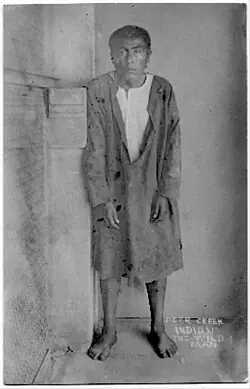
Before sunrise, workers near a slaughterhouse outside Oroville noticed a man standing near the corral.
He looked exhausted.
His hair had been cut short.
His body was thin.
He appeared frightened, hungry and completely alone.
Nobody there understood his language.
Nobody knew his name.
Nobody yet understood why a man who seemed to have stepped out of another California was suddenly standing beside a modern slaughterhouse only a few miles from town.
The workers called authorities.
A sheriff arrived.
There was no law describing what to do with a starving Indigenous man who could not communicate with anyone around him.
So they took him to jail.
Not because anyone had established that he had committed a crime.
Because the jail was one of the few places where local officials knew they could keep him safely while they tried to understand who he was.
The stranger sat inside a cell while word spread.
Reporters came.
Photographers came.
Crowds became curious.
Newspapers quickly began constructing a story around him.
They called him a "wild Indian."
Soon he would be advertised to the nation as something even more dramatic:
"The last wild Indian in America."
That phrase would follow him long after his death.
But almost everything about it concealed more than it revealed.
The man had not spent decades hiding because he somehow belonged to a prehistoric age.
He had not been mysteriously untouched by history.
History had reached him with extraordinary violence.
His people had been attacked.
Their villages destroyed.
Their food systems disrupted.
Their population reduced by killings, disease, starvation and displacement.
The small group around him had survived by doing something incredibly difficult.
They disappeared.
For decades they lived in the canyons and foothills of Northern California while trying to avoid the society expanding around them.
They moved quietly.
They concealed signs of habitation.
They limited fires.
They watched roads.
They survived partly by making settlers believe there was almost nobody left to find.
Then, by 1911, the man at Oroville apparently had no one left beside him.
The people who might have spoken his name were gone.
When anthropologists later tried to ask what he was called, they encountered a cultural problem.
According to the accounts preserved by Alfred Kroeber and others, a person did not simply announce his own name in the way Euro-Americans expected.
Someone else introduced him.
But there was no one from his community present to do that.
So the anthropologists gave him a name.
"Ishi."
A Yana word meaning simply:
Man.
The name by which millions would later know him may never have been his name at all.
And that was only the first strange contradiction of his new life.
He had survived for decades by avoiding white society.
Now white society wanted to study everything about him.
His speech.
His arrows.
His songs.
His hunting.
His stories.
His hands.
His face.
His body.
His past.
The same culture whose expansion had helped destroy his world suddenly treated him as an irreplaceable source of knowledge about the world that had been destroyed.
For the remaining four and a half years of his life, Ishi would live inside that contradiction.
He would become a friend.
An employee.
A research collaborator.
A public attraction.
A linguistic informant.
A museum demonstrator.
A survivor carrying knowledge no institution had preserved elsewhere.
And, in ways that modern institutions now acknowledge more openly, he would also be objectified.
His life would help preserve hundreds of songs, stories, words and techniques.
But even after he died, his body would not entirely be allowed to rest according to his wishes.
The man who emerged from the wilderness in 1911 had survived the violent collapse of his community.
Five years later, tuberculosis would kill him.
Then, against his expressed cultural wishes, an autopsy would be performed.
His brain would be removed.
And it would take eighty-four more years before that part of him was finally returned to Native people in California.
To understand how a single man could carry that much history into one jail cell in Oroville, the story has to begin decades before anyone called him Ishi.
It begins in the years when California was becoming American.
And when becoming American proved catastrophic for many of the people who were already there.
A California That Existed Before Him
The Yahi belonged to the broader Yana-speaking peoples of Northern California.
Their homelands lay in the rugged country east of the Sacramento Valley, around streams and canyons draining toward the Sacramento River.
Long before American settlers arrived in overwhelming numbers, these communities had developed detailed knowledge of the landscape.
The rivers.
Seasonal plants.
Deer movement.
Salmon.
Oak trees.
Stone.
Wood.
Fire.
Water.
The timing of everything mattered.
Food was not something purchased in a market.
It was a relationship between people, territory, skill and season.
Acorns had to be gathered and processed.
Fish had to be caught when runs permitted.
Deer had to be hunted.
Plants had to be understood not only as food but as fiber, medicine and material.
Tools required knowledge accumulated across generations.
A bow was not simply a curved stick.
Arrowmaking involved choices about wood, straightening, stone, feathers and balance.
Stone points required astonishing precision.
Those skills existed within a larger social world.
People had names.
Relatives.
Stories.
Ritual obligations.
Places carrying memory.
The phrase "Stone Age," which later appeared repeatedly in accounts of Ishi, makes that world sound simple.
It was not.
A society can use stone tools and possess highly complex linguistic, social and environmental knowledge.
The assumption that technology moves along one ladder from "primitive" to "civilized" told early twentieth-century audiences more about colonial thinking than about Ishi.
The world into which he was born was already under pressure.
California had changed governments.
Spanish and Mexican colonization had already affected Native communities in many parts of the state.
Then came the American conquest.
Then gold.
The discovery of gold in 1848 triggered one of the fastest demographic transformations in North American history.
People poured into California.
Mining camps expanded.
Roads cut through Indigenous territory.
Ranching grew.
Livestock consumed food resources.
Settlers wanted land.
Native communities stood on that land.
Conflict intensified.
Disease traveled through populations with little immunity to introduced infections.
Food systems collapsed.
Violence followed.
The story was not one continuous battle between two equally equipped armies.
Often it consisted of raids.
Massacres.
Individual killings.
Retaliation.
Expulsion.
Starvation.
Kidnapping.
Forced labor.
And communities becoming smaller with every year.
The California Museum today describes what happened to Ishi's people in explicit terms: disease, starvation and genocide at the hands of white settlers devastated the Yahi and neighboring peoples.
To later newspaper readers, Ishi would seem to have appeared unexpectedly in 1911.
But there was nothing sudden about the process that brought him there.
It had been unfolding his entire life.
The Three Knolls Massacre
One of the most destructive events in Yahi memory occurred in 1865.
The event became known as the Three Knolls Massacre.
California State Parks' historical landmark record says roughly thirty Yahi survived the attack, with further killings reducing the group afterward.
Ishi was probably a child.
His exact year of birth is uncertain.
Later estimates generally placed it around 1860 or 1861.
That means the violence that nearly destroyed his community may have been among his earliest memories.
The details passed down in later retellings vary.
That uncertainty matters.