Josephine Vale knew the exact price her father had placed on her because he had counted the money twice.
Twenty dollars.
Two draft horses.
And a promise that the transaction would never be questioned once the preacher signed his name beneath the marriage certificate.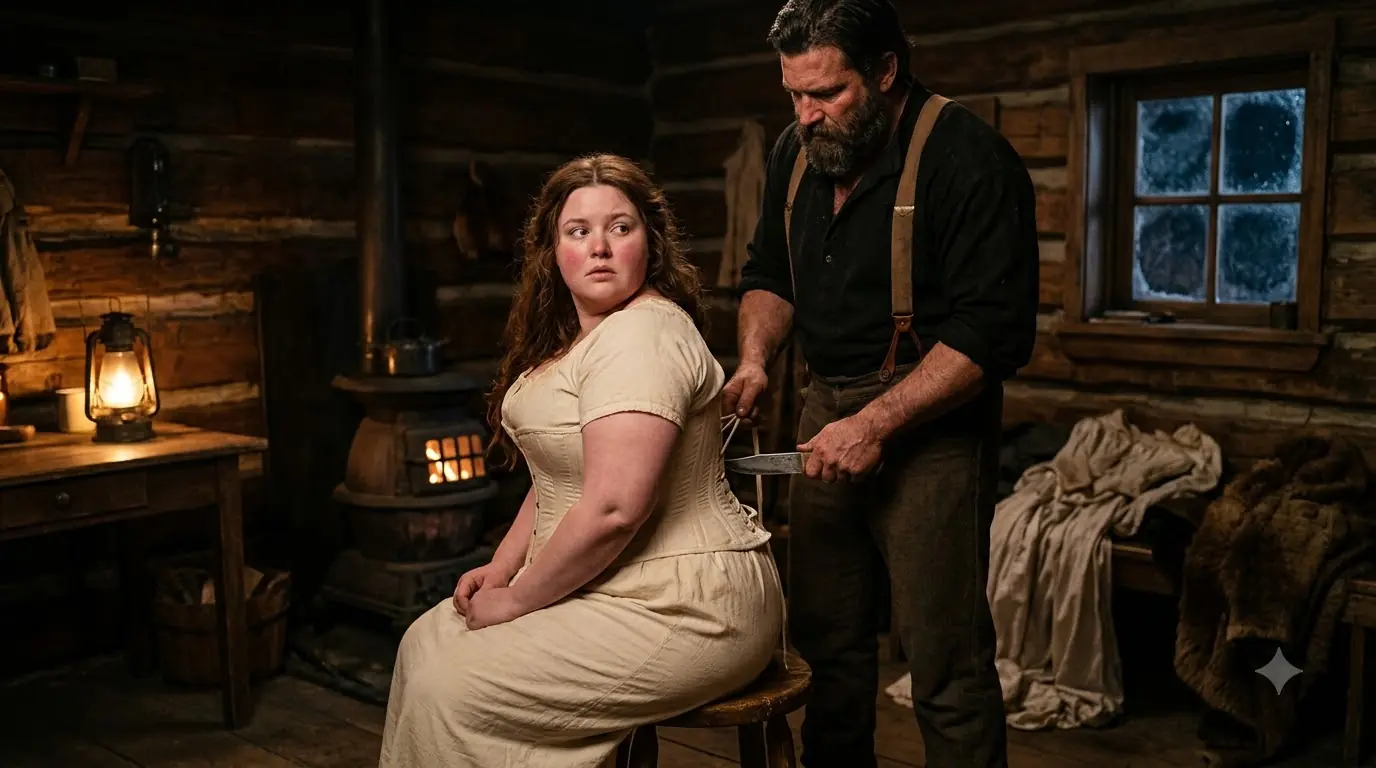
She had been standing in the kitchen doorway when Edwin Vale pushed the coins across the table with his thumb, separating them into neat stacks beneath the yellow light of an oil lamp. The two horses were already tied outside, their breath steaming against the bitter Montana morning.
Josephine remembered wondering whether she should feel insulted that the horses were worth more than she was.
Then she remembered that she had spent twenty-nine years being trained not to expect better.
Her father never called the arrangement a sale.
He called it practical.
“You’re nearly thirty,” he told her. “You need a husband.”
Josephine stood beside the stove wearing the brown work dress she had sewn herself, her large hands clasped tightly against her stomach.
At roughly two hundred kilograms, Josephine had a body that people remembered before they remembered anything else about her.
She was exceptionally large, with heavy thighs, broad hips, thick arms, a generous chest, large soft hands, and a round face that was fuller than most women’s, framed by naturally wavy chestnut hair. Her features were gentle despite their size: blue-gray eyes, a small straight nose, full lips, and cheeks that turned bright pink whenever she was embarrassed or angry.
People rarely bothered noticing those things.
They noticed the size first.
Her aunt Miriam had told her from childhood that she must compensate.
A large woman should speak softly.
A large woman should eat carefully in public.
A large woman should never choose bright colors.
A large woman should be grateful whenever a man showed interest.
And when Josephine reached an age when most girls she knew had married, the advice became crueler.
“Men have preferences,” Miriam once whispered while forcing a corset around Josephine’s waist. “You cannot blame them for nature.”
Josephine had spent years wondering whether nature hated her personally.
Her father had never directly insulted her body.
In some ways, that was worse.
Edwin simply treated her as an unfortunate financial obligation whose prospects diminished with every passing birthday.
He discussed her future as though discussing an aging workhorse.
Feed.
Shelter.
Maintenance.
Usefulness.
Cost.
Never desire.
Never happiness.
Never choice.
Then Harlan Creek appeared.
Josephine did not meet him when the arrangement was made.
Her father claimed Harlan lived alone in the northern mountains and needed a wife capable of managing a household.
“He owns land,” Edwin said. “Good land.”
“Then why can’t he find a woman without paying you?”
Her father’s expression hardened.
“Because sensible women understand the frontier is difficult.”
Josephine looked at the coins on the table.
“And I am not sensible?”
“You are fortunate.”
That answer stayed with her.
Fortunate.
A stranger had paid twenty dollars and surrendered two strong horses for her.
She was fortunate.
The ceremony happened the following afternoon in a small clapboard church outside Timber Crossing.
Harlan did not attend.
That frightened Josephine more than anything.
Preacher Amos Pike explained that the mountain pass was worsening and Harlan had remained at his cabin to prepare for winter. The marriage papers, Pike claimed, could be completed in advance because Harlan had already signed his portion before witnesses.
Josephine stared at the line where her own name was expected.
“Is this legal?”
The preacher frowned.
“Are you questioning my ministry?”
“I’m questioning why a bride can marry a man who isn’t in the church.”
Her father gripped her elbow.
Hard.
“Sign.”
Josephine looked at him.
His fingers tightened.
There were three other people present.
None intervened.
She signed.
By sundown, she belonged—at least according to everyone around her—to a man she had never seen.
The next morning, Preacher Pike loaded her trunk into a wagon.
Josephine climbed beside him.
Her father did not embrace her goodbye.
He handed Pike a folded paper, then glanced toward Josephine as if checking whether a parcel had been properly secured.
“Do your duty,” he said.
Josephine stared at him.
“As a wife?”
“As someone who finally has a home.”
She waited for more.
Nothing came.
Pike flicked the reins.
The wagon rolled north.
Josephine did not turn around.
For six hours, the road climbed into mountains that seemed determined to swallow the sky.
Snow began shortly after noon.
The cheap cotton wedding dress her aunt had insisted she wear was unsuitable for the journey. Wind pushed beneath the skirt. Moisture soaked the hem. By the time the wagon reached the higher elevations, the fabric had frozen stiff around Josephine’s boots.
Worse was the corset.
Miriam had tightened it before dawn.
“If you insist on being enormous, at least let the dress give you shape.”
“I can barely breathe.”
“Beauty requires sacrifice.”
“I’m not trying to be beautiful.”
“That is precisely your problem.”
The corset had been cut for a woman far smaller than Josephine.
The lacing compressed her broad torso so tightly that breathing became a series of short painful sips.
Every bump in the road drove the whalebone deeper into her sides.
Eventually Josephine leaned against the wagon rail and closed her eyes.
Pike noticed.
“You sick?”
“No.”
“Don’t die before we get there.”
She opened her eyes.
He was not joking.
“You’d lose your fee?”
The preacher glanced sideways.