At 4:18 on the afternoon of December 23, Riley Bennett was sitting beneath a white umbrella beside a pool in Nassau when her phone vibrated against the glass table.
She almost ignored it.
The Caribbean sun lay warm across her shoulders, the ocean beyond the resort was impossibly blue, and a server had just placed a cold drink beside her with the kind of casual smile that asked for nothing in return. For the first time in months, Riley had nowhere she was required to be, nobody waiting for her to solve a problem, and no laptop balanced across her knees.
Then the phone vibrated again.
Front Door: Motion Detected.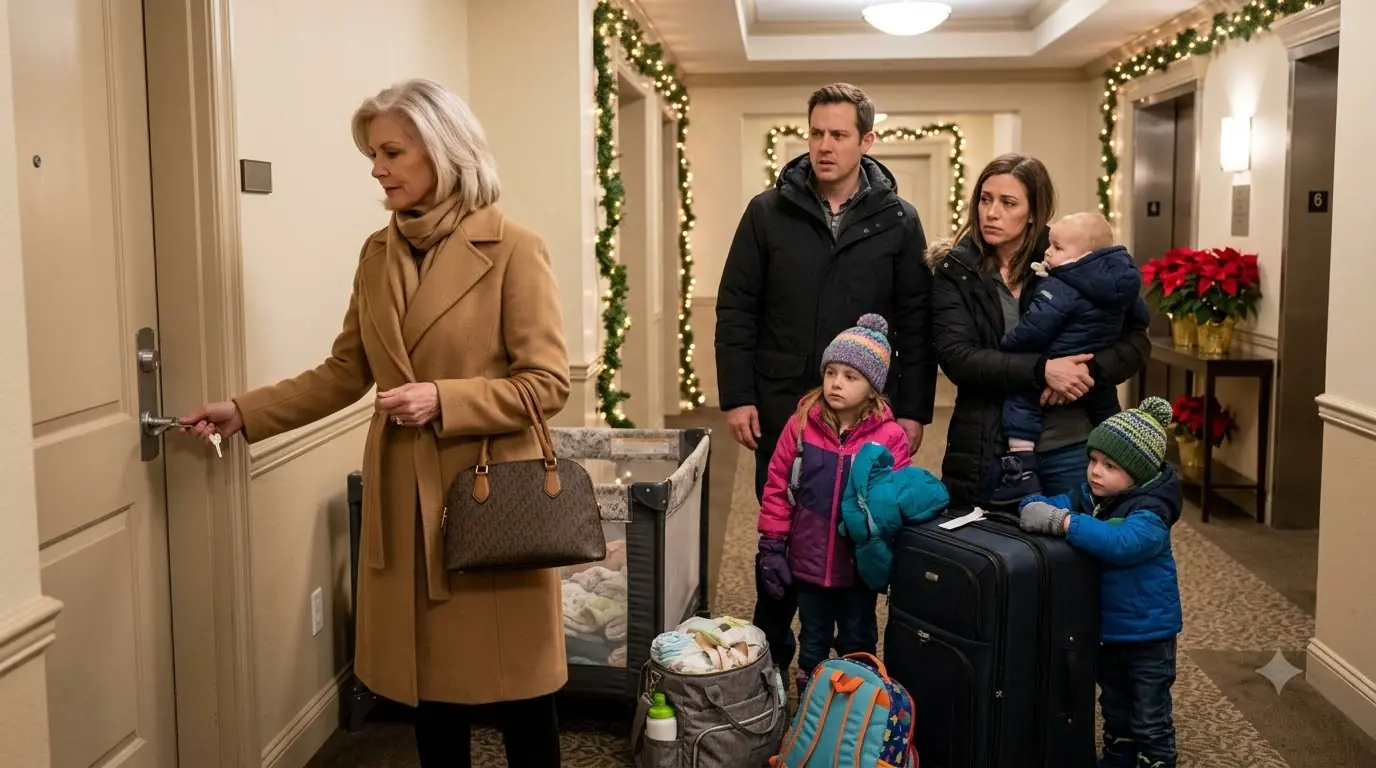
Riley frowned.
Her Denver apartment should have been empty.
She opened the security-camera app.
The video loaded.
For several seconds, Riley simply stared.
Her mother stood directly outside Riley’s apartment.
Linda Bennett wore her expensive camel-colored winter coat, leather gloves, and the expression she always wore when she believed reality had inconvenienced her personally.
Behind Linda stood Riley’s older brother Jason.
Beside him was his wife, Stephanie.
Then came the children.
Six-year-old Emma wore a red puffer coat and carried a purple backpack. Four-year-old Oliver dragged a stuffed dinosaur by one arm. Nine-month-old Sky was strapped against Stephanie’s chest beneath a thick blanket.
And covering nearly half the hallway floor were three large suitcases, a portable crib, two children’s bags, a diaper bag, a cooler, and what appeared to be enough winter clothing for a small expedition.
Riley slowly put down her drink.
“No,” she whispered.
Through the camera, Linda knocked.
Once.
Twice.
Then louder.
“Riley!”
Jason shifted uncomfortably.
Stephanie looked toward the elevator.
Emma sat on one of the suitcases.
Oliver kicked at the wheel of another.
Linda knocked again.
“Riley, open the door.”
Riley did not move.
Her heartbeat began to accelerate, but underneath the disbelief was something else.
Recognition.
Of course they had come.
For two weeks, nobody had mentioned the babysitting disaster.
Riley had interpreted that silence as acceptance.
That had been her mistake.
Linda Bennett did not accept boundaries.
She waited for them to become inconvenient enough to ignore.
Riley watched her mother reach into her purse.
Linda searched for several seconds.
Then pulled out a key.
Riley almost laughed.
The emergency key.
Her mother held it up triumphantly.
Jason said something Riley could not hear clearly through the microphone.
Linda waved him off.
Then inserted the key into the lock.
It did not turn.
She frowned.
Tried again.
Nothing.
Linda removed it, checked it, inserted it again, and twisted harder.
Riley leaned back in her chair.
A strange sense of calm moved through her.
The locksmith had been worth every dollar.
Three weeks earlier, Riley would never have imagined that changing one lock could feel like reclaiming an entire life.
But the lock was only the final part of a much longer story.
And that story had begun years before Christmas.
It began with one sentence.
Riley works from home.
To anyone else, those words described employment.
To Riley’s family, they apparently described availability.
Riley was thirty-one and owned a small but successful copywriting and content strategy company. She worked with technology firms, real-estate companies, medical practices, and several national retail brands. She had spent four years building the business from an old laptop at a secondhand desk in the corner of a studio apartment.
At first, she accepted almost every project offered.
She wrote website copy at midnight.
Edited sales pages on Sundays.
Answered client emails from grocery-store parking lots because she feared somebody would discover she was not a “real company.”
She learned contracts after one client disappeared without paying six thousand dollars.
She learned accounting after her first quarterly tax payment nearly caused a panic attack.
She learned how to tell clients no.
Eventually.
Family was harder.
By thirty-one, Riley had six long-term accounts, two freelance contractors, a part-time assistant, and enough annual income that she had finally stopped checking her bank account before buying groceries.
Her mother still described her work as “the computer stuff.”
Jason was different.
Jason was thirty-six, an orthodontist, married, a homeowner, and the father of three children.
In the Bennett family hierarchy, those facts made Jason busy.
Riley merely happened to be occupied.
When Jason needed somebody to wait at his house for an internet technician, Linda called Riley.
When Stephanie needed a ride to an appointment after dental surgery, Linda called Riley.
When Emma’s school dismissed early because of snow, Linda called Riley.
When somebody needed to sign for a package, meet the plumber, pick up medicine, collect the dog from the veterinarian, or take the children for “only an hour,” Linda called Riley.
The reason was always the same.
“You work from home.”
Riley used to argue.
“I’m still working.”
“I know, sweetheart, but you’re there.”
“I’m there because that’s where my office is.”
“You can move things around.”