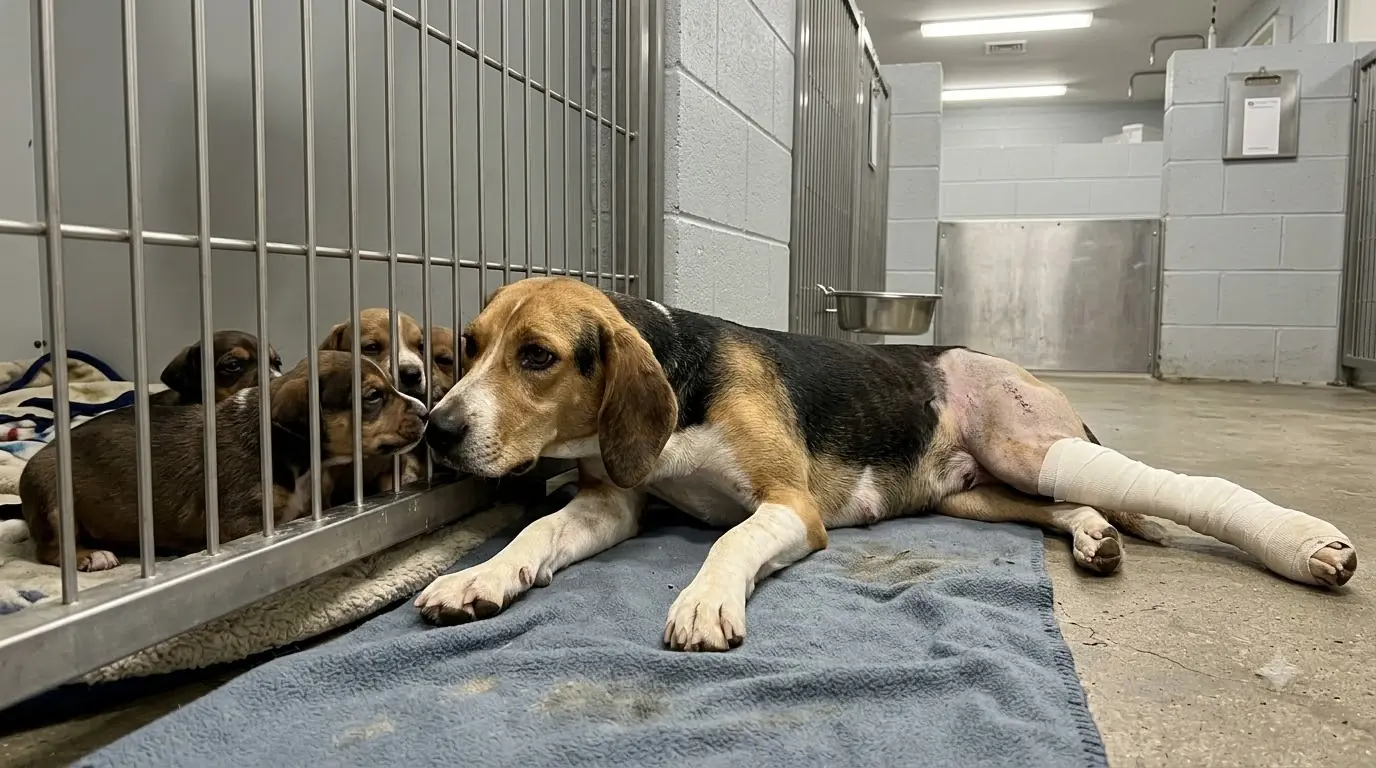
The first time she tried, she made it less than two feet.
The hound mix had returned from surgery only hours earlier. A wide patch of fur had been clipped from one hip and upper hind leg, exposing the cleanly prepared skin around the surgical area. Her recovering rear leg was protected in a visible bandage, and she was still weak enough that standing without support was not considered safe.
She had been placed on thick bedding in the recovery area with everything staff expected her to need within easy reach.
Water.
Clean blankets.
A quiet environment.
Pain medication on schedule.
Close postoperative monitoring.
And only a short distance away, separated by a secure puppy pen, her litter.
The arrangement was deliberate.
She needed to recover from surgery without puppies climbing over the operated leg, pulling at bandaging, or repeatedly forcing her to reposition herself.
The puppies still needed monitoring and care of their own.
For the first part of the afternoon, the mother remained where staff had settled her.
Then the puppies began making noise.
Her head came up.
She listened.
A few seconds later, she planted both front paws into the bedding.
Her chest lifted.
Her hindquarters did not.
She tried again.
The recovering leg stayed behind her.
Instead of standing, she pulled.
Her body moved forward a few inches.
Then she stopped.
She rested.
Then she pulled again.
By the time a caregiver noticed what she was doing, the mother had worked herself partway across the recovery space.
She was headed directly toward the puppy pen.
Staff carefully returned her to her bedding.
Not long afterward, the puppies vocalized again.
The mother lifted her head.
And she started all over.
Surgery Had Solved One Problem and Created a New Challenge
The hound mix had entered rescue care with a significant problem affecting one hind leg.
Exactly how the injury had occurred could not be confirmed.
There was no reliable history that allowed the rescue to say whether it happened while she was living outside, during an accident, or under circumstances no one had witnessed.
The veterinary team could document the condition of the limb.
They could not responsibly invent the events that caused it.
What mattered medically was that the injury was painful enough and mechanically significant enough to require surgical treatment after examination and appropriate imaging.
Her condition was complicated by another fact.
She was raising puppies.
That meant every medical decision had to account for more than the injured limb.
Her nutritional needs were higher.
Her mammary glands needed monitoring.
Medication choices had to take nursing status into account.
Her opportunities for uninterrupted rest had already been limited by a litter that depended heavily on her.
And after surgery, protecting the repair became essential.
A puppy does not understand orthopedic restrictions.
A puppy understands warmth, milk, familiar scent, and the body it has been sleeping against.
The mother could not simply return to unrestricted nursing immediately after leaving the operating room.
The Puppies Were Close for a Reason
Staff did not place the litter on the opposite side of the building.
They created a controlled setup in which mother and puppies could remain near one another while physical access could be managed.
The puppy pen was adjacent to the recovery area.
The mother could hear them.
Depending on her position, she could see and smell them.
The puppies could detect her as well.
The barrier existed to protect her recovering leg.
It was not intended as emotional isolation.
Initially, staff hoped proximity would allow her to settle.
Instead, proximity gave her a destination.
Whenever the puppies became noisy, she tried to reach them.
She Could Not Safely Walk Yet
Postoperative weakness can come from several factors.
Anesthesia takes time to fully clear.
Pain medication can cause drowsiness.
A dog protecting a surgically treated hind limb may be reluctant or temporarily unable to bear normal weight.
Muscle loss that existed before surgery does not disappear because the mechanical problem has been addressed.
The mother had all of those considerations.
When supported appropriately, she could attempt to organize her other limbs beneath herself.
But her balance was poor.
Her recovering hind leg could not yet participate normally.
The veterinary team did not want her repeatedly attempting unsupported stands and falling.
So her movement was restricted.
That restriction made what happened next especially difficult to watch.
She stopped trying to stand.
She discovered another way to move.
She Used Her Front Legs
The sequence became familiar quickly.
A puppy cried.
The mother's ears shifted.
Her head lifted from the blanket.
She looked toward the pen.
Then her front feet moved underneath her chest.
She pushed down.
Her shoulders rose.
Instead of trying to bring the hindquarters upright, she pulled her body forward.
The bandaged rear leg followed behind.
A few inches.
Pause.
Another pull.
Pause again.
Her movements were slow enough that staff could intervene without a dangerous struggle.
But the direction never changed.
Toward the puppies.
Every time.
Letting Her Crawl Was Not an Option
There is a point at which emotionally powerful behavior can become medically harmful.
The rescue team was not going to allow her to repeatedly drag a fresh surgical site across the recovery area simply because the reason looked touching.
The operated limb needed protection.
Incisions need to remain clean.
Swelling needs monitoring.
Excessive movement can increase pain and interfere with healing.
Repeated crawling could also create abrasions or pressure on other parts of her body.
Staff therefore adjusted the plan.
If the mother could not safely reach the puppies, the puppies could sometimes be brought closer to her.
But even that required supervision.
Nursing Had to Change Temporarily
Before surgery, the puppies had been accustomed to direct access to their mother.
After surgery, unrestricted nursing presented several problems.
Puppies knead with their paws.
They climb.
They push against one another.
They reposition constantly.
A litter trying to reach preferred teats can place surprising pressure against a mother's abdomen and hindquarters.
For a dog with a fresh orthopedic surgical site, that activity was not appropriate.
The veterinary team developed a feeding and contact plan based on the puppies' age and individual condition.
Each puppy was assessed.
Their weights were tracked.
Their hydration, activity, stool, and ability to eat independently or accept supplemental nutrition were monitored.
If they were old enough for age-appropriate transitional food, that became part of reducing the physical demand on their mother.
If supplemental feeding was needed, it was provided appropriately.
The goal was not abrupt separation.
It was to prevent an injured mother from carrying a nutritional and physical burden her recovering body could not safely support.
She Didn't Understand the Recovery Schedule
Staff could manage the medical plan.
The mother responded to something much simpler.
Noise.
When the puppies were asleep, she often rested.
When they woke and began moving around the pen, she watched.
When one or several began vocalizing, her response intensified.
Her front paws planted.
Her chest came up.
The first pull followed.
Sometimes a caregiver could interrupt the sequence by moving closer and calmly redirecting her before she had traveled far.
Other times she had already crossed part of the bedding before anyone reached her.
Staff began anticipating the pattern rather than reacting after it happened.
The Recovery Area Was Rearranged
The distance between the mother's bed and the puppy pen was reduced, but not enough to allow unsupervised contact.
Nonslip, padded surfaces covered the route.
Rolled bedding was positioned strategically to help keep her body supported without pressing against the surgical area.
The puppies' enclosure remained secure.
Most importantly, the mother's resting position was changed so she could lie near the barrier without needing to travel across the entire recovery area.
That helped.
But it introduced the behavior that became the defining image of her recovery.
Her muzzle through the bars.
She Reached the Pen and Stopped Pulling
During one supervised period, staff allowed the mother to move a short controlled distance using her front limbs while supporting her hindquarters enough to protect the surgical leg.
She reached the barrier.
Immediately, the effort stopped.
She lowered herself.
Her head moved toward the bottom of the pen.
Then she pushed her muzzle carefully between two of the vertical openings.
The puppies noticed.
Several small bodies moved toward her.
Tiny noses appeared from the opposite side.
They sniffed.
One puppy licked around her muzzle.
Another pushed against its littermate trying to reach the same opening.
The mother stayed down.
She did not attempt to climb into the pen.
She did not become frantic.
She simply remained with her nose against theirs.
Once staff saw that proximity could help her settle without requiring full physical access, it became part of the recovery strategy.
Contact Was Carefully Controlled
There were times when selected puppies could be allowed closer under supervision.
The mother's body was positioned to protect the operated leg.
Staff prevented puppies from climbing over the hip.
Contact sessions remained short.
If nursing was medically appropriate, it was controlled according to the veterinary plan rather than allowed to continue indefinitely.
The mother's mammary glands were checked as nursing frequency changed.
Abruptly reducing nursing can create problems of its own, including uncomfortable engorgement and inflammation.
The transition therefore needed to account for her as a mother and as a surgical patient.
Neither role could be ignored.
Her Own Body Was Depleted
The shaved hip and bandaged leg were visually striking, but they were not the only parts of her body needing recovery.
Raising a litter takes energy.
A nursing mother requires substantially more nutrition than an ordinary adult dog.
This mother had been trying to meet those demands while also coping with a painful hind-limb problem.
Her body condition reflected that strain.
She was not necessarily emaciated, but she had less reserve than the veterinary team wanted going into rehabilitation.
Her meals were adjusted accordingly.
Nutritionally complete food was offered in portions she tolerated well.
Her appetite was monitored closely after anesthesia.
So were water intake, urination, bowel movements, and signs of nausea.
Pain control was reassessed regularly.
If a dog is too uncomfortable to sleep, eat, or remain settled, rehabilitation becomes much harder.
The First Night Required Close Monitoring
The puppies slept in clusters.
Then they woke.
Then they slept again.
Every time their vocalizations increased, the mother became more alert.
During one period, she attempted to crawl toward them despite having been repositioned comfortably.
A caregiver stopped her before she traveled far.
Later, her bed was moved closer to the pen.
She could lie with her face only a short distance from the barrier.
That changed the night.
When the puppies made noise, she still lifted her head.
But she did not always begin pulling herself forward.
Sometimes she could see them from where she was.
Sometimes a puppy approached the pen wall.
The mother extended her neck.
Their noses met through the barrier.
Then she lowered her head again.
For a dog recovering from surgery, avoiding unnecessary movement was itself progress.
The Puppies Were Becoming Individuals
The litter could not remain simply "the puppies" in the medical record.
Each one had to be followed separately.
Some gained weight faster.
Some were more assertive around food.
One might sleep through activity that woke another immediately.
Their stools were monitored.
Their hydration was checked.
Their body weights were recorded regularly.
As they became developmentally ready, they were encouraged to eat appropriate puppy food rather than relying entirely on their mother.
This reduced pressure on her body.
It also allowed the puppies to progress normally.
Maternal devotion can be emotionally compelling.
Maternal depletion is not something a rescue should preserve because it makes a touching story.
The mother needed permission, medically speaking, to stop doing everything.
She Was Not Interested in That Permission Yet
Her body could rest.
Her behavior took longer to change.
If several puppies vocalized together, she still attempted to move.
Sometimes she managed only one pull before a caregiver intervened.
Sometimes she shifted her body toward the pen without actually traveling.
As her pain decreased, she became more capable of movement—which created another challenge.
Feeling better did not mean the surgical repair was ready for unrestricted activity.
Dogs often become willing to do more before healing tissues are prepared to tolerate it.
That meant restrictions remained even when she seemed frustrated by them.
Rehabilitation Began With Almost Nothing
Her first rehabilitation goals were deliberately modest.
Comfortable positioning.
Safe assisted standing.
Controlled weight shifting when appropriate.
Very short supported movement.
Maintaining useful strength in the unaffected limbs without stressing the repair.
No long walks.
No stairs.
No chasing puppies.
No testing whether she could "push through."
Healing tissue needed time.
On an early assisted stand, her front legs did most of the work.
Her unaffected hind leg found the floor.
The operated side remained protected.
She stayed upright for only a brief period.
Then she was lowered back down.
That counted as enough.
The First Steps Were Uneven
When the veterinary team determined that controlled walking was appropriate, a support harness helped stabilize her hindquarters.
The first steps looked nothing like normal walking.
Her front end advanced.
The unaffected hind leg followed.
The recovering leg participated only as much as medically permitted and comfortable.
Her body shifted to compensate.
Staff kept the session extremely short.
She was returned to her bed before fatigue could turn controlled movement into struggling.
The puppies happened to be awake.
She looked toward them.
For once, she had moved while upright rather than dragging herself across the floor.
She did not reach the pen that day.
That was not the goal.
She Had Better Days and Harder Ones
Recovery did not progress cleanly.
One morning she stood more easily.
The following day she appeared stiffer.
After one rehabilitation session, she slept for hours.
Another day, the puppies became particularly noisy and she tried repeatedly to reposition herself toward them.
Staff adjusted activity accordingly.
The surgical site was checked for swelling, redness, discharge, heat, or other changes that could indicate a complication.
The bandage was monitored carefully.
Her pain plan was adjusted based on veterinary assessment.
No single difficult day was treated as failure.
No single strong day was treated as proof that she was healed.
Something Else Began Changing
The puppies stopped calling for her as often.
Not because anything was wrong.
Because they were growing.
They played with one another.
They investigated food.
They chewed toys.
They slept in increasingly varied positions instead of always piling into the tightest possible cluster.
Their world expanded.
The mother noticed them, but she also began sleeping through some of their activity.
That was new.
Early in recovery, a chorus from the puppy pen could bring her front paws underneath her almost instantly.
Later, she sometimes opened her eyes, listened, and remained where she was.
The puppies settled themselves.
So did she.
The First Time She Walked to the Barrier
It happened under supervision.
She was already upright with support.
The distance was short.
Only a handful of careful steps separated her from the puppy pen.
Her gait remained uneven.
The recovering leg was not normal.
It was not expected to be.
But she moved without dragging her body.
One step.
Pause.
Another.
The support harness remained ready beneath her.
When she reached the barrier, she lowered herself with assistance.
Then came the familiar movement.
Her muzzle went toward the opening.
The puppies gathered.
Their noses met hers.
The image looked almost identical to those first postoperative days.
Except for one important difference.
She had reached them on her feet.
Staff Still Didn't Let Her Stay There Forever
Improvement did not mean abandoning boundaries.
The mother needed her own rest.
The puppies needed independence.
After several minutes, she was returned to her recovery bed.
This time she did not immediately try to crawl back.
She drank.
She settled.
Then she slept.
That behavior was as important as walking.
She was beginning to tolerate being away from the litter without treating every separation as something she needed to physically correct.
Nursing Gradually Became Less Central
As the puppies matured, nursing sessions naturally decreased under veterinary guidance.
The mother's mammary tissue was monitored during the transition.
Her calorie needs were adjusted as milk production declined.
She began keeping more of her nutritional intake for her own recovery.
Slowly, her body reflected it.
Her waist looked less depleted.
Muscle restoration would take longer, especially around a surgically treated hind limb, but she had more energy.
Her coat around the clipped surgical area also began growing back.
At first, the difference was barely visible.
A soft shadow over skin.
Then short fur.
The bandage changed or disappeared according to the healing plan.
The visual signs of surgery became less dramatic even while rehabilitation continued.
She Began Choosing Other Places to Rest
For weeks, the puppy pen had functioned almost like a magnet.
If she had a choice, she wanted to be near it.
Then caregivers began finding her elsewhere.
On a thicker bed.
Near a familiar staff member.
Stretched in a patch of afternoon light.
She still checked on the puppies.
But she no longer needed to spend every resting period against their barrier.
The change was especially noticeable after supervised visits.
Earlier, separating them again could trigger another attempt to move toward the pen.
Now she might watch them for a moment and then turn toward her own bed.
The Puppies No Longer Fit at One Opening
They were growing quickly.
The tiny noses that once clustered easily through the same section of barrier now belonged to larger, stronger puppies.
They jostled.
They played.
They approached their mother and then became distracted by something else.
One might remain near her while another wandered toward a toy.
A third might choose food over the reunion entirely.
That was exactly what staff wanted to see.
They were becoming independent dogs.
Their mother was becoming one too.
Her Leg Will Always Be Part of Her Medical History
Surgery does not erase an injury.
Depending on the original orthopedic problem, she may require continued monitoring for stiffness, reduced range of motion, altered gait, or later degenerative changes.
Her future caregivers will need to understand that.
Appropriate body weight will matter.
Controlled conditioning will matter.
Veterinary follow-up will matter.
She may never move exactly as though the injury never happened.
That is not the standard for success.
Comfortable function is.
The Puppy Pen Is Less Important Now
As the litter approached appropriate developmental milestones, their living arrangement changed.
They needed more room.
More individual experiences.
More opportunities for age-appropriate socialization and exploration.
The mother needed increasingly independent rehabilitation.
The barrier that had once separated a postoperative dog from a dependent litter no longer carried the same meaning.
Sometimes the puppies passed nearby without calling.
Sometimes the mother watched.
Sometimes she did not even lift her head.
And occasionally, one of them still approached the barrier.
The mother would walk over.
Slowly.
On all four legs.
She Still Puts Her Muzzle Through the Gap
That part has not completely disappeared.
If the puppies gather near the side of their enclosure, the hound mix sometimes approaches.
Her gait remains careful.
The fur over her hip is still shorter where it was shaved.
Her recovering hind leg does not move with quite the effortless rhythm of the others.
But she no longer plants her front paws and drags the rest of her body behind her.
She walks.
When she reaches the pen, she lowers her head.
One or two puppies may come over.
She pushes her muzzle toward the opening.
A nose meets hers.
Sometimes another puppy joins.
Then, usually within moments, somebody gets distracted.
A puppy turns toward a toy.
Another trots away.
The mother watches.
During those first hours after surgery, that would have been the moment she tried to follow.
Now she often remains where she is for a few seconds.
Then she turns in the opposite direction.
Her bed is waiting.
She walks back to it.
She circles once and lowers herself carefully, protecting a leg that is still healing even though it is much stronger than before.
The puppies continue playing.
She hears them.
Sometimes her ears move toward the sound.
But she does not get up.
For the dog who once tried again and again to pull a freshly operated body across the recovery floor whenever her puppies cried, being able to hear them without needing to reach them may be one of the quietest signs of how far both mother and litter have come.
She can still go to them.
She just no longer has to crawl.