Baxter’s problem was difficult for shelter employees to explain because there was no single thing wrong with him that made people say no. The gray-and-white mixed-breed dog was affectionate with familiar handlers, manageable on leash, physically strong but not constantly demanding, and increasingly eager for human attention once he understood that a person meant him no harm. He did not have a dramatic behavioral history attached to his kennel card, and staff documented no known bite history during his stay. Yet each evening ended with Baxter returning to the same kennel while other dogs disappeared through the front doors with families.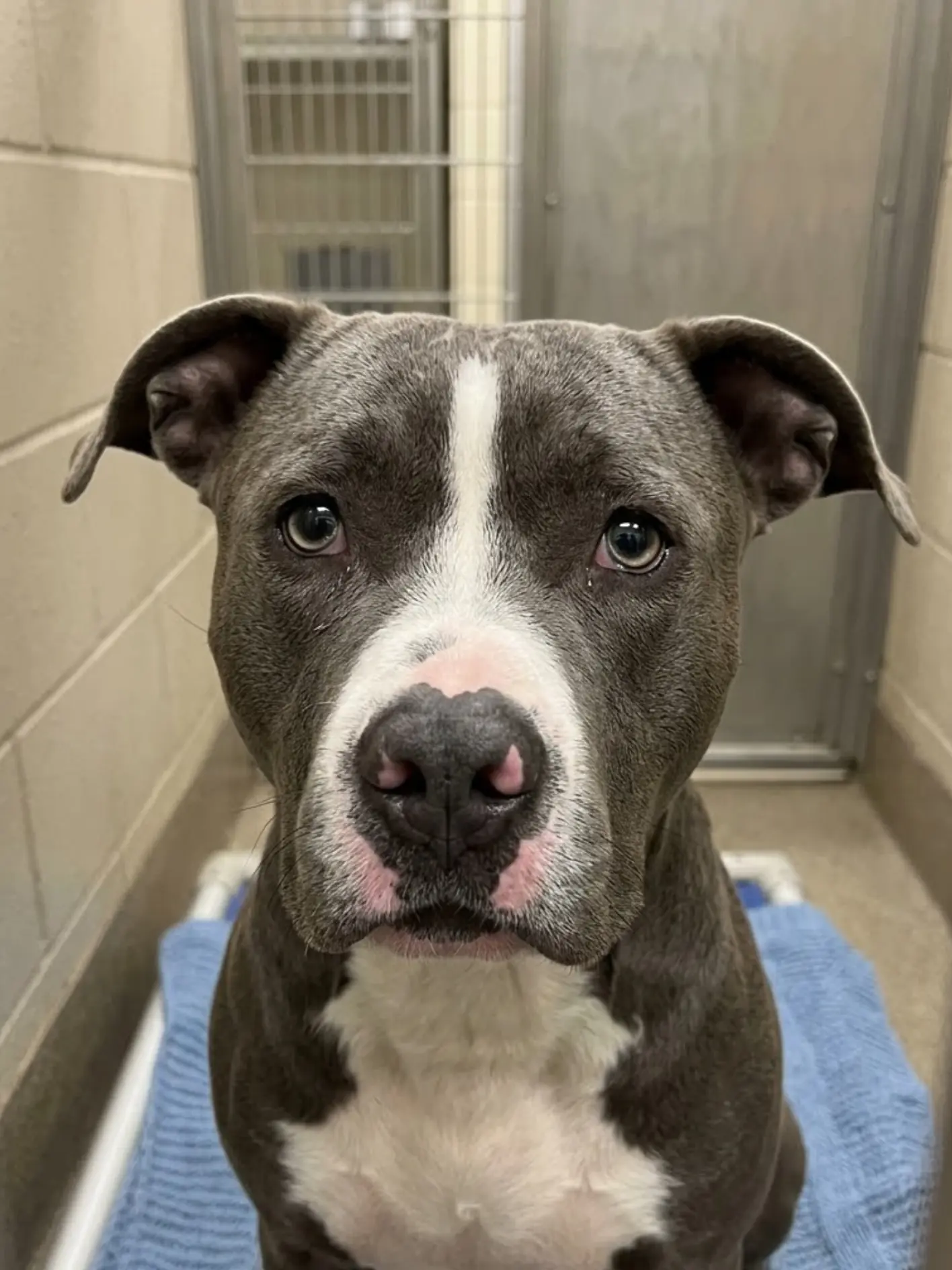
When he first entered the shelter, employees were more concerned about helping him settle than finding an adopter immediately. Baxter had been picked up after several residents reported seeing him wandering through a neighborhood without a person nearby. He wore an old collar, suggesting that at some point he had probably belonged somewhere, but nothing attached to it led directly to a current owner. Staff followed the available process for trying to locate someone searching for him, but nobody arrived to take him home.
The shelter could not know exactly how Baxter had ended up alone. Perhaps he had slipped through a gate and traveled much farther than anyone expected, or perhaps a previous household had changed in a way that left no plan for him. Employees deliberately avoided inventing an abandonment story they could not verify. What mattered now was that Baxter had become another dog living temporarily inside a building already responsible for many others.
His first few days were quiet. Baxter watched people carefully, especially when unfamiliar hands reached toward him, but he rarely reacted dramatically. He usually stood still, lowered his head slightly, and waited long enough to understand what was happening. With employees he saw repeatedly, that hesitation faded quickly. Soon he was moving toward the kennel door when certain voices approached and leaning gently into hands that rubbed the side of his neck.
One kennel attendant named Lauren was among the first to notice how affectionate he could become. During intake, Baxter had seemed serious and reserved, but once she began spending a few minutes with him each day, he started greeting her differently. Instead of remaining several feet back, he would walk toward the gate, wait for the leash, and stay close once they reached a quieter area outside. He was not constantly climbing into her lap or demanding attention; he simply seemed happiest when he could stand beside someone without having to compete for their notice.
That understated personality should have appealed to many adopters. In practice, it became easy to overlook.
The shelter corridor was filled with dogs presenting themselves in much more obvious ways. Some bounced against their gates, wagging so hard their entire bodies moved. Others barked or pushed their noses through the bars whenever a visitor approached. Baxter often sat quietly and watched. People stopped because his broad face and pale eyes were striking, but many made their first judgment before he had enough time to show anything else.
Some visitors seemed uncertain because of his appearance. Baxter had the sturdy body and broad head often associated with bully-type mixes, and employees occasionally heard people ask whether dogs that looked like him were naturally aggressive. Staff responded with the information they actually had rather than making broad promises about breed. Baxter’s shelter behavior had been manageable, he had no known bite history during his stay, and his interactions with familiar people had been affectionate. At the same time, no shelter could guarantee how any dog would behave in every future environment.
That honesty mattered, but it also meant the people considering Baxter had to think beyond a photograph.
The first family who seriously asked to meet him had two teenage children and had owned large dogs before. Their meeting began well. Baxter spent several minutes investigating the room and checking Lauren’s position before gradually approaching the family. He accepted treats, allowed gentle petting, and eventually stood between the father and one of the teenagers as though the space between them had become comfortable enough to occupy.
The family liked him. They stayed nearly an hour, asked about feeding and exercise, and took him outside for a walk. Baxter pulled with some enthusiasm during the first few minutes but settled once he had a chance to explore, which did not particularly bother the father, who had handled larger dogs before.
The problem emerged later in the conversation. Their homeowners insurance had restrictions involving certain dog types, and although nobody at the shelter could definitively assign Baxter a breed based on appearance alone, the family worried that bringing him home could create a coverage problem. They promised to call the insurance company and left without making a final decision.
The answer arrived the next morning.
They could not take him.
The family apologized. Lauren understood. Housing policies and insurance restrictions are practical barriers that affection cannot always overcome, and encouraging people to ignore them can place a dog at risk of another surrender later.
Baxter went back to waiting.
A second potential adopter arrived several days later. She was a woman in her thirties who lived alone and wanted a dog primarily for companionship. Baxter responded unusually well to her. Within twenty minutes he was standing close enough that she could rub his chest, and by the end of the meeting he followed her calmly through the exercise yard.
For a while, shelter workers thought Baxter might finally be leaving.
Then the woman explained that her elderly mother visited frequently and was frightened of larger dogs. She had hoped meeting Baxter might change her own confidence enough that she could convince her mother, but after seeing his size in person, she admitted that bringing him home would probably create a family conflict every weekend.
She left without him.
Nobody had rejected Baxter because he had behaved badly.
Again, circumstances had simply failed to fit.
That distinction became increasingly important as his stay lengthened. Baxter was not a dog nobody liked. He was a dog people repeatedly liked without being able to build a permanent plan around him. One person lived somewhere with restrictive rules, another already had animals and did not know whether a safe introduction would be possible, while another household wanted a smaller dog that an older family member could handle comfortably.
Each decision was individually understandable.
Together, they left Baxter behind.
Lauren began taking him outside more frequently whenever her workload allowed. She discovered that Baxter’s favorite part of a walk was often not the walking itself but what happened afterward. Once he had spent enough time sniffing and moving, he would stand close to her or sit beside the bench while she finished notes on her phone. If she stopped petting him, he sometimes turned his head toward her hand as if quietly asking whether she had really finished.
Those moments changed how she described him to visitors. Instead of calling Baxter merely “sweet,” a word used so often in animal rescue that it can become almost meaningless, Lauren explained what she had actually seen. He sought physical affection after he trusted someone, settled reasonably after initial excitement, and seemed content sharing space rather than demanding constant entertainment.
New photographs were taken outside the kennel. In one, Baxter stood beside Lauren with his mouth relaxed and his attention focused on her instead of the camera. Another showed him resting after a walk. Staff hoped removing the visual barrier of kennel bars would help people imagine him somewhere else.
The photographs worked in one sense.
More people noticed him.
A local community page shared Baxter’s profile, and hundreds of reactions followed. People commented on his eyes, his expression, and the unfairness of seeing such a gentle-looking dog still waiting. Several offered to contribute toward his adoption fee. One person promised to pay for a professional training session if an adopter came forward.
The number of comments made Baxter appear surrounded by help.
His kennel remained occupied.
This is where shelter visibility can become misleading. A dog may receive hundreds of reactions without receiving a single completed application. One person sees dozens of comments and assumes somebody else is already driving to the shelter. Another notices several rescue organizations tagged beneath a photograph and believes one of them must have arranged a transfer. Someone who could realistically foster may decide there is no need to ask because the dog looks popular enough to be safe.
Baxter was becoming popular.
He was not becoming placed.
A rescue organization eventually contacted the shelter after seeing one of Lauren’s posts. The coordinator liked what staff reported about Baxter and believed a foster home might reveal even more about his behavior outside the kennel. The organization could potentially accept responsibility for him, but there was one major problem: all of its large-dog foster homes were occupied.
The rescue shared Baxter again and asked its volunteer network for temporary space.
For two days, nothing happened.
Then a foster offer appeared. A man who had previously owned large dogs said he could keep Baxter for several weeks while the rescue searched for an adopter. He owned his home, had a fenced backyard, and appeared comfortable during their initial conversation.
The plan looked promising until staff learned that he had an unneutered male dog with a history of serious conflict with unfamiliar dogs. The foster believed the two could simply meet loose in the yard and “work it out.”
The rescue declined.
Emergency placement could not mean intentionally creating another emergency.
A second possible foster lived in an apartment that technically allowed dogs, but the property had a strict weight limit. Baxter exceeded it.
Another door closed.
Lauren found those failed possibilities more emotionally exhausting than Baxter did because he had no idea they existed. She could spend an evening believing he might finally sleep somewhere outside the shelter, only to arrive the following morning and find him waiting exactly where she had left him. Baxter greeted her the same way regardless of whatever messages had been exchanged after closing.
His world remained smaller.
Food.
Water.
The kennel.
The hallway.
The occasional walk.
People who arrived.
People who disappeared.
As the weeks continued, the shelter itself changed around him. Several dogs entered through animal control within a short period, including strays that needed to remain available for owners to find them. Two animals arrived after a family lost housing unexpectedly, while another kennel had to be temporarily removed from general use because a dog required medical isolation.
Open runs became scarce.
Nothing about Baxter had changed enough to explain why his situation suddenly felt more dangerous. He had not developed a new medical crisis. There had been no major incident that caused staff to decide he was unmanageable. If anything, employees knew him better than when he arrived and had accumulated more positive observations.
The change was mathematical.
Too many dogs.
Too few exits.
Public animal shelters cannot stop intake simply because an individual dog has not found his perfect adopter. Lost animals continue needing somewhere to go. Emergency cases still arrive. Housing instability, illness, and family crises do not wait for a kennel to become conveniently available.
Every dog that leaves safely creates room.
Every dog that remains occupies it.
Baxter’s length of stay began appearing in internal discussions about animals needing faster placement.
Staff contacted the earlier rescue again. Still full.
Other groups were asked.
One replied that it could share Baxter but had nowhere to house him. Another organization already had several large dogs waiting for foster placement. A third rescue asked whether the shelter could guarantee that Baxter was safe with cats, something staff could not responsibly promise because they did not have enough information.
The answers were not cruel.
They were limitations.
Those limitations accumulated around Baxter until his situation became urgent.
Lauren responded by changing the way she advocated for him. She stopped writing posts centered entirely on sadness because sadness had already generated attention. Instead, she focused on practical fit. Baxter needed someone comfortable with a strong medium-to-large dog, able to provide a responsible adjustment period, willing to continue training, and prepared to learn who he was outside the shelter rather than judging him from a few minutes behind bars.
The change produced fewer comments.
It produced better inquiries.
One couple visited twice and appeared genuinely prepared. They had no other animals, owned their home, and had experience with larger dogs. Baxter relaxed during both meetings and seemed especially comfortable with the husband, eventually placing his head beneath the man’s hand when the petting stopped.
Everyone involved became cautiously optimistic.
The couple left after the second meeting saying they wanted one night to think before adopting.
Lauren understood.
A ten-year responsibility deserved more than an impulsive answer.
The following afternoon, the couple called.
A close relative had experienced a serious medical emergency, and the family’s immediate plans had changed. They would be traveling frequently over the next several months and no longer believed bringing Baxter home was responsible.
Another almost.
Another kennel door remaining closed.
By then, staff could no longer discuss Baxter’s case as though unlimited time remained. The shelter population continued climbing, and several long-stay dogs were moved into critical placement status.
Baxter was one of them.
The notice meant that adoption, foster care, or rescue transfer was no longer merely desirable. It needed to happen quickly.
His photograph circulated again, this time accompanied by an explanation that he could be euthanized for space if placement was not secured. The reaction was immediate and intense.
Some commenters blamed the shelter.
Others demanded to know why employees could not simply keep Baxter somewhere else.
Several people accused everyone who had met him previously of failing him.
Lauren understood the anger, but none of it created a home. The employees feeding Baxter were also the people networking him. The rescue organizations declining him were often managing dozens of dogs with no empty foster homes. The potential adopters who walked away had frequently done so for practical reasons that might have caused the adoption to fail later.
There was no single villain standing between Baxter and safety.
There was simply no confirmed place for him to go.
Then staff received the final notice.
Unless an appropriate adopter, foster, or rescue commitment was secured that day, Baxter was scheduled to be euthanized because the shelter needed space.
Today.
Lauren read the update before beginning her shift.
When she reached Baxter’s kennel, he stood and moved toward the gate.
He looked exactly as he had the previous morning.
That was the part she found hardest.
Baxter did not know that yesterday had contained more future than today. He could not understand why people were suddenly sharing his photograph more urgently or why employees were making additional phone calls. Dogs do not know what euthanasia lists mean.
Baxter knew Lauren.
He knew the leash.
He knew that the kennel door opening usually meant several minutes outside.
She clipped it on and took him for a walk.
Baxter left the building with his usual initial enthusiasm, sniffing near the fence and pulling briefly toward something he found interesting before settling. Lauren deliberately did not treat the outing as a farewell. She followed the same path they normally used and sat on the same bench after he had enough time to explore.
Baxter approached.
He stood beside her.
When Lauren rubbed his chest and then stopped, he moved closer until her hand returned.
She laughed despite herself.
That was Baxter.
Not the gray dog from an urgent post.
Not a number representing occupied kennel space.
Just a dog who liked being touched by someone he trusted.
Lauren remained outside longer than usual, but eventually the shelter routine required them to return. Baxter followed her down the corridor and walked into the kennel.
The gate closed.
Calls continued.
By late morning, several new inquiries had arrived. One person wanted him but could not come until the following week. The shelter could not promise a following week. Another household wanted Baxter as a permanent outdoor guard dog, which staff did not believe fit what they had learned about him.
A third caller already had four dogs and wanted to bring Baxter directly into the group without controlled introductions.
That was not a safe emergency plan either.
Time grew shorter.
The person who eventually changed the outcome was not somebody who discovered Baxter that morning. His name was Thomas Greene, and he had already walked past Baxter several weeks earlier.
Thomas was fifty-seven and had come to the shelter with his adult daughter, who was looking for a small dog. While she met several animals, Thomas wandered through the larger-dog section and stopped at Baxter’s kennel.