David Mercer stepped outside his camper shortly after sunrise expecting nothing more unusual than a wet picnic table, a cold fire ring, and another gray morning in the mountains of northern Idaho. Rain had moved through Pine Creek Campground for most of the night, tapping steadily against the roof of his trailer and turning the narrow gravel roads between campsites into shallow strips of mud.
By dawn, the storm had weakened to a mist, and the surrounding forest was quiet except for water dripping from ponderosa pine branches and the low sound of the creek beyond the campground boundary.
Mercer had made coffee and was walking toward the trash station when something pale caught his attention near the entrance road.
At first, he thought it was a plastic bag tangled in the grass.
Then the object moved.
A white head lifted.
Mercer stopped.
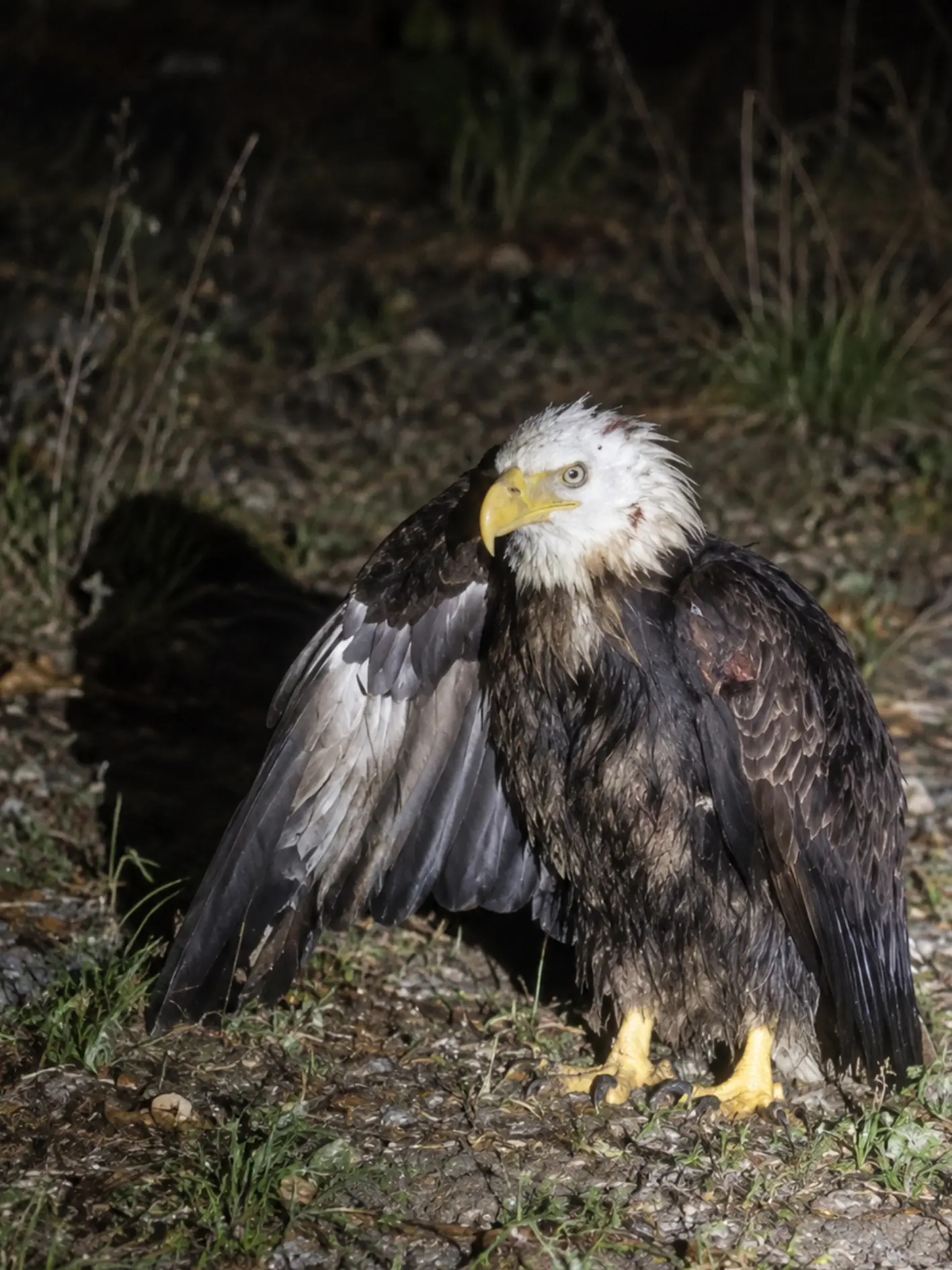
Less than fifty yards beyond the campground entrance, an adult Bald Eagle stood on the muddy edge of a drainage area with one wing hanging noticeably lower than the other.
The bird was soaked.
Its dark body feathers clung together in places, making the eagle look smaller than it actually was. The white feathers around the head and neck were dirty and flattened from the rain. One wing remained partly extended, the long flight feathers nearly touching the ground. A small area near the shoulder appeared darker than the surrounding plumage.
Mercer had seen Bald Eagles many times while fishing in Idaho, but never one standing like this.
For several minutes, he stayed where he was.
The eagle looked directly toward him.
Its eyes were open and alert.
That was reassuring.
What happened next was not.
The bird shifted its weight, opened both wings, and appeared to prepare for flight.
The left wing extended fully.
The right wing moved only partway.
The eagle gave two hard flaps, lifted its body slightly, and came back down almost immediately.
It did not reach the nearest tree.
Mercer stepped backward.
The eagle remained standing, breathing faster after the failed attempt.
He now understood that the bird had not simply landed beside the campground to rest.
It could not leave.
Mercer returned to his campsite and told his wife to keep their dog inside. He also walked to the neighboring campsites and asked several early risers not to approach the eagle.
A few people wanted to see it.
Mercer discouraged them.
The bird was injured, wet, and exhausted. A crowd would only increase the likelihood that it tried to fly again.
He called the ranger station serving the fictional Clearwater Ridge Recreation District and explained what he had found.
The ranger who answered asked him to describe the bird’s posture.
One wing lower than the other.
Visible blood?
Possibly near the shoulder, though Mercer could not tell from a distance.
Standing?
Yes.
Flying?
It had tried and failed.
Any obvious fishing line or wire?
None that he could see.
The ranger instructed him to maintain distance and keep dogs away. A staff member would be sent to assess the bird, and if necessary, a licensed raptor rehabilitation team would be contacted.
Mercer returned to a place where he could observe without approaching.
The eagle barely moved for the next twenty minutes.
It occasionally turned its head.
Once, it tried to preen its chest but stopped almost immediately.
Rainwater continued dripping from the feathers.
The injured wing remained low.
Mercer wondered how long the bird had been there.
He had gone to bed shortly after ten the night before. The campground had been dark and nearly empty because the weather had discouraged most weekend visitors. He remembered hearing something outside around two in the morning, a heavy rustling sound somewhere beyond the trailer. At the time, he assumed wind had knocked a branch down.
Now he wondered if the eagle had already been on the ground.
If so, it may have spent much of the night wet, cold, and unable to fly.
Ranger Melissa Carter arrived shortly after seven.
She stopped her vehicle well away from the bird and used binoculars before getting out.
The adult Bald Eagle was still in the same general area.
Carter immediately noticed the wing position.
She also noticed something Mercer had not seen clearly: several feathers around the upper right wing were disturbed, and there appeared to be a small wound near the shoulder.
Carter walked back toward Mercer rather than toward the eagle.
“This one needs help,” she said.
She radioed the Inland Northwest Raptor Rehabilitation Center and requested a field response.
While waiting, Carter asked Mercer whether he had seen or heard anything during the night that might explain the injury.
No vehicle strike.
No gunshot.
No fight between birds.
No collision witnessed.
The campground entrance road was lightly traveled after dark, though a service vehicle or camper could have passed without Mercer hearing it through the rain.
Tall trees surrounded the area.
Several utility lines ran near the access road farther downhill.
There were enough possible hazards that no single explanation stood out.
Carter did not speculate.
Where the eagle was found was known.
How it became injured was not.
The bird attempted another short movement about ten minutes later.
This time it walked away from the road toward low brush.
The right wing brushed the wet vegetation.
When the eagle tried to lift it higher, the motion stopped abruptly.
The bird stood still again.
Its body posture had become more hunched.
That concerned Carter.
The eagle was still alert enough to react to people, but the combination of injury, exposure, and exhaustion was gradually reducing its ability to compensate.
The wildlife-response vehicle arrived shortly after eight.
Field rescuers Hannah Blake and Eric Nolan carried a ventilated transport crate, thick towels, heavy protective gloves, and basic stabilization equipment.
They watched the eagle before approaching.
Blake immediately agreed with Carter’s assessment.
The bird needed capture.
They planned their positions carefully.
The campground road was behind the eagle.
Dense brush and a steep creek bank lay ahead.
If the bird reached the creek, the rescue could become much more difficult.
Nolan moved slowly toward the lower edge of the brush so he could prevent the eagle from entering the steepest section.
Blake approached from the open side.
The eagle noticed her almost immediately.
Its head rose.
The beak opened.
The body shifted forward.
For a few seconds, the bird looked powerful again.
Then instinct took over.
The eagle ran.
Both wings opened.
The left side extended broadly.
The injured right wing opened only partway.
The bird made one hard attempt to leave the ground.
Its feet lifted.
Its body moved forward several yards.
Then the right side dropped, and the eagle came down in the wet grass.
Blake stopped.
She did not want another attempt.
Every forceful wingbeat could worsen an unstable fracture or deepen soft-tissue damage.
The eagle remained low after the failed launch.
Its breathing was heavy.
Nolan held position near the brush.
Blake waited until the bird settled, then approached with a towel.
The eagle raised one foot defensively.
Even exhausted, it was capable of striking.
Blake placed the towel over the head and upper body while Nolan immediately controlled the legs above the feet.
The talons closed forcefully around the heavy gloves.
The bird struggled beneath the towel.
Both wings moved, but the injured side remained limited.
Blake supported the right wing against the body before lifting the eagle.
Up close, the injuries became easier to see.
Several feathers around the shoulder were missing or broken.
There was a deeper abrasion beneath the upper wing, surrounded by bruising and dried blood.