By the time Mark Holloway reached the riverbank, the other Bald Eagles were already gone.
Only one remained.
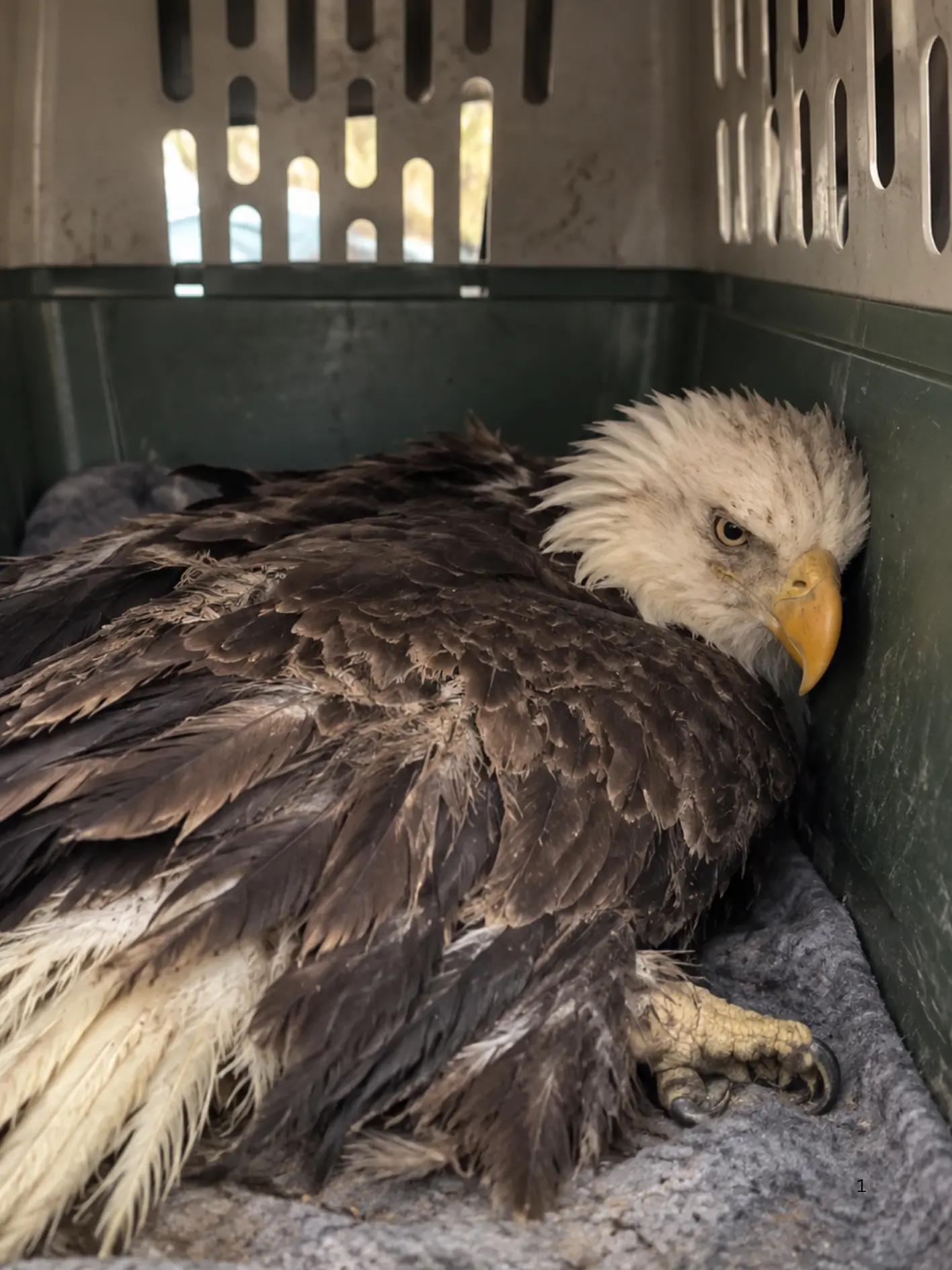
It was crouched beneath a cottonwood near the edge of the Yellowstone River in western Montana, its dark body pressed low against wet gravel and its white head barely raised above the surrounding driftwood. From a distance, the bird appeared to be resting. Up close, something was clearly wrong.
Holloway had noticed several Bald Eagles in the area less than ten minutes earlier. He had been walking a narrow public-access trail shortly after sunrise when a cluster of ravens drew his attention toward a gravel bar. Three or possibly four adult and immature eagles were gathered near what appeared to be fish remains along the water.
The scene was not unusual for the season.
What happened next was.
A sudden burst of movement erupted near the shoreline. Wings opened. Several birds lifted almost simultaneously. Holloway heard rapid wingbeats and a harsh call, then saw one eagle drop abruptly toward the ground.
He could not tell whether two birds had collided, whether the eagle had struck a branch, or whether something else had happened during the confusion.
The other eagles continued across the river.
The bird that had gone down did not follow.
Holloway waited.
The eagle stood once, spread both wings and appeared to prepare for takeoff. It managed several hard wingbeats but barely lifted from the gravel. After a few feet, it came down again.
The bird remained upright for several seconds.
Then it lowered itself.
Holloway stopped walking.
The eagle’s posture did not look like that of a healthy bird choosing to stay behind.
Its chest moved rapidly. One shoulder appeared slightly lower. Several feathers along the back and wing were disturbed. The bird turned its head toward Holloway but did not attempt another flight.
He backed away and called the regional wildlife office.
The dispatcher asked him not to approach again.
An injured Bald Eagle can remain extremely dangerous, even when exhausted. Its feet may retain enough strength to cause severe injury, and forcing a traumatized bird into repeated takeoff attempts can worsen internal damage.
Holloway stayed nearly fifty yards away.
From there, he watched the eagle try to walk toward a patch of brush.
The first few steps looked normal.
Then the bird stopped.
Its head lowered.
It remained motionless for almost a minute before taking several more steps.
Holloway had seen wild eagles countless times along Montana rivers. Even when feeding on the ground, they carried themselves differently. They were alert, mobile, and ready to leave.
This bird looked as though every movement required calculation.
The other eagles were nowhere in sight.
To Holloway, the scene felt like abandonment.
Wildlife specialists would later describe it differently. Bald Eagles are not a coordinated social group in the human sense, and there was no evidence that the other birds had deliberately left an injured companion behind. They had simply been able to escape the disturbance.
This eagle had not.
Conservation Officer Rachel Whitmore arrived about twenty-five minutes later.
Holloway met her at the trailhead and explained what he had seen.
“There were several of them,” he said. “Then everything happened at once. They went up, and this one came down hard.”
“Did you see another eagle hit it?”
“I couldn’t tell.”
“Did you hear a gunshot?”
“No.”
“Any vehicle nearby?”
“Nothing close enough that I noticed.”
Whitmore wrote the details down without converting uncertainty into certainty.
The timing mattered.
So did what Holloway had actually witnessed.
Several birds became airborne.
One came down abruptly.
That was useful information.
It did not establish a cause.
Whitmore used binoculars from the trail.
The eagle remained beside the cottonwood.
Its wings were folded, but the body looked unusually low.
She noticed that the bird’s breathing remained rapid despite having been undisturbed for several minutes.
That concerned her more than the visible abrasions.
A superficial wound can look dramatic and still be relatively minor.
Abnormal breathing after blunt trauma can signal something deeper.
Whitmore contacted the fictional Montana Raptor Recovery Center and requested a field team.
While they waited, the eagle stood again.
This time it moved toward the water.
Whitmore immediately repositioned herself to discourage the bird from entering the river without forcing it to run.
An eagle weakened enough to lose flight could become trapped or hypothermic if it reached deep water.
The bird changed direction.
It walked beneath another tree and stopped.
The wildlife response vehicle arrived shortly before eight.
Field rehabilitators Claire Dawson and Ben Ortiz carried a padded transport kennel, heavy gloves, towels, and basic emergency supplies.
Before attempting capture, Dawson watched the eagle for nearly five minutes.
She noted the same things Whitmore had.
Rapid respiration.
Reduced willingness to move.
A slightly dropped shoulder.
Dirty feathers along the belly.
The bird still followed people with its eyes.
That was reassuring.
The rest was not.
Dawson planned the approach with Ortiz and Whitmore.
The eagle had open water on one side and thick vegetation on the other. If startled too aggressively, it could enter either environment and become much harder to reach.
Ortiz moved quietly toward the river side.
Whitmore stayed farther inland.
Dawson approached from the open gravel bar.
The eagle saw her immediately.
Its head rose.
The beak opened.
One foot shifted forward.
For several seconds, the bird looked stronger.
Then Dawson moved closer.
The eagle began to run.
Both wings opened.
The first wingbeats lifted it perhaps two feet above the ground.
The bird traveled only a short distance.
Then its body lost height abruptly.
It landed heavily, stumbled, and remained low.
Dawson stopped.
She did not want another attempt.
The failure was informative enough.
The wings could move.
The bird could generate lift briefly.
Something was preventing sustained flight.
Once the eagle’s breathing slowed slightly, Dawson approached again.
The bird raised one foot.
Its talons opened.
Even exhausted, it was still capable of defending itself.
Dawson placed a towel over the head and upper body while Ortiz controlled the legs above the feet. Whitmore supported one wing as the bird struggled.
The resistance lasted only a few seconds.
That was what worried Dawson.
Healthy adult Bald Eagles rarely surrender so quickly during restraint.
The feet remained functional, but the overall strength was poor.
“What worries me most is how fast it gave up,” she said.
The responders lifted the eagle carefully.
At close range, the external injuries were visible but not catastrophic.
There was bruising beneath feathers along the upper chest.
A small superficial wound crossed one shoulder.
Several covert feathers were broken.
There were minor abrasions around the head.
No bone was exposed.
No major active bleeding was present.
The wings did not feel grossly fractured.
The bird’s chest, however, moved rapidly beneath the towel.
Its breathing remained shallow.
Dawson kept handling to an absolute minimum.
The eagle was placed into the padded kennel.
Inside the carrier, it settled almost immediately onto the blanket rather than remaining standing.
Holloway watched from the trail.
He asked whether the bird had been attacked by the other eagles.
Dawson answered cautiously.
“Something happened while those birds were together, but we cannot say yet whether another eagle caused this. It could have collided with another bird. It could have hit the ground, a tree, or something else during the disturbance.”
What mattered medically was the impact.
The exact object could wait.
The eagle was transported to Montana Raptor Recovery Center.
Dr. Evelyn Carter met the field team in the treatment area.
The carrier was opened in a quiet room with oxygen available nearby.
The eagle remained low.
Its eyes were open.
The head rose when Carter approached.
That response was reassuring.
The respiratory pattern was not.
The bird was breathing faster than expected, and the breaths appeared shallower than normal.
Carter began with a rapid stabilization examination.
Body temperature was below ideal.
Hydration was moderately reduced.
Grip strength was present but weaker than expected for a healthy adult Bald Eagle.
Both pupils responded normally.
The spine did not show obvious instability.
The major wing bones felt intact on cautious palpation.
There was bruising across the breast and one shoulder.
The bird reacted when the chest wall was examined.
Carter immediately limited further manipulation.
A traumatized bird with compromised respiration should not be handled longer than necessary.
Oxygen support was started.