We are deeply saddened to share that the young Bald Eagle our team had been caring for over the past 10 days has died after an intensive effort to reverse the effects of severe starvation, dehydration, and prolonged emaciation.
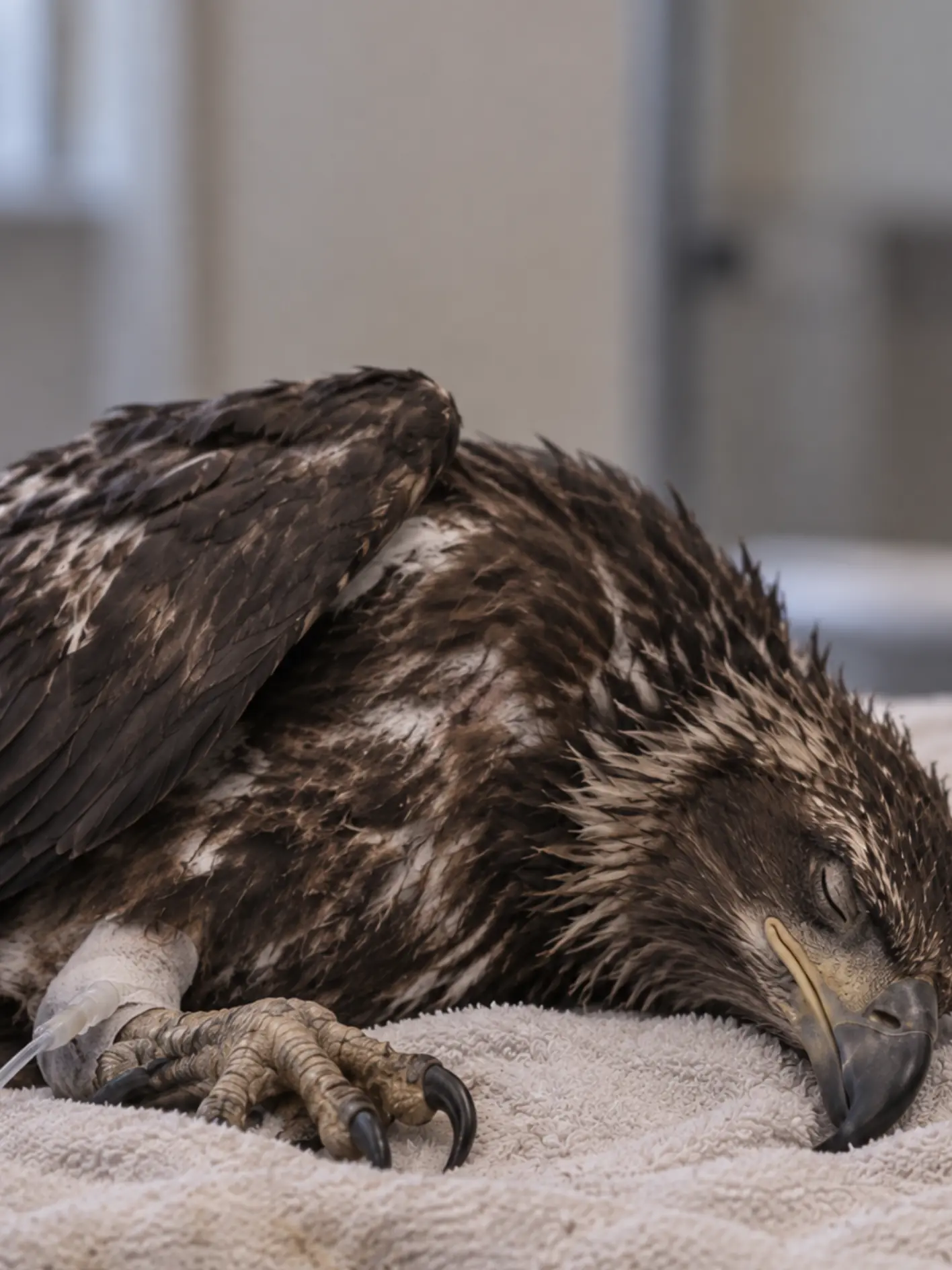
During those 10 days, the eagle received supportive medications, carefully measured nutritional support through tube feeding, subcutaneous fluids, repeated physical examinations, radiographs, warmth, quiet housing, and close monitoring around the clock. Every reasonable effort was made to give its body enough time and energy to recover.
For brief periods, we thought it might be working.
The young eagle became slightly more alert. It began holding its head higher. Its eyes followed movement more consistently. Its grip occasionally felt stronger than it had on admission, and there were moments when the bird appeared to be turning a corner.
Unfortunately, those small improvements could not overcome what had happened before the eagle ever reached us.
By the time rescuers placed the bird in our hands, it had already lost a profound amount of body condition. Its breast muscles were severely depleted, its hydration was poor, and the energy reserves a young eagle normally depends on during illness or stress were almost gone.
The bird was alive, but its body had been surviving without adequate nutrition for far too long.
Despite 10 days of intensive supportive care, the damage associated with prolonged starvation and emaciation proved irreversible.
The juvenile died quietly while under professional care.
We do not know exactly what happened before it was found. We cannot say with certainty that its parents intentionally abandoned it. We do not know whether one or both adults disappeared, whether the juvenile became separated from them, whether an injury prevented it from following or begging normally, or whether some other event interrupted its access to food.
What we do know is that when this eagle finally reached a wildlife hospital, it was already critically compromised.
This is the part of wildlife rehabilitation that rarely appears in release videos.
Sometimes rescue means opening a carrier and watching a bird return to the sky.
Sometimes rescue means spending 10 days doing everything possible for an animal whose body has already been pushed beyond what medicine can reverse.
The Young Eagle Was Found With Almost No Strength Left
The first call came after a resident noticed a large immature eagle remaining unusually low to the ground for an extended period.
The bird did not behave like a healthy young Bald Eagle.
It was conscious, but subdued.
Instead of moving away when people remained at a reasonable distance, it stayed in place. Its posture was low, and its wings rested heavily against the body. The head occasionally lifted, but the bird appeared to tire quickly.
There was no obvious catastrophic injury.
No wing was hanging at an extreme angle.
There was no large open wound.
Nothing about the bird immediately suggested a collision severe enough to explain why it could barely move.
That absence of dramatic trauma initially made the situation deceptive.
The eagle looked exhausted.
It was only after rescuers safely contained the bird and felt the body beneath the feathers that the severity of the problem became clear.
The bird was extraordinarily thin.
Feathers can hide body condition extremely well. A large raptor may still look impressive from several feet away even after losing a dangerous amount of muscle and fat.
Once the eagle was in hand, the breastbone was prominent beneath the skin. The pectoral muscles that should normally form strong, rounded masses on either side of the keel were greatly reduced.
The bird also felt much lighter than expected.
Its feet were weak.
Its grip was poor.
The head drooped whenever stimulation stopped.
The rescue team immediately recognized that this was not simply a bird that needed one meal and a night of rest.
The juvenile needed emergency medical care.
The Bird Was Transported With Minimal Stress
A profoundly emaciated eagle has very little energy available for struggling.
That can make capture appear easy, but ease of handling is not reassuring in a wild raptor.
A healthy Bald Eagle, even a young one, should resist unnecessary restraint.
This bird barely did.
Rescuers controlled the feet first because the talons remain capable of causing injury even in a weakened patient. The wings were supported carefully, and the eagle was placed in a darkened padded carrier.
The goal was to spend as little of the bird’s remaining energy as possible.
Every unnecessary escape attempt could consume calories and oxygen that the body no longer had in reserve.
During transport, the eagle remained quiet.
Its breathing was monitored.
The bird occasionally opened its eyes but spent most of the trip resting low against the towels.
By the time the carrier reached the hospital, staff were waiting.
The First Examination Confirmed Severe Emaciation and Dehydration
The eagle was transferred onto thick towels in the treatment room.
The photograph from that stage of care shows the young bird resting on its side with its eyes closed. A catheter and supportive-care equipment are visible near one leg. The feathers appear full enough to make the bird look substantial, but underneath them the body was severely depleted.
The veterinary team began with the basics.
Respiration was evaluated.
Body temperature was checked.
Hydration was assessed.
The mouth, eyes, wings, legs, spine, and abdomen were examined for evidence of trauma or disease.
The most consistent finding remained severe loss of body condition.
There was little meaningful fat reserve.
Muscle mass was poor.
The bird was dehydrated and unable to maintain normal posture for long.
It could move the wings and legs, but the movements lacked strength.
The eyes remained responsive, suggesting that the eagle was still neurologically aware of its surroundings.
That responsiveness gave the team reason to continue.
Radiographs Were Used to Look for an Explanation Beyond Starvation
Severe emaciation can be a final consequence rather than the original disease.
A bird may stop eating because of a fracture, gastrointestinal obstruction, foreign body, infection, neurologic illness, lead exposure, or another underlying problem.
For that reason, the veterinary team did not assume that the juvenile had simply failed to find food.
Radiographs were obtained once the bird was stable enough to tolerate the procedure.
The images were reviewed for major fractures, abnormalities of the gastrointestinal tract, evidence of a foreign object, and other conditions that might explain why the eagle had stopped feeding normally.
No catastrophic skeletal injury was identified.
There was no major wing fracture that would obviously have prevented the bird from reaching food.
There was no severe spinal injury explaining the weakness.
Nothing on the images provided a simple mechanical answer.
That shifted attention back toward the systemic effects of prolonged malnutrition and dehydration.
Bloodwork Showed a Body Under Significant Metabolic Stress
A limited blood sample was collected carefully because the eagle was already severely compromised.
The team evaluated parameters associated with hydration, red blood cells, circulating proteins, glucose regulation, organ function, and systemic stress.
The overall picture was consistent with a bird whose body had been operating with inadequate nutritional reserves for a prolonged period.
In severe starvation, the body does not simply become thin.
It changes priorities.
Stored energy is consumed.
Fat reserves disappear.
Muscle tissue begins to break down.
The immune system may become less effective.
The gastrointestinal tract may lose normal function.
The body may struggle to maintain temperature.
Electrolyte balance can become unstable.
Eventually, essential organs are asked to continue working with less and less metabolic support.
That is why an emaciated animal cannot always recover simply because food becomes available again.
By the time nutrition is restored, the consequences of starvation may already involve multiple organ systems.
Feeding a Severely Starved Animal Requires Restraint, Not Urgency
The most natural reaction to seeing an extremely thin animal is to feed it as much as possible.
In severe emaciation, that can be dangerous.
A body that has adapted to prolonged starvation may not tolerate the sudden introduction of a large amount of nutrition. Rapid changes in glucose metabolism and electrolytes can create potentially serious complications during refeeding.
For that reason, the veterinary team did not simply fill the eagle’s stomach.
Nutrition had to be introduced gradually.
The goal was not to make the bird feel full.
The goal was to give the body an amount of energy it could safely process.
Because the eagle was too weak to consume enough food independently, tube feeding became part of the treatment plan.
Small, carefully calculated volumes were provided.
The bird’s ability to digest and tolerate each feeding was monitored before the amount was increased.
This process required patience.
Everyone wanted the eagle to gain weight.
Moving too quickly could have made the situation worse.
Tube Feeding Became a Daily Part of Intensive Care
Several times during the early phase of hospitalization, the juvenile was gently restrained while nutritional support was delivered.
Handlers minimized the length of each procedure.
The eagle was wrapped securely enough to prevent sudden wing movement, while staff protected the airway and monitored the bird throughout the feeding.
The formula was selected to provide digestible nutrition in a controlled form.
Afterward, the eagle was returned to the warm enclosure and allowed to rest.
The team watched for regurgitation, poor digestion, abdominal discomfort, or other indications that the gastrointestinal system was not tolerating the feeding plan.
At first, the bird accepted the small volumes reasonably well.
That gave us hope.
Hydration Had to Be Corrected Just as Carefully
The eagle was also significantly dehydrated.
Fluids were administered according to its condition, including subcutaneous hydration as part of supportive management.
Dehydration places additional stress on circulation and kidney function, and a severely weak animal may not drink enough voluntarily to correct the deficit.
Again, the objective was not aggressive correction at any cost.
The treatment had to match what the compromised body could tolerate.
The eagle was weighed and reassessed.
Hydration status was monitored.
The bedding was kept clean and dry.
Temperature support was provided because extremely thin birds have less insulation from body fat and may struggle to maintain normal heat.
The entire treatment plan focused on reducing the amount of work the eagle’s body had to perform while supplying the basic resources required for recovery.
The First Two Days Gave Us Small Reasons to Hope
During the first 24 hours, the eagle remained profoundly weak.
It spent most of its time resting.
Its eyes opened when staff entered.
The head could be lifted, but only for relatively short periods.
By the second day, some of those responses appeared stronger.
The bird held its head up longer.
It became slightly more aware of activity around the enclosure.
There was a little more resistance during necessary handling.