When Luca first arrived at the shelter, employees assumed his size would protect him from a long stay. The tiny black Chihuahua-type mix weighed only a few pounds, with oversized ears, a narrow frame, and enormous dark eyes that seemed to follow every movement outside his kennel. Small dogs often attracted visitors who lived in apartments, older adopters who did not feel comfortable handling large breeds, and families looking for companions they believed would fit easily into their homes. During Luca’s first days, staff heard more than one person predict that he would be adopted almost immediately.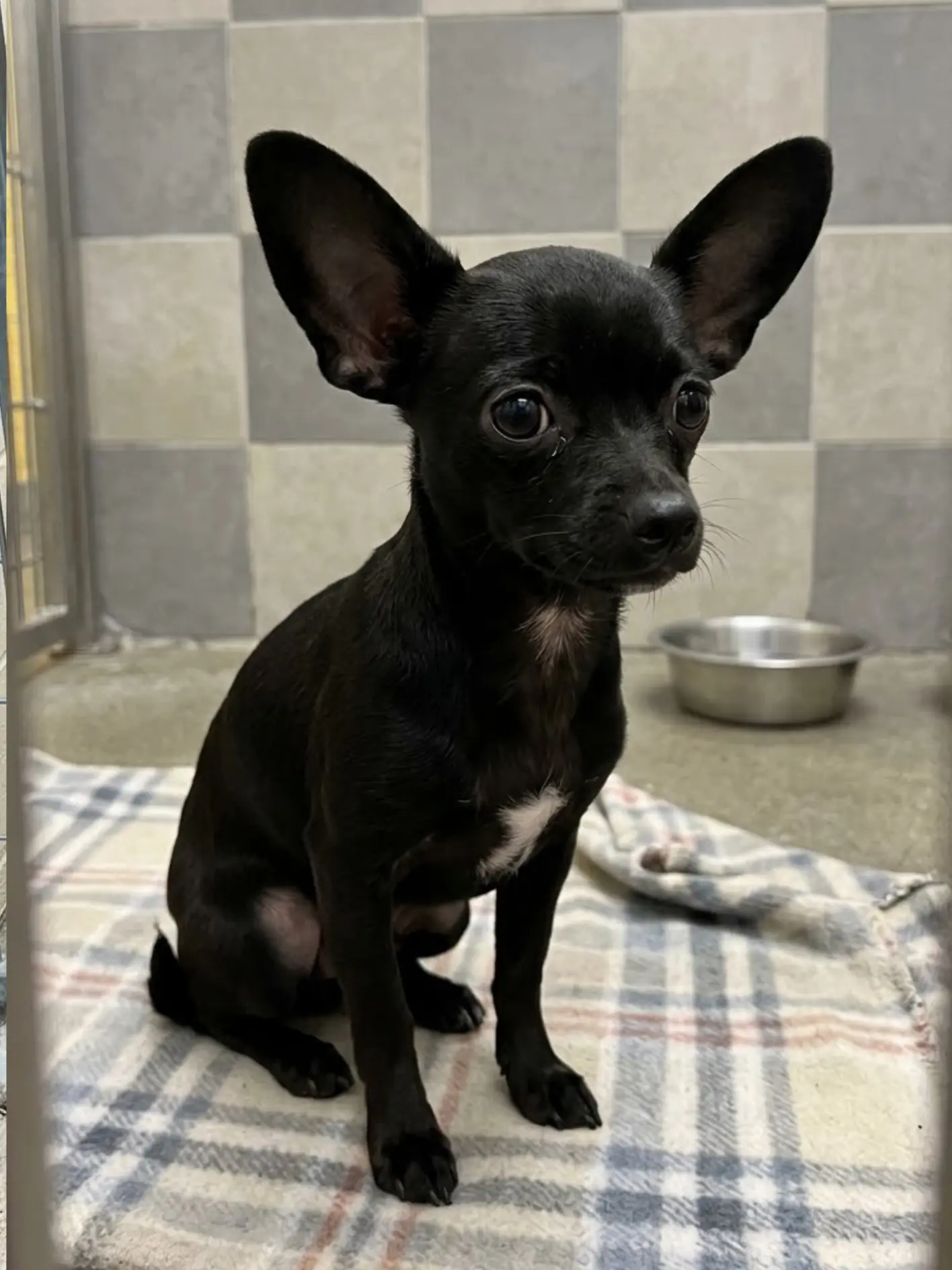
The prediction sounded reasonable. Luca was young, physically small, and healthy enough to become available for placement. He had been brought in after being found alone near the back entrance of a grocery store, where employees said he had spent much of the morning hiding beneath a row of shopping carts before somebody was finally able to secure him. He wore no identification, and the available efforts to locate an owner did not lead to anyone coming forward. By the time his holding period ended, the shelter knew very little about where he had come from or how such a small dog had ended up outside by himself.
What staff did know was that Luca was deeply uncertain around unfamiliar people. During intake, he allowed handling but kept his body rigid and attempted to make himself as small as possible whenever someone reached toward him. He did not lunge or try to bite, and there was no known bite history during his stay, but he clearly preferred distance until he had time to understand who was approaching. In the kennel, he often sat on his blanket with his ears raised and his eyes fixed on the hallway, watching rather than participating in the noise around him.
That behavior quickly complicated the assumption that a small dog would automatically be easy to place.
Visitors noticed Luca constantly. His size drew people toward the kennel, and his enormous ears made him especially memorable. Some crouched in front of the gate and spoke to him in the high, excited voices people often use around tiny dogs. Luca rarely responded the way they expected. Instead of rushing forward, wagging, or climbing toward their hands, he frequently remained seated several feet away. If someone leaned too close or reached through the bars, he sometimes moved farther back.
People would smile when they first saw him and then become uncertain once he failed to behave like the affectionate lap dog they had imagined.
The first serious adopter came during Luca’s opening weekend. A woman named Melissa had recently lost an elderly Chihuahua and arrived at the shelter specifically because Luca reminded her of the dog she had owned for nearly fourteen years. She spoke gently to him through the bars and asked staff whether she could meet him somewhere quieter.
The interaction began slowly. Luca entered the meeting room with a shelter employee and immediately moved toward the far side. Melissa sat on the floor and waited, but after several minutes she began calling him and patting her lap, hoping he would approach. Luca watched without moving. Eventually, he came close enough to smell her shoe before quickly stepping away again.
Melissa was disappointed.
She explained that her previous dog had been intensely affectionate and slept in her lap whenever she sat down. What she wanted now was another companion who enjoyed constant physical contact. Staff explained that Luca might become much more affectionate after he felt secure, but no one could promise when that would happen or exactly what his personality would become in a home.
Melissa thought about it and ultimately chose not to adopt.
Nobody criticized her decision. She knew the type of relationship she wanted, and adopting a dog while hoping he would transform into another animal could create problems later.
Luca went back to his kennel.
A second family noticed him several days later. They had two children, ages six and eight, who became excited as soon as they saw the tiny dog behind the bars. The parents asked to meet him, but the children moved quickly and spoke loudly in the meeting area, and Luca immediately retreated toward the shelter employee.
The family did nothing intentionally wrong. The children simply behaved like excited children meeting a very small dog.
Luca appeared overwhelmed.
Staff suggested that a quieter household might initially be easier for him, particularly because his history around young children was unknown. The parents agreed and decided to continue looking for a dog with a more established record around family activity.
Again, the decision was responsible.
Again, Luca remained.
By the middle of his second week, employees had begun noticing an uncomfortable contradiction. Luca was probably one of the most frequently photographed dogs in his section of the shelter. People loved his appearance. Visitors pointed out his ears, commented on how tiny he was, and regularly asked whether he was a puppy.
Yet very few stayed long enough to see what happened once Luca stopped being afraid.
A volunteer named Rebecca became the first person outside the regular kennel staff to discover that difference. Instead of trying to make him interact immediately, she began sitting near him during quiet periods without reaching toward him. The first few times, Luca stayed on the opposite side of the kennel. Rebecca read messages on her phone, spoke occasionally in a low voice, and allowed him to control the distance.
Several visits passed before anything visibly changed.
One afternoon, Luca moved from the back of the kennel and sat several feet closer.
Rebecca did not reach for him.
The next day, he came closer again.
Eventually, Luca approached long enough to smell her hand.
The progress was so small that most visitors would probably have overlooked it. To Rebecca, it revealed something important: Luca was not refusing human contact. He was asking for more time than the average shelter visitor expected to give him.
Once he began trusting her, the differences accumulated. Luca stood when Rebecca approached. He accepted treats from her hand. During walks through a quieter enclosed area, he remained close instead of freezing near the doorway. Eventually, he allowed her to lift him briefly without struggling, although she avoided carrying him unnecessarily because she wanted him to develop confidence moving on his own.
The dog everyone described as painfully shy began following Rebecca through the yard.
She took a short video.
There was nothing particularly dramatic in it. Luca walked several feet behind her, stopped to investigate the ground, then hurried forward when Rebecca changed direction. Near the end, she sat on a low step and Luca cautiously approached until he was standing beside her leg.
The shelter posted the video alongside one of his kennel photographs.
The response was enormous.
People who had previously seen only Luca sitting alone on his blanket commented that they had no idea he behaved so differently outside the kennel. Several said he simply needed patience. Others tagged friends and relatives who liked small dogs.
One person offered to cover his adoption fee.
Another said she would donate toward training.
A local rescue organization shared the post.
For a day, Rebecca thought the attention might finally produce a home.
It did not.
The shelter received inquiries, but each one came with a complication. A woman wanted Luca but already owned three small dogs and could not arrange an appropriate introduction immediately. Another potential adopter worked twelve-hour shifts and hoped a Chihuahua could simply use indoor pads and remain alone throughout the day. Staff explained that Luca’s small size did not eliminate his social, behavioral, or exercise needs.
A man messaged repeatedly about Luca and scheduled an appointment.
He never arrived.
The online comments continued growing while Luca remained physically in the same kennel.
This is one of the most misleading parts of shelter advocacy. A dog can appear popular online without having a single confirmed destination. Hundreds of people may say they want an animal safe, while every person assumes somebody else is closer, more prepared, or already completing the process.
A busy comment section creates the impression of security.
The shelter record tells the truth.
Luca had no adopter.
No foster.
No rescue commitment.
His photographs were traveling farther every day while he remained exactly where they had been taken.
At first, the shelter still had enough space for staff to continue working through possible placements. Then intake increased.
Several stray dogs arrived over one weekend. Some needed to remain through mandatory or locally required owner-search periods before becoming generally available. Two animals entered after their owner was hospitalized and no family member could immediately care for them. Another dog required medical isolation, temporarily removing one kennel from ordinary use.
Space tightened quickly.
Because Luca was physically small, people online began asking why the shelter could not simply place him in a crate somewhere indefinitely. The question sounded logical from the outside. Inside an operating shelter, the answer was more complicated. Safe animal housing requires more than enough square footage for a body. Staff must consider sanitation, stress, separation, staffing, safe handling, disease control, and the continuing flow of animals through the facility.
A small dog still needs a safe place.
Luca’s size reduced the amount of physical room he occupied. It did not create unlimited capacity.
Employees began contacting rescue groups more aggressively. Small-dog rescues received his photographs and behavior notes. Several were interested, particularly after seeing Rebecca’s video, but interest once again collided with capacity.
One organization had every foster home occupied.
Another had space only for dogs comfortable around resident pets, something Luca’s limited history did not allow anyone to guarantee.
A third rescue agreed to take responsibility if the shelter could locate a temporary foster first.
Volunteers began searching.
A foster offer finally appeared two days later. The woman had experience with shy small dogs and seemed like exactly what Luca needed. She lived alone, worked remotely, and had a quiet home.
For several hours, staff believed they had solved the problem.
Then the woman contacted her landlord.
Her lease allowed her own registered pet but prohibited additional animals, including temporary fosters.
She apologized.
The offer disappeared.
Luca spent another night on the plaid blanket inside the shelter.
Rebecca learned about the failed plan during her next visit. She entered the kennel expecting to feel disappointed and instead found Luca standing as soon as he saw her. He did not know that a room had almost opened for him. He did not know somebody had spent hours discussing where he might sleep next.
To Luca, Rebecca had arrived.
That was enough to make the day different.
She sat beside him for a while and found herself thinking about how little dogs understand the administrative machinery surrounding their lives. Luca did not know whether a rescue had answered an email. He did not know the shelter population had increased. He could not know why some people visited and disappeared.
He knew familiar voices, meals, the sound of a leash, and the small routines that had developed around him.
The humans were the ones counting.
As the third week continued, Luca’s progress with familiar people became easier to see. He approached several employees he had learned to recognize and could be handled with far less tension than during intake. That improvement created optimism among volunteers but did not immediately help with strangers. In a first meeting, Luca was still the uncertain little dog sitting at the edge of the room.
A potential adopter named Charles came after seeing Rebecca’s video and appeared unusually patient. He sat on the floor, ignored Luca initially, and allowed the dog to approach gradually. The meeting lasted almost ninety minutes, and by the end, Luca was accepting treats and remaining close.
Rebecca thought this might finally be it.
Charles liked him too.
Then he explained that he frequently traveled for work and planned to bring Luca on commercial flights. He wanted a dog small enough to fit in an airline carrier and believed Luca’s size made him ideal.
Staff asked how frequently he traveled.
Sometimes twice a month.
For a confident, travel-experienced dog, that lifestyle might be manageable with careful planning. For an animal who was already struggling with unfamiliar environments and strangers, repeated airports, aircraft cabins, hotels, and changing surroundings could create significant stress.
Charles appreciated the concern.
He chose not to proceed.
Luca returned to his kennel.
The outcome became another example of why shelter employees could not simply hand him to the first person interested. The objective was not to make the kennel empty for one evening. It was to find a situation likely to keep Luca from returning.
That distinction became harder to protect as time shortened.
The shelter population continued growing, and staff received notice that several long-stay animals required immediate placement. Luca’s name appeared among them.
Rebecca was stunned.
He was small.
He was young.
He had become noticeably more social.
He was also still homeless in a building that needed space.
Volunteers increased outreach again. His photograph appeared beside increasingly urgent language. People who had previously assumed a tiny dog could never become vulnerable suddenly began paying attention.
Some became angry.
They asked how a shelter could possibly consider euthanasia for a dog who looked healthy.
Others blamed the people who had previously met Luca and walked away.
Rebecca understood the emotional reaction, but neither target solved the problem. The families who had declined Luca had done so for reasons that often protected both the dog and their households. The staff caring for him had been trying for weeks to create a safe exit.
Nobody needed another argument.
Luca needed somewhere to go.
The final notice arrived sooner than anyone wanted.
If no appropriate adopter, foster, or rescue placement was confirmed, Luca could be euthanized for space.
The deadline was today.
Rebecca read the update that morning before driving to the shelter.
She had known Luca long enough that the sentence felt almost impossible. The same dog who had once hidden at the back of his kennel now stood whenever she approached. He had started climbing partially into her lap when she sat on the floor.
People online saw the deadline.
Luca saw Rebecca carrying a leash.
He stood immediately.
She took him outside.
The morning was ordinary. Luca investigated the edge of the walkway, stopped when he heard another dog barking, then continued after Rebecca moved forward. He followed her toward a quieter enclosed area and eventually sat near her feet.
Rebecca did not turn the walk into a goodbye.
There was still time.
More importantly, Luca would not have understood the ceremony.
After several minutes, she sat on the ground.
Luca approached and placed his front paws against her leg before settling beside her.
That tiny gesture affected Rebecca more than anything dramatic could have.
Weeks earlier, he had refused to come within several feet of her.
Now he trusted her enough to choose contact.
Rebecca knew the cruel part was that the progress had arrived at exactly the moment the shelter had almost run out of time to benefit from it.
Eventually, she brought him back inside.
Luca stepped onto the blanket.
The gate closed.
Calls continued.
The shelter published another update making the situation unmistakable. Luca was still there. No matter how many people were commenting or sharing, there was no confirmed placement attached to his name.
By midmorning, one family called and said they could adopt but would not be available until the following week.
The shelter could not promise the following week.
Another woman wanted Luca as a surprise birthday gift for her mother. Staff explained that animals should not be placed into someone else’s home without that person participating in the decision.
The woman became frustrated.
The shelter did not change its position.
Urgency still did not make an unsuitable adoption responsible.
A rescue coordinator said she was contacting every former foster in her network.
Nothing had opened yet.
Noon approached.
Rebecca continued refreshing the internal updates even though she knew it was accomplishing nothing.
Then a call reached the shelter from a man named David Kim.
David was 58 and worked from home repairing and restoring vintage watches for collectors. He lived alone in a quiet townhouse and had owned Chihuahuas for most of his adult life. His last dog had died the previous winter at sixteen, and David had repeatedly told friends he was not planning to adopt another.
He had seen Luca’s photograph several times.
Initially, he had avoided it.
Luca reminded him too much of the nervous little dog he had adopted nearly two decades earlier.
The deadline finally made him read the entire post.
What caught David’s attention was not the possibility of euthanasia.
It was Rebecca’s description of how long Luca needed before approaching strangers.
David understood that kind of dog.
His previous Chihuahua, Peanut, had hidden beneath a kitchen table for three days after adoption and took weeks before willingly approaching visitors. By the time Peanut was old, he had become an affectionate dog, but he never stopped being cautious around unfamiliar people.
David did not see Luca’s hesitation as something strange.
He saw a behavior he already knew how to live with.