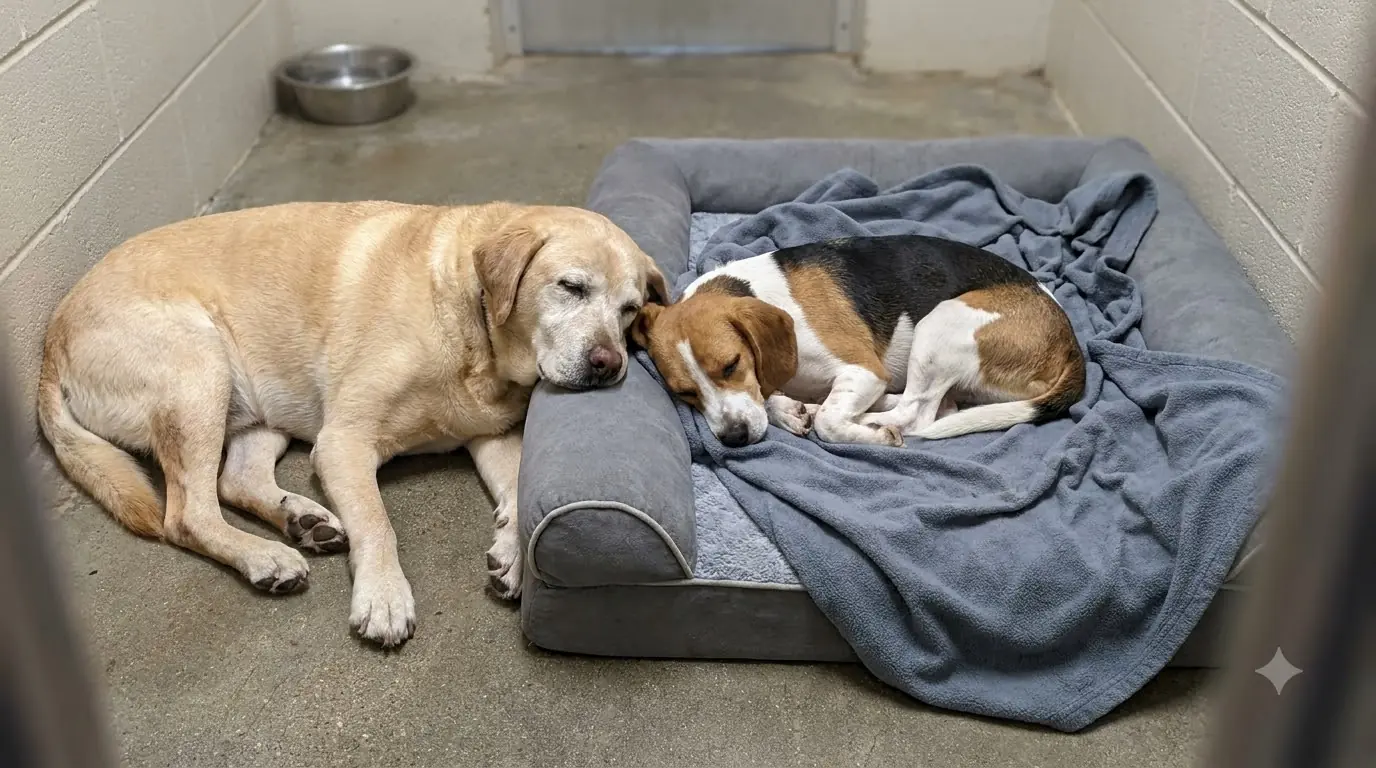
Every evening, Mabel slowly gets off the most comfortable bed in the kennel.
For a senior Labrador Retriever with arthritis, that is not an effortless decision her body makes. She shifts her weight forward, plants her paws carefully, and takes a few stiff steps away from the thick orthopedic bed that was placed there partly for her own aging joints.
Then Finn climbs into it.
The young Beagle mix has a congenital deformity affecting his hind legs. He cannot move as easily as other puppies, and when he was housed alone, staff quickly discovered another problem: Finn panicked.
But when Mabel was nearby, he settled.
So the two dogs were placed together in a quieter kennel.
That solved one problem.
Then staff began noticing something happening every night.
Finn curled himself into the center of Mabel’s orthopedic bed.
And instead of trying to move him, Mabel lowered her arthritic body onto the floor beside it.
By morning, staff would often find them almost exactly that way—Finn asleep on the warm bed and Mabel pressed against its edge, her head resting beside his little hind legs.
Finn Was Struggling With More Than His Legs
Finn’s disability was obvious from the beginning.
His hind legs did not function normally because of a developmental deformity, giving him an awkward gait and making it difficult to keep pace with other young dogs.
A veterinary assessment was important not only to understand the structure of his legs, but also to determine what could realistically help him.
Some congenital limb abnormalities can be improved with rehabilitation, supportive equipment or surgery. Others are managed rather than corrected.
For Finn, the immediate goal was simple: keep him comfortable, protect his joints and skin, and help him move as safely and independently as possible while his longer-term needs were evaluated.
But staff soon realized his physical disability was only part of the challenge.
Being alone frightened him.
A Kennel by Himself Wasn't Working
Whenever Finn was left alone, he had difficulty settling.
Instead of curling up to sleep, he became increasingly distressed. He moved around as much as his legs allowed, vocalized and remained alert to sounds outside the kennel.
That amount of agitation was especially concerning for a puppy whose mobility was already compromised.
He needed rest.
He also needed an environment where he was not constantly struggling to move because of anxiety.
Staff tried reducing stimulation around him. His kennel was kept quieter, and his bedding and essential items were positioned so he did not have to travel far.
Still, being alone remained difficult.
That was when Mabel entered the picture.
Mabel Was Almost the Opposite of Finn
Mabel was a senior Labrador Retriever who had already learned to take life slowly.