The command is sometimes spoken without anyone thinking much about it.
It is an old working cue, familiar from another part of Max and Ranger’s lives.
Max reacts almost immediately.
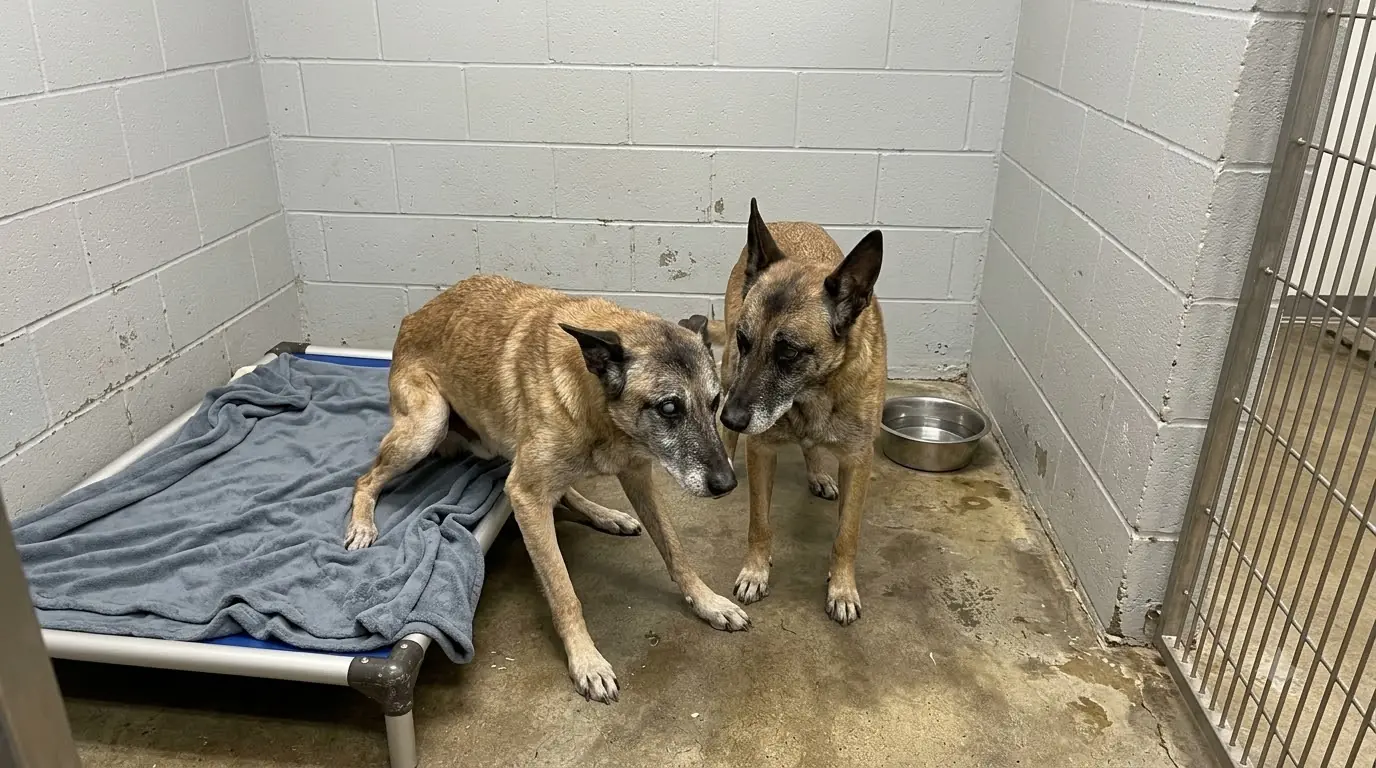
The senior Belgian Malinois lifts his head. His ears come forward, and despite the stiffness that now comes with age, he rises into a posture that looks strikingly familiar to staff who know his history.
Ranger does nothing.
He remains on his bed.
The other elderly Malinois is now almost completely deaf, and his vision has deteriorated so severely that spoken commands and distant movements often give him little useful information.
But Max does not simply remain standing.
After responding to the cue, he turns around.
He walks back toward Ranger’s bed and lowers his muzzle until his nose touches the older dog.
Ranger feels it.
His head comes up.
Then, slowly and with considerable effort, he begins pushing himself onto his feet.
A few moments later, the two retired working dogs are standing beside each other.
Only one of them heard the command.
Yet somehow, both ended up answering it.
Their Working Years Had Ended Long Before Rescue
Max and Ranger had spent years as working search dogs before retirement.
By the time they arrived at a senior rescue together, neither dog resembled the tireless Belgian Malinois people often picture when they think of active working dogs.
Their muzzles had grayed.
Their movements had slowed.
Long periods of activity had been replaced by longer periods of sleep.
They had already been retired for years, and the rescue had no intention of treating them as working animals again.
What mattered now was making old age manageable.
For Max, that meant ordinary senior-dog considerations: supportive bedding, appropriate low-impact activity, good footing and monitoring for changes in mobility or cognition.
Ranger needed considerably more environmental support.
He was losing access to two of the senses he had once relied upon most.
Ranger's World Had Become Much Smaller
Hearing loss alone can change how an elderly dog interacts with a shelter environment.
A person may enter without the dog noticing.
A food bowl can be placed nearby without producing the familiar response.
Another dog may approach from behind and startle him.
For Ranger, severe vision loss complicated things further.
He could still navigate familiar areas to some extent, but staff could not assume he could see obstacles, read distant body language or recognize someone approaching from across the room.
His kennel therefore needed consistency.
Beds, water and other important objects were kept in predictable locations.
Staff avoided rearranging the space unnecessarily.
When approaching Ranger, they learned to use methods he could still detect rather than relying entirely on voice.
Sometimes that meant allowing him to pick up a nearby scent.
Sometimes it meant a gentle physical cue once he knew someone was close.