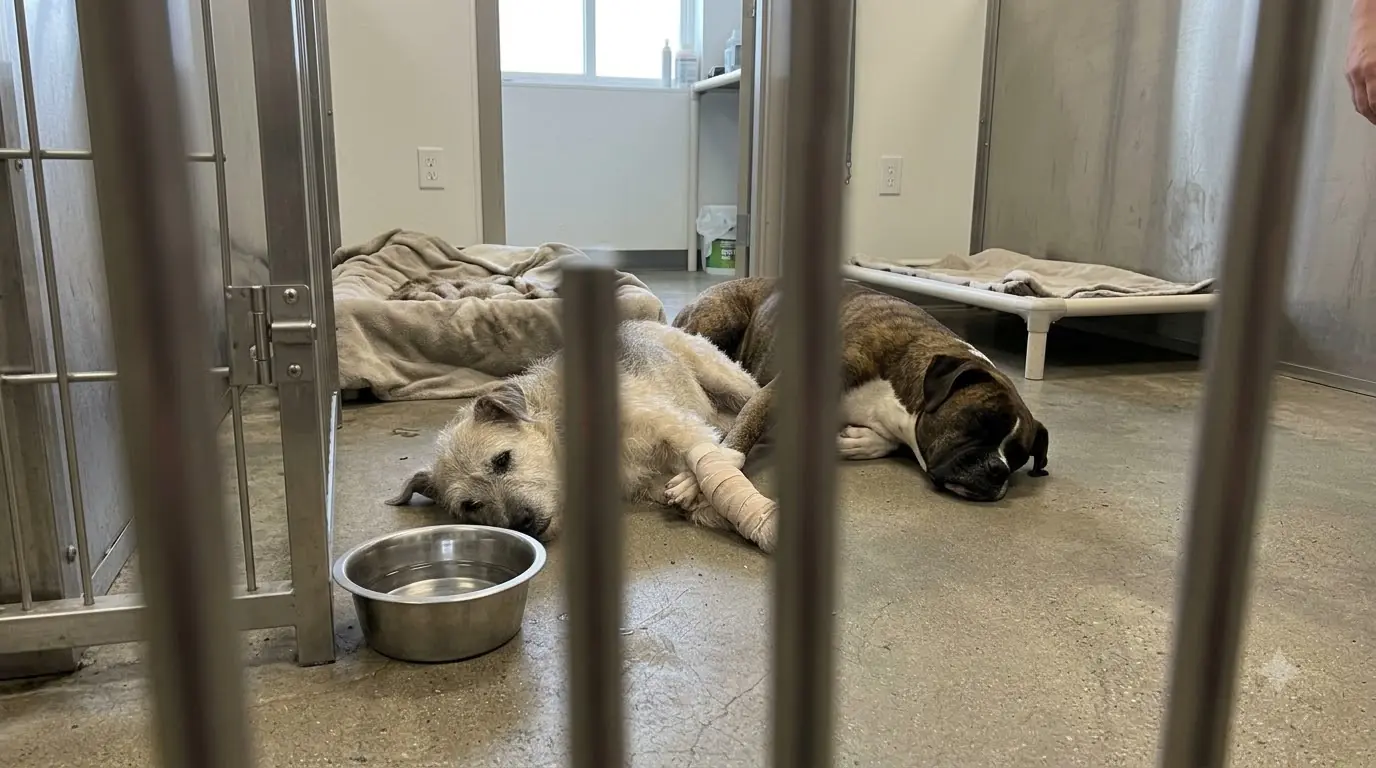
There are two beds in Tucker and Millie's recovery kennel.
One belongs to Millie.
One is there for Tucker.
Most mornings, staff find at least one of them empty.
Tucker is a 6-year-old Boxer mix. He is younger, more mobile, and perfectly capable of stretching out on a bed of his own.
Millie is a 10-year-old senior Terrier mix. A bandage is wrapped around one of her front legs, and right now she spends much of her day resting while shelter staff monitor her recovery.
Space is not the problem.
Tucker has it.
He simply keeps choosing Millie's.
When Millie settles onto her blanket, Tucker finds whatever space remains along the edge. Sometimes that means squeezing himself into a position that looks considerably less comfortable than the empty bed a few feet away.
He leaves the center for Millie.
Then he sleeps beside her.
When Millie wakes, Tucker notices.
When she stands, Tucker usually stands too.
And one night, when Millie could not make it all the way to the water bowl without stopping, Tucker made another choice.
By morning, neither dog was sleeping in a bed.
They were together on the floor beside the water bowl.
Tucker and Millie Share More Than a Kennel
Tucker and Millie are currently housed together in a shelter recovery kennel where Millie can rest and staff can keep an eye on her physical condition.
Her bandaged front leg means her routine is quieter than it might otherwise be.
The shelter's focus is straightforward: keep her comfortable, follow the veterinary care plan, monitor her movement, and give her the time she needs to recover.
Tucker does not require the same level of physical rest.
At six, he is younger than Millie by four years.
He has his own energy level, his own interests, and his own bed.
Yet from the beginning, staff noticed that Tucker repeatedly organized his resting time around Millie.
If she was awake, he might move around the kennel.
If she settled, he often settled.
If she chose the blanket, Tucker usually chose it too.
That did not mean climbing directly on top of her or forcing her to share space.
Quite the opposite.
Tucker seemed to make himself smaller.
Millie would take the softer central portion.
Tucker would stretch along an edge.
Sometimes part of his body barely fit.
His own bed remained available nearby.
He rarely seemed interested.
Millie Needs More Rest Right Now
At 10 years old and recovering with a bandaged front leg, Millie naturally spends more time lying down.
Staff do not expect her to keep Tucker's schedule.
She is allowed to rest.
Her movement is monitored, and her activity is kept appropriate to her current condition and veterinary recommendations.
The exact medical details beyond what is known are not something staff need to embellish.
Millie has a bandaged front leg.
She is a senior dog.
She is recovering.
Those facts are enough.
Her body currently asks her to move carefully.
Standing can take a little more effort.
Walking across the kennel can be slower.
Sometimes she wakes, changes position, takes a drink, and returns to rest.
Tucker notices almost every transition.
If Millie lifts her head, his eyes may open.
If she begins pushing herself up, Tucker often rises too.
He does not pull her.
He does not physically support her.
He simply gets up.
Then he stays close enough to know where she is going.
He Has a Bed of His Own
This detail has become one of the simplest ways to explain Tucker and Millie's relationship.
Tucker is not sleeping with Millie because there is nowhere else to go.
There is.
His bed is right there.
It is available during the day.
It is available at night.
Sometimes staff straighten it during kennel cleaning.
Later, they return and find Tucker squeezed beside Millie again.
The choice is especially noticeable because Tucker is the larger dog.
A Boxer mix does not disappear easily onto the edge of a Terrier mix's blanket.
He has to arrange himself.
Millie settles first.
Tucker finds the remaining space.
He may curl more tightly than necessary.
He may leave part of the blanket untouched because that area belongs to where Millie has positioned herself.
He does not appear bothered by the compromise.
Once he is down, he rests.
For shelter staff, the empty second bed has become almost as revealing as the occupied blanket.
Their Relationship Appears in Transitions
Some bonded pairs reveal themselves through play.
Others share toys.
Some become visibly unsettled when separated.
With Tucker and Millie, one of the clearest patterns happens whenever Millie changes what she is doing.
She wakes.
Tucker wakes.
She stands.
Tucker stands.
She begins moving.
Tucker pays attention.
It is not constant.
Tucker still has moments when he is engaged with something else.
He receives individual attention and has needs independent of Millie.
But the pattern repeats often enough to matter.
Millie does not have to call him.
She does not have to touch him.
Her movement itself seems to be enough.
Tucker notices.
That is particularly important during her recovery because Millie's days contain many more pauses than Tucker's would naturally require.
He could spend those pauses elsewhere.
He frequently chooses not to.
The Night Millie Stopped Halfway
One evening, Millie woke and decided to get a drink.
The water bowl was across the kennel.
She stood.
As usual, Tucker stood too.
Millie began walking.
She moved carefully on her bandaged front leg.
Tucker remained aware of her.
But that night, Millie did not make it all the way to the bowl.
About halfway across the kennel, she stopped.
Then she lowered herself onto the floor.
There was no dramatic collapse.
There was no emergency scene.
She was simply tired and needed to stop.
Tucker walked toward her.
He lowered his head and gently licked one of her ears.
Then he lay down beside her.
The floor was harder and colder than either bed.
Tucker's bed was still available.
Millie's blanket was still behind them.
Neither dog returned to it.
Millie rested where she had stopped.
Tucker stayed where Millie was.
By Morning, Both Beds Were Empty
When staff returned the next morning, the kennel told the story before either dog moved.
Millie's bed was empty.
Tucker's bed was empty.
The blanket where they normally squeezed together had been left behind.
Near the water bowl were two sleeping dogs.
Millie had remained on the floor.
Tucker had remained beside her.
At some point, they had settled completely.
Tucker could have gone back to his own bed after Millie fell asleep.
He did not.
He could have returned to the shared blanket.
He did not.
By morning, he was still there.
That image — two unused beds and Tucker sleeping on the floor beside Millie — became one of the clearest examples staff had seen of the choices he makes around her.
We Don't Need to Guess What Tucker Was Thinking
It is tempting to assign human motives to moments like this.
Shelter staff try not to.
We cannot say Tucker consciously decided that Millie should never sleep alone.
We cannot know what he understood about her bandage.
We cannot claim he knew why she stopped walking.
What we can say is much simpler.
Millie stopped.
Tucker approached her.
He licked her ear.
He lay down beside her.
He remained there through the night.
Those are observable behaviors.
And they fit with the behaviors staff see during the rest of their day.
Tucker repeatedly chooses proximity to Millie.
When she moves, he notices.
When she rests, he frequently rests nearby.
When comfortable space is available elsewhere, he often chooses the smaller space beside her.
No elaborate explanation is necessary.
Millie Does Not Always Need Tucker Beside Her
Their relationship is important, but shelter staff also make sure neither dog is treated as half of a single animal.
Millie needs rest.
Sometimes Tucker needs activity.
There are moments when they are not touching.
There are moments when Tucker is more interested in something happening outside the kennel.
There are times when Millie appears content simply to sleep.
That is normal.
A healthy relationship between two animals does not have to mean constant physical contact.
What makes Tucker and Millie's behavior significant is that they have alternatives.
And repeatedly, when given those alternatives, they reconnect.
Tucker may investigate the gate.
Eventually he comes back.
Millie may change sleeping positions.
Tucker adjusts his own.
One may be awake while the other sleeps.
Then Millie stands, and Tucker's attention returns to her.
Tucker Is Not Millie's Nurse
There is another important distinction.
Tucker should not be expected to manage Millie's medical needs.
He cannot.
Millie's recovery belongs in the hands of veterinary professionals and shelter caregivers.
Her bandage needs appropriate monitoring.
Her activity needs to follow professional guidance.
Her comfort and mobility need to be evaluated by people who understand her medical condition.
Tucker's role is different.
He is familiar company.
He is the dog who sleeps beside her.
He is the dog who gets up when she does.
He is the dog who left a perfectly usable bed empty because Millie stopped on the floor.
That companionship may be meaningful without turning Tucker into something he is not.
He is not her medical caretaker.
He is her companion.
Millie Gives Tucker Something Too
Because Millie is older and currently recovering, most people initially notice what Tucker does for her.
But their relationship should not be reduced to a younger dog watching over an older one.
Millie gives Tucker something too.
She gives him a familiar place to return to.
Tucker may be younger and physically stronger, but he repeatedly chooses to settle near her.
That choice suggests that being close to Millie matters to him independently of whether she needs assistance.
When Millie is already asleep, Tucker still joins her.
When nothing medical is happening, he still chooses her blanket.
When there is no reason to monitor her movement, he still positions himself nearby.
His own bed is not rejected only during difficult moments.
It is regularly rejected.
Millie appears to be part of how Tucker settles.
She may move more slowly.
She may spend more time sleeping.
But her presence gives Tucker a clear resting point in an environment filled with changing sounds, people, and routines.
Shelter Life Keeps Moving Around Them
Recovery kennels are not completely isolated from shelter life.
Staff enter.
Bowls are changed.
Cleaning happens.
Medications or medical checks may occur.
Dogs move through nearby areas.
Doors open.
Footsteps pass.
Meal times arrive.
Tucker often notices the activity.
Millie may simply continue resting.
During cleaning, both dogs may need to shift temporarily.
Tucker can move more easily.
Millie needs more time.
Once the kennel is ready again, Millie usually finds her comfortable place.
Tucker eventually finds Millie.
At breakfast, they are monitored as individuals.
During enrichment, Tucker can participate according to his abilities while Millie's activities remain appropriate to her recovery.
Throughout those routines, staff continue seeing the same basic pattern.
Tucker has a wider physical range right now.
He repeatedly brings that range back toward Millie.
Recovery Makes Adoption More Complicated
Finding one appropriate home for an adult dog can take time.
Finding one home for two dogs requires more.
Tucker and Millie's situation adds another practical consideration: Millie is a senior currently recovering from a physical issue.
Some adopters are specifically open to senior dogs.
Others are not.
Some have experience managing recovery periods.
Others may reasonably decide they are not equipped for that responsibility.
A person interested in Tucker might be prepared for a healthy 6-year-old Boxer mix but not for the additional care associated with a 10-year-old Terrier mix.
Another person might adore Millie but live somewhere that cannot accommodate two dogs.
Neither situation makes that person uncaring.
The shelter's responsibility is not to make people feel guilty.
It is to find a realistic match.
Two Dogs Mean Two Sets of Needs
An adopter considering Tucker and Millie needs to think beyond the image of them sleeping together.
There will be two food plans.
Two sets of routine veterinary care.
Two sets of preventive medications.
Two personalities.
Two exercise needs.
Two aging timelines.
Millie is already 10.
Tucker is six.
As Millie gets older, she may prefer increasingly quiet routines while Tucker could remain considerably more active.
That difference needs to be accommodated.
Tucker should not be denied appropriate exercise simply because Millie cannot participate.
Millie should never be pushed beyond her comfort because Tucker wants to go farther.
Their bond needs to be preserved without forcing them into identical lives.
That requires an adopter capable of thinking about them together and separately.
The Home Needs to Work for Millie's Body
Millie's current mobility makes the physical environment important.
Depending on her veterinary recommendations and how her recovery progresses, a home with easy access to resting areas may be preferable.
Slippery flooring could require management.
Stairs may need consideration.
Comfortable beds should be readily available.
Ironically, Tucker may still ignore his.
But it should be there.
An adopter also needs to be prepared for the normal realities of caring for a senior dog.
Medical needs can change.
Mobility can change.
Activity levels can change.
The shelter cannot predict exactly what Millie's future will look like.
A responsible adopter simply needs to understand that senior care often requires flexibility.
Tucker Needs His Own Life Too
Tucker's devotion to staying near Millie should not become an excuse to overlook his needs.
At six, he may want more activity than she does.
He needs exercise appropriate for a Boxer mix.
He needs enrichment.
He needs individual interaction with people.
He should have opportunities to build confidence and routines that do not depend entirely on Millie.
A suitable home would allow Tucker to take a longer outing if appropriate while Millie rests comfortably.
Then he could come home to her.
That balance is important.
Being bonded should expand the care plan, not shrink either dog's world.
What Potential Adopters Need to See
When people meet Tucker and Millie, the shelter wants them to see ordinary behavior.
Not simply a photograph of two dogs curled together.
They need to see Tucker's energy.
They need to see Millie's current pace.
They need to understand the bandage and whatever care instructions apply at the time.
They need to watch how Tucker responds when Millie stands.
They need to notice that his own bed exists.
And they need to understand that keeping them together means accepting responsibility for both dogs, not merely preserving a touching image.
A meet-and-greet can help answer important questions.
How does Tucker interact independently?
How does Millie respond to unfamiliar people?
How comfortable is the potential adopter moving at Millie's pace?
Can they manage Tucker's activity level too?
If there are other pets in the home, what introductions would be necessary?
If there are children, does the household suit both dogs?
The right answer has to work for everyone.
Someone May Want Tucker but Not Be Able to Take Millie
This is one of the hardest realities for bonded pairs.
Tucker may attract interest on his own.
He is younger.
He is more mobile.
Someone looking for an adult dog may see him and think he fits perfectly.
Then they learn about Millie.
Perhaps they live in a small apartment.
Perhaps their lease limits them to one animal.
Perhaps they already have a dog.
Perhaps senior veterinary expenses are beyond what they can responsibly add.
The shelter cannot turn those limitations into a moral failure.
A person who can responsibly care for one dog should not be pressured into adopting two.
But that leaves Tucker and Millie in a difficult position.
There may be homes available for one.
The challenge is finding the home capable of saying yes to both.
Their Adoption Story Has to Be Told Together
That is why the shelter does not want Millie reduced to a footnote on Tucker's profile.
Nor should Tucker appear only as the dog sleeping beside an injured senior.
Their story works because both dogs are visible.
Adoption photos can show their size difference.
Videos can capture Tucker squeezing onto the edge of Millie's blanket.
Updates can show Millie's progress without making her medical condition the entire narrative.
Potential adopters can see Tucker participating in his own activities.
They can also see what happens when he returns.
He finds Millie.
That repeated return is important.
The Most Promising Questions Are Practical Ones
When someone expresses serious interest in both dogs, staff listen carefully to what they ask.
Questions about Millie's recovery matter.
Questions about Tucker's exercise needs matter.
Questions about costs matter.
Questions about stairs, transportation, sleeping arrangements, feeding, resident pets, and veterinary care matter.
Someone asking those things is beginning to imagine actual life with Tucker and Millie.
That is more meaningful than simply saying their story is touching.
The shelter does not need someone who feels sorry for them.
It needs someone who has thought about Tuesday morning six months after adoption.
Millie may need extra time.
Tucker may be ready to go.
Can the household meet both needs?
That is the real test.
Their Current Update
For now, Tucker and Millie remain together while Millie continues recovering.
Her condition and bandaged leg are being monitored according to her care plan.
She continues spending much of her day resting.
Tucker continues spending much of that rest time near her.
He still has his own bed.
He still rarely chooses it when Millie is settled somewhere else.
Staff continue giving both dogs individual attention.
Tucker has opportunities appropriate to his age and energy.
Millie's activity remains suited to her recovery.
Their future placement will depend on finding a home capable of supporting both dogs responsibly.
There is no need to rush that decision.
The goal is not simply an adoption.
It is an adoption that can last.
One Day Millie May Not Need the Bandage
Millie's current medical condition is temporary in ways that her age is not.
Her recovery will continue to be evaluated.
The bandage may eventually come off according to veterinary guidance.
Her mobility may improve.
Her routine may become more active.
But even as those details change, staff will continue watching the relationship itself.
Does Tucker still choose her blanket?
Does he still stand when she does?
Does Millie seek him out?
How do they behave during brief separations?
How comfortable is each dog independently?
Those observations help determine what placement is genuinely in their best interest.
The decision to keep a bonded pair together should be based on the animals in front of us, not simply the label attached to them.
Tucker and Millie keep providing plenty to observe.
What Their Future Home Would Need
The right household needs room for two dogs with different ages, sizes, and activity levels.
It needs financial preparation for two animals.
It needs patience with Millie's senior needs and recovery.
It needs enough time and energy for Tucker.
It needs comfortable resting areas, even if Tucker continues choosing whichever one Millie occupies.
The adopter should be willing to follow veterinary recommendations rather than assuming Tucker's companionship can substitute for medical care.
They should encourage healthy independence in both dogs while respecting the closeness they repeatedly choose.
And they need to understand that the relationship will continue changing.
Millie will age.
Tucker will age too.
Their needs will not always remain synchronized.
A sustainable home must be prepared to adapt.
Both Beds Were Empty
That night beside the water bowl remains one of the simplest ways to understand them.
Millie had tried to walk across the kennel.
Halfway there, she needed to stop.
Tucker approached.
He licked her ear.
Then he lowered himself onto the floor beside her.
Hours passed.
There were two beds behind them.
One was Tucker's.
One held the blanket he usually shared with Millie.
By morning, neither had been used.
Staff found Millie still resting beside the water bowl.
Tucker was still beside her.
The next day would bring another round of care.
Another meal.
Another medical check.
Another opportunity for Tucker to use the bed that had been provided specifically for him.
He might even use it for a while.
But when Millie wakes and begins trying to stand, staff already know what they are likely to see.
Tucker will notice.
He will get up too.
And while the shelter continues searching for a household prepared to care for two very different dogs, Tucker keeps making his own preference remarkably easy to understand.
Wherever Millie finally settles, he wants enough room beside her