When Milo and Nico first entered the shelter, employees noticed something before they knew almost anything else about them: the two small black dogs preferred being together. They were similar enough in size, coat, and oversized upright ears that staff believed immediately that they were related, and information provided at intake later confirmed that they were brothers from the same litter. Wherever one moved inside the kennel, the other usually followed, and when unfamiliar people approached, the pair frequently stood shoulder to shoulder as though the presence of the other made the strange environment slightly easier to understand.
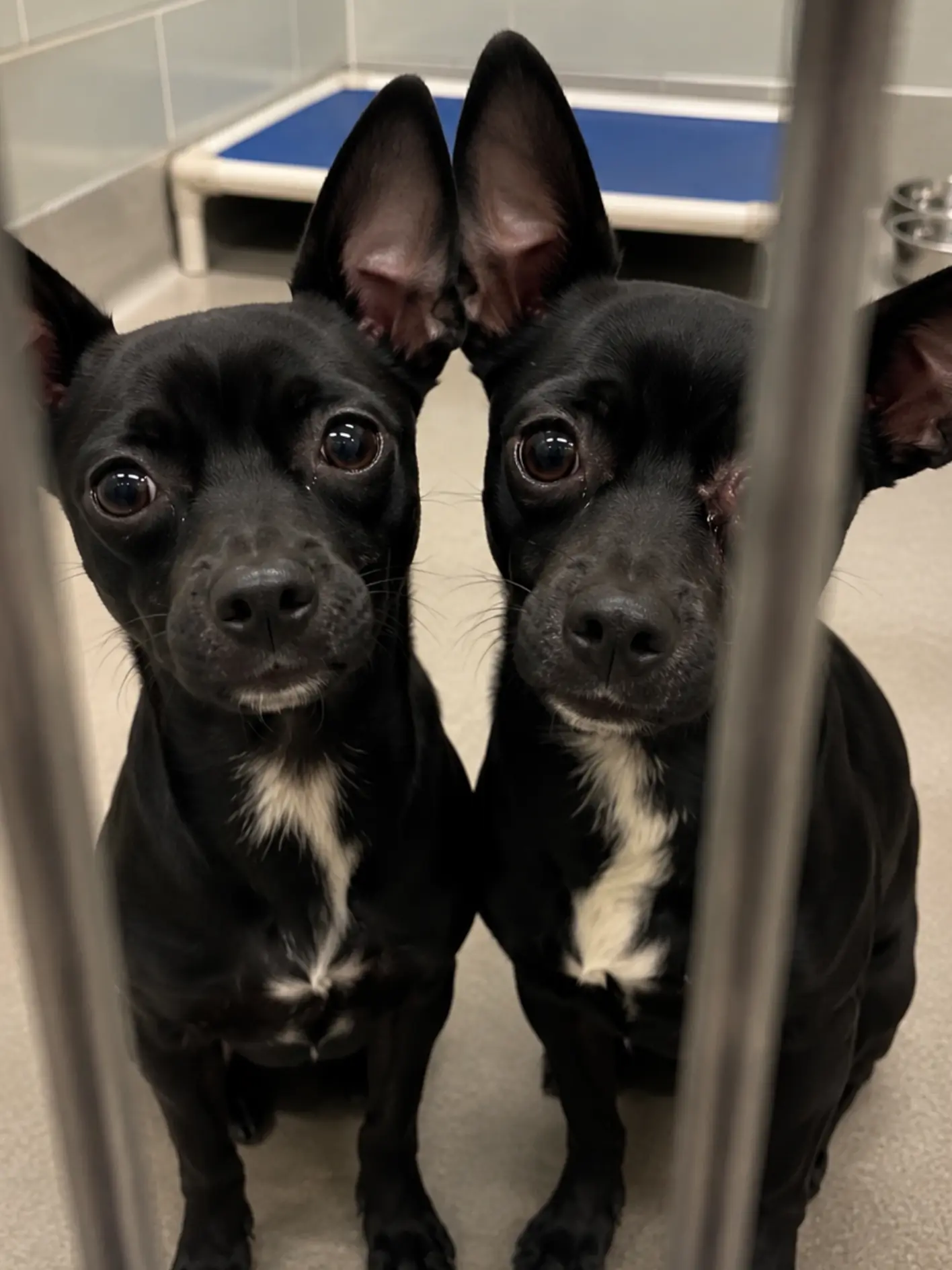
There was one obvious difference between them. Nico, the slightly smaller brother, had an injury around one eye that made the area look irritated and uncomfortable. Staff could not establish exactly how the injury had happened before the dogs arrived, and they were careful not to invent a story around it. What they knew was that the eye needed attention and follow-up, while Nico otherwise remained alert, mobile, and interested in his surroundings.
Milo appeared particularly attentive whenever employees handled his brother. If Nico was moved several feet away for an examination, Milo remained focused on where he had gone and often moved toward the kennel gate until he returned. Shelter workers avoided describing the behavior in human terms or claiming that Milo understood his brother was injured, but they could observe something simpler: the dogs were accustomed to each other, and separation clearly changed the way they behaved.
The brothers had arrived after a landlord discovered them living in a rental unit that was being vacated. Their previous owner had apparently left the property suddenly, and there was no reliable arrangement for the dogs after the move. By the time animal-control workers became involved, Milo and Nico were still inside the residence with no confirmed person prepared to take responsibility for them.
The available information about their earlier life was incomplete. Staff did not know exactly how long they had lived in that apartment, whether they had routinely met children or other animals, or how much training they had received. They appeared familiar with people but cautious around strangers, and neither immediately behaved like the outgoing small companion dog many visitors expected when they first saw their photographs.
That caution became important almost immediately.
During their first several days, Milo and Nico drew considerable attention. Their matching black coats, white chest markings, enormous ears, and habit of sitting beside one another made them one of the most photographed pairs in the shelter. Visitors regularly stopped at the kennel and commented on how similar they looked, while several people asked whether they had to be adopted together.
Staff answered carefully.
There was not enough information to declare that the brothers could never live apart, and shelters generally avoid making lifelong claims based only on a short observation period. What employees could say was that Milo and Nico appeared comfortable together and frequently sought proximity in the unfamiliar shelter environment. If a safe placement could keep them together, staff believed that would be worth considering, but their primary goal remained finding a responsible way for both dogs to leave alive.
At first, employees believed that might happen quickly.
Small dogs often attracted renters, older adopters, and people who did not feel prepared to manage a larger animal. Two young dogs could certainly represent more responsibility than one, but shelter staff hoped their size and obvious familiarity with each other might appeal to someone already considering a pair.
The first serious visitor came specifically because she had seen their photograph online. Her name was Allison, and she had recently lost a small terrier after fourteen years. She stood at the kennel for several minutes watching Milo and Nico before asking whether she could meet them.
The meeting started slowly. Milo approached first but stopped several feet away, while Nico remained closer to the shelter employee. Allison sat down and allowed both dogs time to investigate rather than immediately trying to lift them. Within twenty minutes, Milo had accepted treats from her hand, and Nico had moved close enough to smell her shoes.
Allison liked both dogs.
Then the practical questions began.
She lived in a condominium where the association allowed only one dog per unit.
Staff asked whether she might consider adopting one brother while another placement was found for the second. Allison became visibly uncomfortable with the idea. She had watched them together long enough that choosing one and leaving the other felt wrong to her, even though employees explained that they could not know whether permanent separation would necessarily harm them.
She left without either dog.
No one criticized her decision. Housing rules are not changed by sympathy, and secretly bringing home a second dog would have placed both adopter and animals at risk of another surrender.
Milo and Nico returned to their kennel.
A few days later, a couple arrived interested in adopting both. They lived in a house, had no other pets, and appeared financially prepared for two dogs. For a while, the meeting looked more promising than anything staff had seen since the brothers became available.
Then the couple asked about Nico’s eye.
Employees explained everything they knew and everything they did not. The injury had been observed and required appropriate veterinary follow-up, but the shelter could not promise what future treatment might involve until the eye was fully evaluated over time. There was no responsible way to guarantee that the issue would resolve without additional expense.
The couple hesitated.
They had budgeted for routine veterinary care but had not planned for the possibility of immediate medical costs involving one of the dogs.
After discussing it privately, they decided not to proceed.
Again, the choice was understandable.
Again, both brothers remained.
For the shelter employees who cared for them each day, the pattern was beginning to feel familiar. People noticed Milo and Nico constantly. Some loved the idea of two matching little dogs until they considered the cost of two veterinary appointments, two sets of vaccinations, two training needs, and the possibility that both could require significant time to settle into a household. Others wanted only one dog but felt guilty deciding which brother to take.
Nico’s eye added another layer of uncertainty. Most people who stopped at the kennel expressed sympathy, but sympathy did not always survive the conversation about possible follow-up care.
The brothers did not know any of this.
They knew meals.
They knew footsteps.
They knew the sound of the kennel gate.
They seemed to know when one another was nearby.
A volunteer named Rachel became particularly interested in them after noticing how differently they behaved once removed from the main kennel corridor. Inside, the brothers were often extremely still when strangers approached. Outside, after several minutes in the exercise area, Milo became more curious and Nico eventually followed his lead.
Rachel began walking them together whenever possible. Milo usually moved slightly ahead, stopping often to investigate the ground, while Nico stayed close enough that the leashes occasionally crossed. Once the initial excitement faded, both dogs could settle near her, and Nico sometimes rested against Milo when they paused.
Rachel began taking photographs away from the bars because she worried that the kennel images made the brothers appear more frightened than they did after several minutes outside. One short video showed the dogs walking together, pausing at the same patch of grass, then returning toward Rachel when she crouched several feet away.
The post spread quickly.
People loved the fact that they were brothers.
Comments filled with suggestions that they should never be separated. Others asked whether somebody could sponsor Nico’s medical care. Several people offered donations if a rescue organization would take both dogs.
For a day, the attention seemed enormous enough that Rachel believed the problem might finally be solved.
It was not.
A donation could help with veterinary expenses after placement, but it could not become a foster home. A person offering money for Nico’s eye could not physically remove the dogs from the shelter. A rescue organization could want to help both brothers and still have nowhere for them to stay.
The shelter record remained unchanged.
No adopter.
No foster.
No confirmed rescue transfer.
Milo and Nico were still there.
That difference between online concern and physical placement became more important as the shelter population began increasing. Several dogs arrived through animal control during the same week, including strays whose owners still needed time to locate them. Two owner surrenders came in following an eviction, and another kennel had to be temporarily removed from general use because a dog required medical isolation.
Within days, staff were looking at the available kennel count differently.
The shelter had not suddenly stopped caring about Milo and Nico. Their food continued arriving, the kennel was cleaned, Nico’s eye continued receiving attention, and volunteers continued working with both dogs. The problem was that care inside the building did not create more buildings.
Shelters operate with physical limits.
Lost dogs may continue arriving whether or not every existing kennel is occupied. Injured animals still need safe housing. Families facing eviction, hospitalization, or financial emergencies may have nowhere else to take pets. Animal-control cases do not simply disappear because the facility is crowded.
The system depends on safe exits.
An adoption opens a kennel.
A foster placement opens a kennel.
A rescue transfer opens a kennel.
A reunion with an owner opens a kennel.
When incoming animals outnumber those exits, dogs who appeared safe only days earlier can quickly become urgent.
Milo and Nico were moving toward that point.
Staff contacted rescue organizations before the brothers were formally listed as critical. One small-dog rescue was interested immediately but had only one open foster home. The organization asked whether the brothers could be separated temporarily.
Staff considered the possibility.
There was no absolute behavioral evidence proving the dogs could not be housed separately, but employees were also reluctant to make an unnecessary separation when both were already coping with substantial change. The rescue attempted to locate a second foster so each brother would at least remain within the same organization.
No second foster appeared.
The available space was filled by another urgent dog before a plan could be completed.
Another rescue said it could potentially accept both brothers if one foster household volunteered to take the pair. The organization shared them throughout its network.
People responded.
Nobody with an appropriate home committed.
A third rescue expressed particular interest in Nico because of his eye, but it was already managing several dogs receiving medical treatment and could not responsibly add another case without an available foster and additional resources.
Again, everyone wanted a solution.
Nobody had a place.
Rachel found the contradiction increasingly difficult. Milo and Nico had become recognizable online. People she had never met would message asking whether “the little brothers” were safe, and she frequently had to give the same answer.
Not yet.
One promising opportunity appeared when a family contacted the shelter after following the brothers for several days. They lived in a home with a fenced yard and said they were prepared to adopt both. They also had two teenagers who seemed enthusiastic about the responsibility.
Staff arranged a meeting.
Milo warmed up gradually.
Nico remained cautious but accepted treats.
The family asked good questions and did not appear frightened by the eye injury.
For nearly an hour, everything looked unusually promising.
Then the parents began discussing their work schedules. Both adults traveled periodically, and the teenagers would be leaving for college within a year. The parents had initially imagined the dogs entertaining each other during long periods alone.
Shelter employees explained that having two dogs does not eliminate the need for human care, supervision, training, exercise, or companionship. Two uncertain young dogs could even require more structured attention during the adjustment period, not less.
The family left to think.
They called the next morning.
They had decided against adoption.
Milo and Nico remained.
Days continued accumulating.
The shelter became louder.
More dogs arrived.
The available alternatives became narrower.
Eventually, staff received notice that several animals needed immediate placement because space had reached a critical level. Milo and Nico were included.
The news shocked some volunteers because the brothers seemed like exactly the kind of dogs people constantly asked shelters to save. They were small, young, visually distinctive, and had attracted considerable public sympathy.
None of those characteristics created a kennel.
Their photographs were shared again, this time with stronger language.
The brothers needed an adopter, foster, or rescue immediately.
The response became emotional almost at once.
People offered to pay their adoption fees.
Someone offered several hundred dollars toward Nico’s eye care.
Another person pledged transportation money if a rescue could move them to another county.
Several viewers insisted that somebody should simply take one dog so at least one would be safe.
Rachel understood the impulse.
She also knew the shelter was still trying to find an outcome for both.
No one wanted to choose which brother deserved more time.
The preferable solution was a placement that removed both from risk.
That did not necessarily mean they had to spend the rest of their lives in the same household, but today they were two dogs in the same shelter facing the same capacity problem.
Staff contacted every rescue that had previously expressed interest.
Still full.
No foster.
Can share.
Will check.
Those answers had become painfully familiar.
Then came the notice everyone had hoped would never appear beside their names.
If no appropriate adopter, foster, or rescue placement was secured today, Milo and Nico could be euthanized because the shelter needed space.
Today.
Not next week.
Not after somebody had more time to discuss adopting two dogs.
Today.
Rachel read the notice before beginning her volunteer shift.
When she approached the kennel, both dogs stood.
Milo came forward first.
Nico followed.
The injured eye remained visible, but what affected Rachel most was the way the two dogs moved toward the gate together as though nothing about the morning had changed.
They had no idea it had.
Dogs do not understand euthanasia lists or placement deadlines. They do not know that one date on a shelter record has become more important than the previous one. Milo and Nico understood routine far better than administration.
Rachel meant a walk.
The leash meant outside.
A bowl meant food.
The other brother being nearby meant something familiar remained in a world that had changed repeatedly.
Rachel took them outside together.
The walk was deliberately ordinary.
Milo moved ahead, and Nico followed. They spent several minutes investigating the same area along the fence before Rachel guided them toward a quieter section of the yard.
When she sat down, both dogs remained nearby.
Milo approached first.
Nico settled beside him.
Rachel resisted the urge to interpret the scene as the brothers comforting one another or somehow understanding the danger. There was no evidence they knew anything about the deadline.
What she could see was enough.
Two small dogs had arrived together.
They were still together.
Unless someone acted today, they might never leave the shelter alive.
She stayed outside longer than usual.
Eventually, she brought them back.
Both walked into the kennel.
The gate closed.
The newest post went online.
The wording was simple and urgent. Milo and Nico had only today. One brother had an injured eye requiring continued care, and there was still no confirmed placement for either dog.
People were asked not to assume the situation was solved because the post had hundreds of comments.
That assumption can be dangerous.
Someone sees fifteen people offering to help and assumes an adopter has been found.
Another sees money pledged and assumes a rescue has already accepted the dogs.
A third person with actual room in the home decides not to call because the brothers appear surrounded by options.
The result can be an animal remaining exactly where the photograph was taken while the internet congratulates itself for caring.
By late morning, several new inquiries had arrived.
One person offered to adopt Milo but not Nico because she could not afford veterinary care for the injured eye.
Staff discussed the option carefully.
Saving one dog was certainly preferable to losing both, but before separating the brothers, employees wanted to know whether any placement for Nico was developing.
Nothing had been confirmed.
The woman also lived several hours away and could not arrive before the following day.
There was no guarantee that tomorrow was available.
Another family said they would foster both for one night.
They had no rescue support and no plan for what would happen after that night.
Moving the dogs temporarily only to return them to the same crisis could create more instability without solving the problem.
A third caller offered a home but already had four small dogs and wanted to place Milo and Nico directly into the group without a controlled introduction.
Staff could not treat that as safe simply because the deadline was frightening.
Urgency shortened the amount of time available to find a responsible placement.
It did not eliminate responsibility.
Noon passed.
The brothers were still there.
Rachel shared them again.
This time she focused less on the possibility of euthanasia and more on the practical reality. They needed physical space. Someone capable of fostering or adopting two small dogs—or a rescue able to coordinate safe placements—needed to contact the shelter directly.
The post eventually reached a veterinary assistant named Erin Wallace.
Erin was 29 and lived with her husband, Marcus, in a modest house about thirty minutes from the shelter. They already owned one older Chihuahua mix named Daisy, and under ordinary circumstances, Erin would have assumed that adding two more dogs at once was unrealistic.
What stopped her was Nico’s eye.
She worked around animals every day and knew that an injured eye did not automatically mean a catastrophic future. It meant the dog needed proper evaluation, realistic expectations, and someone willing to follow through with whatever care was recommended.
Erin read the entire post.
Then she noticed something else.
The shelter was not demanding that one household permanently adopt both brothers. Foster or rescue placement could also remove them from immediate risk.
She contacted a small rescue organization she had occasionally volunteered with through her clinic.
The rescue already knew about Milo and Nico.
It had no open foster capable of taking both.
Erin asked a different question.
“What if I foster them?”
The coordinator did not immediately celebrate.
Erin already had a resident dog.