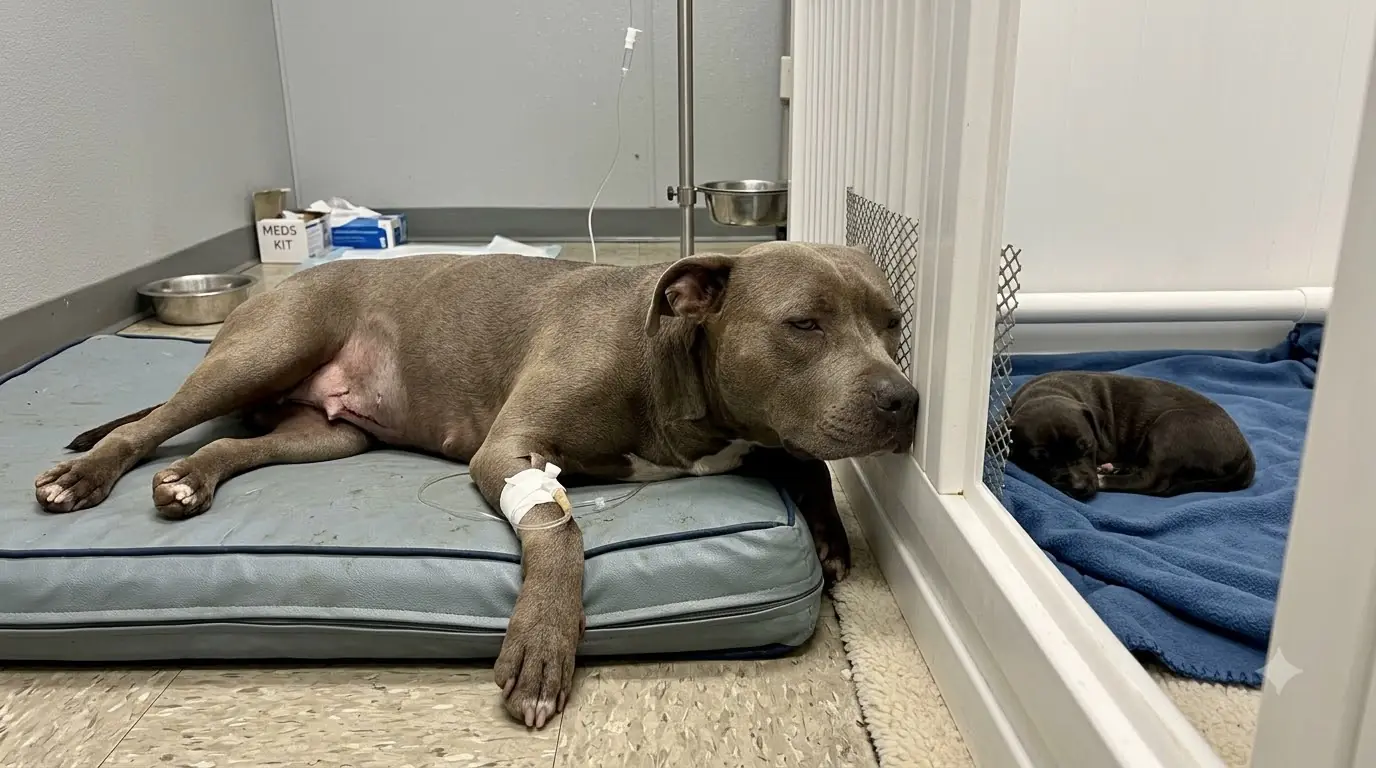
Molly is supposed to stay on the medical bed.
Her abdomen is still shaved from surgery. One front leg has an IV catheter secured in place, and even changing positions takes more effort than it should for an adult American Pit Bull Terrier.
Her only surviving puppy is just inches away.
Staff deliberately placed the puppy’s maternity bed beside Molly’s resting area so mother and baby could remain close without requiring Molly to constantly move.
Most of the time, it works.
Then the puppy crawls to the far side.
Molly notices.
She raises her head first. After watching the puppy for a moment, she begins the slow process of leaving her own bed.
She does not climb into the maternity area or try to pick the puppy up.
Instead, Molly lowers herself against the side of the pen.
Then she pushes her muzzle through the opening as far as it will comfortably go.
She stays there.
Eventually, the puppy turns.
It crawls back across the bedding until it reaches Molly’s face, curls against her muzzle, and falls asleep.
Only then does Molly stop shifting.
For shelter staff trying to help a weak mother recover from surgery, the routine creates a difficult problem.
Molly needs rest.
But every time her only puppy sleeps too far away, she keeps getting up to close the distance herself.
Molly Arrived With Only One Puppy
There had once been more than one puppy in Molly’s litter.
By the time she entered shelter care, however, only one remained with her.
Staff did not invent a history for the puppies that were no longer there. Without reliable information, there was no way to know exactly what had happened before intake.
What they did know was what they could see.
Molly was physically compromised.
She required surgery and was now recovering with a shaved abdomen, an IV line and very little energy to spare.
Beside her was one very young puppy that still depended heavily on its mother.
That immediately made Molly’s recovery more complicated than an ordinary postoperative case.
She was not simply a surgical patient.
She was a nursing mother.
Surgery Had Left Molly With Almost No Extra Energy
After an abdominal procedure, rest and careful monitoring matter.
Staff watched Molly’s incision for swelling, discharge, excessive redness or other signs of complications. Her temperature, hydration, appetite, pain level and overall behavior were also important parts of postoperative monitoring.
The IV allowed prescribed fluids or medications to be administered as needed while she recovered.
Movement had to be controlled.
An adult dog who suddenly jumps, twists or repeatedly climbs over barriers after abdominal surgery can put unnecessary strain on healing tissue.
Molly was unlikely to jump anywhere in her weakened condition.
But even her slow trips out of bed were using energy staff wanted her to conserve.
There was also the puppy to consider.
Molly still needed to be positioned safely enough for maternal contact and, when medically appropriate, nursing.
The shelter needed a setup that protected both patients at once.
The Maternity Pen Was Placed Right Beside Her
Staff arranged the space so Molly would not have to travel across the room to reach her puppy.
The puppy had a warm, padded maternity area immediately beside Molly’s medical bed.
That allowed the two dogs to smell and touch each other while giving caregivers better control over Molly’s postoperative movement.