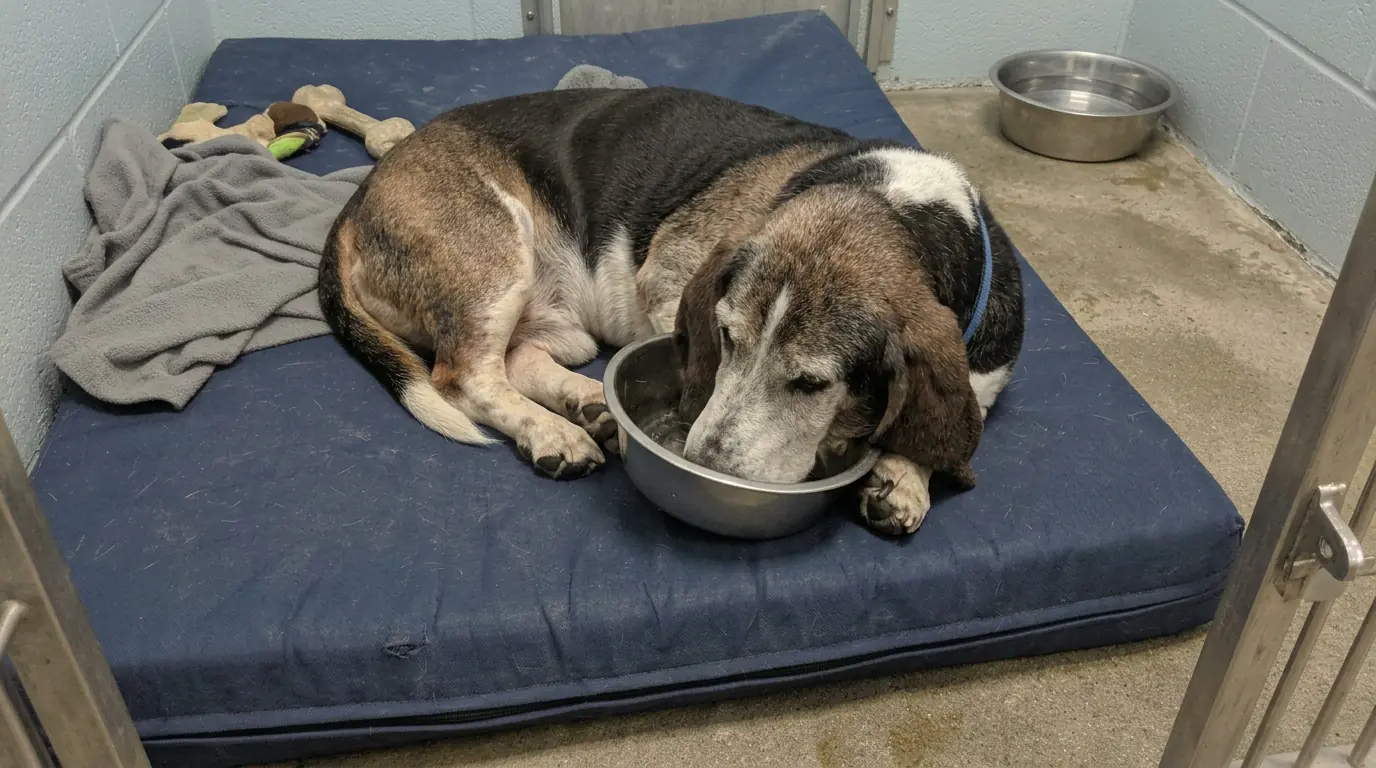
Murphy did something after every meal that shelter staff could not ignore.
The eight-year-old Basset Hound would finish eating, lower his head to the stainless-steel bowl, and lick it clean.
Then, instead of walking away, he picked it up.
Murphy carried the empty bowl across the kennel.
He climbed onto his thin mattress, turned in a slow circle, and placed the bowl against his chest.
Then he curled himself around it.
Sometimes he rested his chin against the rim.
Sometimes he tucked the bowl between his front legs.
And then Murphy slept.
Not for a few minutes.
For hours.
The strange part was that he had other things available.
There was a blanket.
There were toys.
There was bedding.
But after each meal, Murphy seemed to want the empty bowl closest to him.
For a dog who had arrived underweight after spending time as a stray, the behavior raised an obvious question.
Why did a completely empty food bowl seem to matter so much?
Murphy Arrived Looking Like Food Had Been Hard to Come By
Basset Hounds are naturally low to the ground and heavy-bodied, but Murphy looked noticeably thin when he arrived.
His waist was more pronounced than expected.
His ribs were easier to feel.
The loose skin typical of the breed made his weight loss look less dramatic at first glance, but a closer examination showed that he had lost condition.
No one knew exactly how long he had been living outside.
There was no reliable feeding history.
No one could say how often he had found food or whether he had spent days going without it.
Like many stray dogs, Murphy arrived with a story that had gaps no one could fill.
The shelter could see what his body looked like now.
They could not know every meal he had missed before he got there.
The First Meal Seemed Completely Normal
Murphy was clearly interested in food.
That was not unusual for a hungry dog.
He approached the bowl, ate steadily, and spent extra time licking the bottom after the food was gone.
Nothing about that first part surprised staff.
The unusual behavior came afterward.
Murphy closed his mouth around the rim of the metal bowl.
Then he lifted it.
Because of his short legs and long body, carrying the bowl was awkward.
The bottom occasionally bumped against the floor as he moved.
Still, he kept going.
He crossed the kennel and reached the mattress.
Then he climbed onto it with the bowl still in his mouth.
Only after he was settled did he put it down.
Staff initially thought he might simply be playing with it.
He was not.
Murphy drew the empty bowl against his chest and curled around it.
Then his eyes closed.
The Same Thing Happened at the Next Meal
One odd moment can be meaningless.
A repeated pattern gets attention.
At the next feeding, Murphy ate again.
Then he licked the bowl.
Picked it up.
Carried it to bed.
Curled around it.
And slept.
After another meal, he did the same thing.
It was not random.
Murphy seemed to have developed a routine.
Eat.
Clean the bowl.
Carry it away.
Keep it close.
Rest.
The repetition made staff more curious.
Why that object?
Why after every meal?
Why not the blanket?
Why not a toy?
The Bowl Was Worth Nothing Once the Food Was Gone
From a human perspective, the bowl should have become unimportant as soon as the meal ended.
It was empty.
It had no smell of a full meal left beyond whatever traces remained after Murphy licked it clean.
It did not provide warmth.
It was not soft.
It was not especially comfortable to sleep against.
And yet Murphy consistently treated it as though it had value.
That was what made the behavior so striking.
Dogs can become attached to objects for many different reasons.
Some carry toys.
Some guard chews.
Some move blankets.