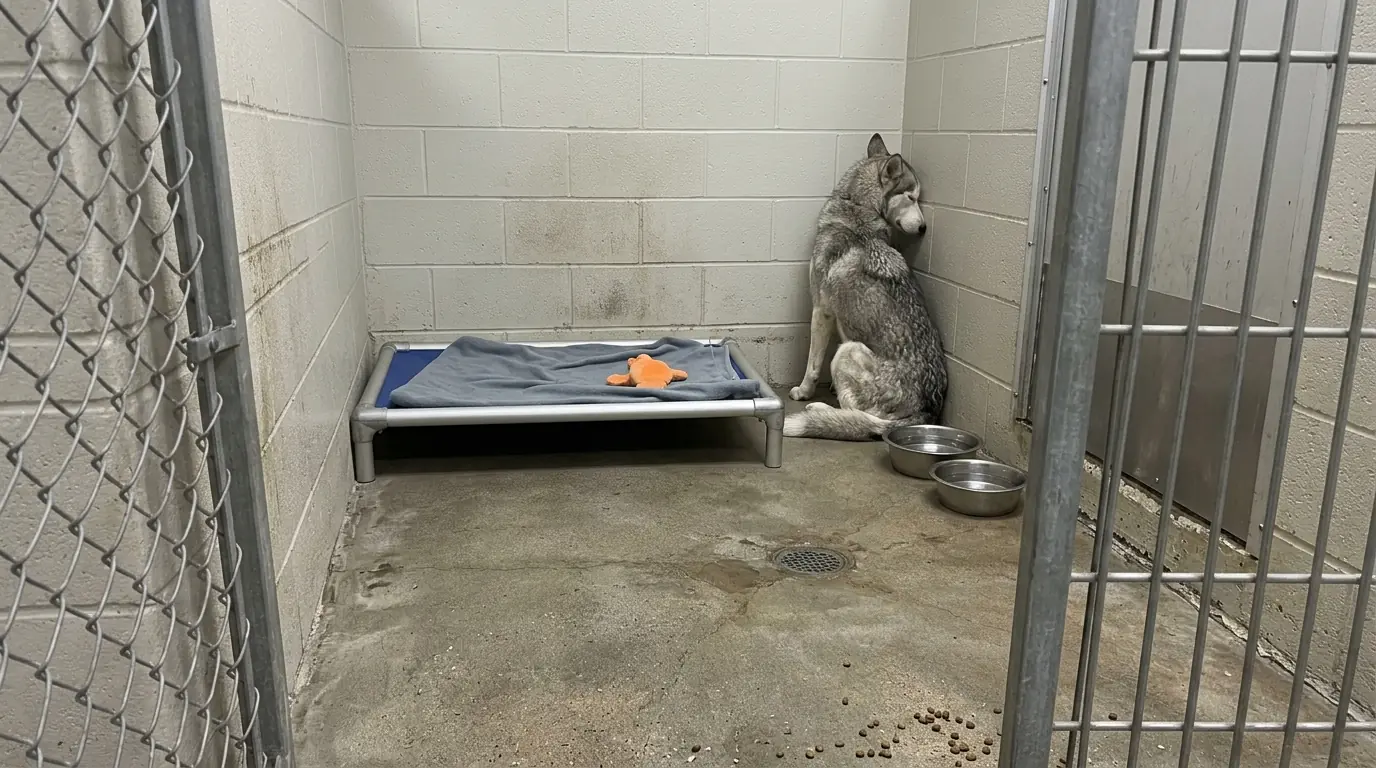
Nala does not sleep the way most dogs do.
The five-year-old Siberian Husky has a bed inside her shelter kennel. She has enough room to turn around, stretch out, or curl into a comfortable position.
But Nala almost never chooses any of those things.
Instead, she walks to the back corner of the kennel.
She turns away from the door.
Then she presses her forehead against the wall.
Sometimes she remains standing like that for a long time.
Other times she slowly lowers herself into a sit, still facing the wall, still refusing to look toward the hallway behind her.
Eventually, exhaustion begins to win.
Her back legs soften.
Her body slides lower.
Only then does Nala finally settle onto the floor.
Even while sleeping, her face remains turned toward the wall.
For shelter staff, the behavior is difficult to watch because nothing seems to happen before it.
No one has to approach.
No one has to touch her.
Sometimes the ordinary sounds of the shelter are enough.
A kennel door closes.
Another dog barks.
A cart rolls down the hallway.
Nala turns toward the corner and disappears into the only place she seems able to rest.
Nala Came From a Property With Too Many Dogs
Before arriving at the shelter, Nala had been removed from an overcrowded property.
Exactly what her daily life looked like there cannot be reconstructed from her behavior alone.
Overcrowded animal environments can vary enormously.
Some dogs may have limited access to quiet areas.
Some may compete for space or resources.
Others may have very little individual handling or exposure to unfamiliar people and environments.
What shelter staff did know was that Nala arrived profoundly fearful.
She did not behave like a dog who was simply uncertain about a new kennel for a few hours.
Her entire body seemed organized around avoiding attention.
She backed away when people entered.
She avoided the front of the kennel.
Sudden sounds made her tense.
And when the shelter became busy, Nala often placed herself as far from the activity as the walls allowed.
Then she turned her face away.
The Strange Sleeping Position Was One of the First Things Staff Noticed
Dogs choose all kinds of sleeping positions.
Some curl tightly.
Some stretch across the floor.
Some sleep with their backs against a wall.
Others prefer covered beds, corners, blankets, or raised platforms.
Nala's position stood out because it looked less like a comfortable preference and more like a way of shutting out the environment.
Her forehead would rest directly against the corner.
Her nose pointed downward.
Her ears angled back or to the sides.
The rest of her body remained behind her, exposed to the kennel.
Yet she seemed unwilling to turn around.
At times, Nala would remain standing in that position even when her eyes began closing.
Her legs would stiffen slightly as she fought sleep.
Then her head lowered farther.
Still she did not lie down.
She Seemed Too Alert to Let Herself Rest
Sleep requires vulnerability.
An animal has to stop monitoring the environment long enough to relax.
For some frightened dogs, that can be difficult.
Nala appeared exhausted but unable to fully surrender to sleep.
She might remain seated for long periods with her face against the wall.
Her body would sway slightly.
Her eyes closed.
Then a sound in the hallway caused them to open again.
A few minutes later, the same cycle repeated.
Eventually her muscles could not maintain the posture.
Her front legs bent.
Her hindquarters shifted.
Nala slowly slid down the wall until her body reached the floor.
Even then, she rarely turned to face the kennel door.
The corner seemed to matter more than the bed.
Staff Did Not Know Exactly What the Wall Meant to Her
It would be easy to describe the behavior as if Nala were "hiding from her past."
But dogs cannot tell us the symbolic meaning of a sleeping position.
The wall may reduce visual stimulation.
The corner may feel more predictable because nothing can approach from directly in front of her.
Turning away from the kennel door may help her avoid watching constant movement.
Or the behavior may simply be a coping strategy she developed over time.
No one could say for certain.
What mattered was that Nala repeatedly chose the position when she was overwhelmed.
The pattern was consistent enough to deserve attention.
The Shelter Was Almost the Opposite of Quiet
Animal shelters are full of unavoidable noise.
Dogs bark.
Kennel latches click.
Bowls move.
Doors open.