An adult Bald Eagle brought into a wildlife rehabilitation center in northern Wisconsin arrived showing a combination of signs that staff had learned to take seriously.
The bird was lethargic.
It was dehydrated.
Its grip was weak.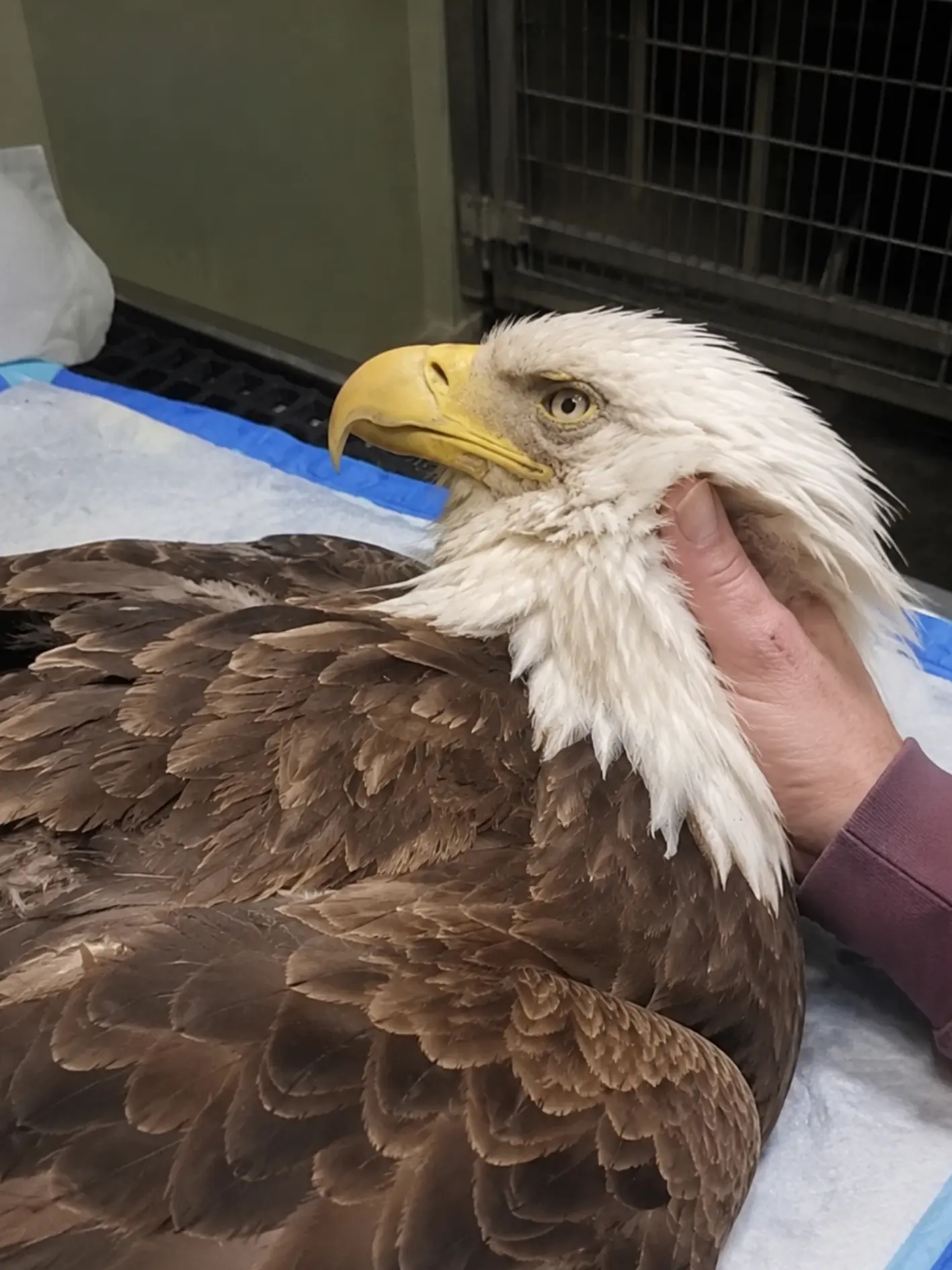
Its posture was low, and it struggled to move with the coordination expected from a healthy adult eagle.
At times, the bird appeared visually unfocused and slow to react to movement around it. It could lift its head and remain conscious, but it did not have the strength or motor control needed to perch normally.
Those signs can have many causes.
A Bald Eagle found in that condition might have suffered a collision, head trauma, an infectious disease, severe dehydration, internal injury, or toxic exposure.
Blood testing provided an important clue.
The eagle had a clinically significant concentration of lead in its bloodstream.
For the rehabilitation team, the diagnosis was troubling but not surprising.
According to the center’s rehabilitation director, this eagle was one of nine Bald Eagles from the surrounding region recently found with significant lead exposure.
“The signs can range from a bird that simply looks weak to an eagle that can no longer stand, grip, or coordinate its movements normally,” the director said. “By the time some of them reach us, they are already very sick.”
He believes that scavenging animal remains containing fragments of lead ammunition is the most likely exposure pathway in many of the cases the center sees.
“Most of the lead we believe these birds are encountering comes from feeding on deer carcasses, gut piles, or other animal remains containing fragments of lead ammunition,” he said.
No specific carcass has been definitively linked to each of the nine eagles, and wildlife specialists cannot reconstruct the exact feeding history of individual birds.
But the repeated pattern has become difficult for rehabilitators to ignore.
Again and again, a Bald Eagle arrives weak.
Again and again, blood is collected.
And again and again, lead is found at a level high enough to become part of the medical problem.
A Sick Eagle Does Not Always Look Dramatically Injured
One of the challenges with lead toxicosis is that the early external signs can be subtle.
There may be no blood.
No broken bone.
No obvious wound.
A severely affected eagle may simply sit low and remain unusually quiet.
The adult bird in this case was photographed during its initial medical evaluation resting on an examination surface while staff supported the head and neck.
The bird was alert enough to watch its surroundings, but its posture was subdued and its body remained heavily supported.
That appearance alone cannot diagnose lead poisoning.
Many conditions can cause a Bald Eagle to lie low or appear weak.
But once the blood lead result returned, several of the clinical signs became easier to interpret.
Lead can affect the nervous system.
It can interfere with muscle function.
It can contribute to dehydration and loss of appetite.
It can impair the blood’s ability to function normally.
In more severe cases, it may interfere with the coordination necessary for a bird to stand, perch, see accurately, or fly safely.
Lethargy Is Often One of the First Signs People Notice
A healthy wild Bald Eagle usually does not allow a person to approach closely.
It may remain on the ground while feeding, but once uncomfortable, it normally has the strength and coordination to move away.
An eagle that sits motionless while people approach may already be significantly compromised.
Lethargy can reflect a broad range of problems, but in lead-exposed birds it may occur alongside weakness, dehydration, neurological abnormalities, and reduced appetite.
The bird may appear to “just be resting.”
In reality, it may lack the strength to respond normally.
That difference is clinically important.
A quiet eagle is not necessarily a comfortable eagle.
In wildlife medicine, excessive tolerance of human presence can be a warning sign.
Weakness Can Progress Until the Bird Can No Longer Perch
Perching looks effortless when a healthy eagle does it.
It is not.
A Bald Eagle must maintain continuous muscle tone through both legs and feet.
The toes have to grip securely.
The nervous system makes constant adjustments to body position.
Vision contributes to balance.
The bird must respond instantly to changes in wind or movement.
Lead intoxication can interfere with several of those functions simultaneously.
A bird may begin by gripping less strongly.
Then it may lose balance.
Eventually, it may stop attempting to perch at all and remain on the ground.
That is why rehabilitation staff pay close attention to the feet.
Can the eagle flex its toes?
Does it grip equally with both feet?
Can it maintain pressure around a perch?
Does it place its feet in the correct position?
A bird whose grip is weak cannot safely be released even if its wings appear normal.
Vision Can Also Be Affected
Some lead-exposed birds show changes that appear to involve vision or visual coordination.
They may not track movement normally.
They may react slowly.
They may have difficulty accurately positioning their feet or navigating their surroundings.
Not every eagle with elevated lead becomes visually impaired.
The clinical presentation varies.
But when a bird appears disoriented or visually abnormal, veterinarians take the sign seriously.
A Bald Eagle depends heavily on vision.
It must locate food from a distance.
It must judge speed and altitude.
It must avoid trees, wires, vehicles, and other birds.
It must land precisely on branches.
Even a modest visual deficit can become dangerous in the wild.
For that reason, visual function is evaluated repeatedly during rehabilitation.
Loss of Mobility Can Be the Most Alarming Sign
Some of the worst cases arrive conscious but barely mobile.
The eagle may still look at staff.
It may move its head.
It may even flex its feet.
But it cannot stand.
It cannot grip.
It cannot coordinate its legs well enough to walk.
It cannot fly.
Those cases illustrate how severe neurological dysfunction can become before an eagle is discovered.
The bird may have been weakening for days.
By the time a member of the public finds it grounded, the toxic exposure may already be advanced.
That delay can dramatically affect prognosis.
Nine Eagles Have Been Identified in the Region
The rehabilitation center says nine Bald Eagles from the surrounding northern Wisconsin region have recently been confirmed with clinically significant lead exposure.
That number represents birds that actually reached professional care.
It is not an estimate of how many Bald Eagles in the wider wild population have been exposed.
Rehabilitation facilities see a highly selected group of animals — those sick or injured enough to be captured.
The nine cases should therefore not be interpreted as a prevalence estimate for Wisconsin as a whole.
Even so, the repetition has become meaningful to the people treating these patients.
When one eagle arrives with a positive lead result, it may look like an isolated case.
When several birds arrive with similar signs and similar laboratory findings, the pattern becomes harder to dismiss.
Where Is the Lead Coming From?
In most individual cases, the exact source cannot be proven.
Bald Eagles can travel considerable distances.
A bird may feed in one county and become visibly ill in another.
It may consume food from several different carcasses over several days.
By the time the bird is grounded, there is usually no practical way to identify the exact piece of tissue that contained lead.
The rehabilitation team believes one recognized exposure pathway is especially important in its region: scavenging animal remains containing fragments of lead ammunition.
That may include:
- deer carcasses,
- discarded internal organs,
- unrecovered animals,
- or other remains left accessible to scavengers.
Bald Eagles are opportunistic feeders.
Scavenging is normal behavior.
Carrion provides concentrated calories with relatively little energy expenditure.
The eagle does not know whether the tissue contains metal fragments.
To the bird, the food looks like food.
A Bullet Does Not Have to Remain Intact to Create Risk
One misunderstanding is that an eagle would have to swallow an entire bullet to become poisoned.
That is not necessary.
Lead projectiles can deform or fragment after impact.
Some fragments may be very small.
They can remain embedded in tissue beyond the main wound channel.
A scavenger eating that tissue may swallow those pieces without detecting them.
Once ingested, lead can enter the gastrointestinal system and be absorbed into the bloodstream.
The effect depends on multiple factors, including:
- the amount ingested,
- the size and composition of the fragments,
- how long the material remains in the digestive tract,
- the bird’s overall condition,
- and whether repeated exposures have occurred.
Not every exposure produces the same clinical picture.
But when enough lead enters the body, the consequences can be severe.
The Nervous System Is Particularly Vulnerable
Neurological dysfunction is one of the most concerning consequences of significant lead exposure.
Affected birds may develop:
- poor coordination,
- reduced grip,
- tremors,
- abnormal head movement,
- weakness,
- difficulty standing,
- loss of normal escape behavior,
- or inability to fly.
A bird may be structurally capable of flight while neurologically unable to control the body well enough to use that ability safely.
That distinction matters.
An eagle can have intact wings and still be grounded.
Lead Can Also Affect the Blood
Veterinarians do not look only at neurological signs.
Lead exposure can interfere with processes involved in red blood cell production.
That may contribute to anemia.
An anemic eagle has reduced capacity to deliver oxygen efficiently to working tissues.
The result can be profound fatigue and poor endurance.
Packed cell volume, or PCV, may therefore be monitored during treatment.
If the PCV drops substantially, a bird may remain extremely weak even while some neurological signs improve.
That is one reason clinicians follow several laboratory values rather than relying on a single lead result.
Gastrointestinal Problems Can Make Everything Worse
Lead exposure may also affect appetite and gastrointestinal function.
Some birds stop eating.
Others become dehydrated.
A bird that already has neurological weakness can deteriorate rapidly if it also stops taking in food and water.
Nutritional decline weakens the flight muscles.
Dehydration affects circulation and organ function.
The medical problems begin to reinforce one another.
By the time the eagle is found, it may no longer have the physical reserve needed to compensate.
Treatment Starts With Stabilization
When a severely affected Bald Eagle arrives at the hospital, the first priority is often basic supportive care.
The bird may be placed in a quiet enclosure with padded flooring.
If it cannot perch safely, staff do not force it to.
Fluids may be administered to correct dehydration and support circulation.
Body temperature is monitored.
Appropriate nutrition is provided.
Pain from any secondary injuries is managed.
Handling is minimized.
A sick eagle already has limited energy reserves.
Repeated restraint can consume energy the bird needs for recovery.
Chelation Therapy May Be Used for Significant Lead Exposure
When blood lead concentrations and clinical signs indicate significant toxicosis, veterinarians may use chelation therapy.
Chelating medications bind lead and help the body eliminate it.
But the treatment is not instantaneous.
A lower blood lead concentration does not necessarily mean neurological function has returned.
The toxic metal may have already caused damage.
Lead may also redistribute from tissues, which is one reason repeat blood testing can be important.
Some birds require more than one treatment cycle.
The veterinary team therefore follows both the laboratory values and the bird itself.
Is the grip stronger?
Is the eagle standing?
Is it eating?
Can it balance?
Can it perch?
Those questions matter just as much as the number on the blood test.
Some Eagles Recover
Lead poisoning is not automatically fatal.
Some birds respond well to treatment.
The progression can be remarkable.
An eagle that initially lies on padded towels may begin holding its head upright more consistently.
Then it may grip.
Then stand.
Then eat without assistance.
Later, staff may introduce a low perch.
If balance and grip continue improving, the bird can move into a larger rehabilitation enclosure.
Eventually, flight conditioning can begin.
These changes usually happen gradually rather than all at once.
Some Birds Arrive Too Sick to Save
Other cases are much more severe.
The rehabilitation director said some Bald Eagles arrive after the neurological or systemic effects of lead exposure have already become profound.
They may be unable to stand.
Unable to swallow normally.
Severely dehydrated.
Profoundly underweight.
Significantly anemic.
Or affected by additional trauma sustained while they were already weak.
“Some birds recover, but others arrive after the exposure has already caused profound neurological or systemic damage,” the veterinarian said. “At that point, our responsibility is also to determine whether continued treatment has a realistic chance of restoring an acceptable quality of life.”
In some cases, it does not.
Humane Euthanasia Can Become the Most Responsible Medical Decision
Wildlife rehabilitation is not simply about keeping an animal alive.
The goal is meaningful recovery.
For a wild Bald Eagle, that ultimately means the ability to function independently.
A bird must be able to:
- stand,
- perch,
- grip,
- eat,
- see,
- fly,
- maneuver,
- and land safely.
If severe neurological injury makes those functions unlikely to return, prolonged treatment may only extend suffering.
Humane euthanasia may then be recommended.
That decision is based on the entire clinical picture, not on a positive lead test alone.
Veterinarians consider:
- neurological function,
- swallowing ability,
- blood values,
- strength,
- response to treatment,
- secondary injuries,
- and expected quality of life.
Why Some Eagles Die Despite Treatment
Several factors can influence survival.
One is the amount of lead absorbed.
Another is how long the bird remained exposed before rescue.
Repeated exposure may also matter.
Severe anemia can complicate recovery.
Neurological damage may be only partly reversible.
Secondary injuries can worsen the prognosis.
An eagle weakened by lead may collide with a vehicle, fall from a perch, or become unable to avoid other hazards.
By the time the bird reaches a rehabilitation center, clinicians may be treating poisoning, trauma, dehydration, and starvation simultaneously.
Rehabilitation Staff Are Looking Beyond the Hospital
Because the same pattern has appeared repeatedly, the center believes prevention deserves as much attention as treatment.
The rehabilitation director has encouraged hunters who are willing and able to do so to consider copper or other non-lead ammunition.
“If more hunters choose copper instead of lead, that removes one preventable source of exposure from the landscape,” he said. “The goal is not to stop hunting. It is to prevent fragments of a toxic metal from becoming part of a scavenger’s next meal.”
The distinction matters.
The issue being raised is not hunting itself.
It is the material used in ammunition and what happens to fragments after an animal is harvested.
Hunters Are Also Important Wildlife Conservation Partners
Across the United States, hunters contribute substantially to wildlife conservation through licensing, excise taxes, habitat initiatives, and direct stewardship.
Many are also among the people most likely to encounter injured wildlife and report it.
The rehabilitation center’s message therefore focuses on practical risk reduction rather than blame.
Copper and other non-lead ammunition can perform the same broad purpose without leaving lead fragments in tissue.
For people who have access to suitable alternatives, switching materials may reduce one known exposure pathway for scavenging wildlife.
Carcass Management May Also Matter
Where practical and consistent with local regulations, reducing access to remains containing lead fragments can also lower risk.
That may mean removing certain remains from areas heavily used by scavengers or disposing of them in a way that prevents access.
However, the appropriate approach depends on local laws, land-use practices, and hunting conditions.
The rehabilitation center does not suggest one method will work everywhere.
The broader goal is simply to keep toxic metal out of food sources that eagles naturally use.
Why Bald Eagles Are Especially Vulnerable
Bald Eagles are both predators and scavengers.
That flexibility is usually an advantage.
They can catch fish.
Take waterfowl.
Steal prey from other birds.
Feed on carrion.
But that same willingness to scavenge exposes them to substances they cannot detect.
A deer carcass is a valuable food source.
An eagle cannot visually identify microscopic metal fragments hidden inside muscle.
There is no warning.
The bird eats normally.
The exposure happens silently.
Clinical signs may not appear until later.
The Current Eagle Still Has Work Ahead
The adult eagle featured in this case remains under treatment.
Its blood lead concentration is being monitored.
Hydration and food intake remain important.
Neurological function continues to be reassessed.
The rehabilitation team is watching for stronger grip, better posture, improved coordination, and normal visual responses.
The bird is not yet considered ready for flight evaluation.
That would come much later.
Standing Comes Before Flying
The first major functional milestone is reliable weight-bearing.
Can the eagle place both feet correctly?
Can it stand without collapsing?
Can it support itself for an extended period?
Once those abilities return, a low perch may be introduced.
A low perch allows staff to evaluate grip and balance without creating a major fall risk.
If the bird repeatedly slips or cannot hold the perch, neurological recovery is incomplete.
Flight Is the Final Test
Even after an eagle appears medically stable, release is still a demanding standard.
The bird must demonstrate:
- strong takeoff,
- symmetrical wingbeats,
- normal endurance,
- precise turning,
- appropriate visual navigation,
- and controlled landing.
Landing is particularly important in lead cases because subtle neurological deficits can affect timing and foot placement.
A bird may fly across an enclosure and still be unsafe in the wild if it cannot accurately grip a perch.
Repeated successful flights are therefore necessary.
One Normal Lead Result Would Not Be Enough
The medical team also needs confidence that the bird’s toxic burden is no longer at a clinically concerning level.
Repeat blood testing may be required.
The bird’s red blood cell status must also be adequate.
Appetite must be normal.
Body condition needs to recover.
A releasable eagle must not simply be alive.
It must be capable of sustaining itself without assistance.
The Nine Cases Do Not Tell Us How Many Wild Eagles Are Exposed
The rehabilitation center is careful about what its own case numbers can and cannot show.
Nine treated birds do not tell biologists what percentage of all Bald Eagles in northern Wisconsin carry lead.
Some exposed birds may never develop severe signs.
Some may recover without being found.
Others may die without reaching a rehabilitation facility.
The center’s numbers represent only the animals that entered care.
But from a clinical perspective, those nine birds are still significant.
Each one represents an individual eagle exposed strongly enough to become sick.
The Pattern Is What Worries the People Treating Them
For rehabilitation staff, the concern is not one isolated poisoned eagle.
It is repetition.
A grounded eagle arrives.
The bird is lethargic.
Its grip is weak.
It cannot fly.
Blood is drawn.
Lead is detected.
Treatment begins.
Sometimes the bird improves.
Sometimes it does not.
And then another eagle arrives.
That pattern has made lead screening part of the routine thinking around debilitated Bald Eagles in the region.
Public Awareness Can Help With Early Rescue
People who encounter Bald Eagles can help by recognizing abnormal behavior.
Signs that should prompt a call to professionals include:
- remaining grounded for an extended period,
- allowing unusually close approach,
- inability to fly,
- poor balance,
- abnormal head movements,
- weak grip,
- obvious visual disorientation,
- or profound lethargy.
People should not attempt to treat the bird themselves.
Even a weak eagle can cause severe injury with its talons.
Food and water should not be forced into the beak, particularly when neurological impairment may affect swallowing.
The safest approach is to contact a licensed wildlife rehabilitator, animal-control service, or wildlife agency.
Early Intervention Can Change the Outcome
The sooner a severely affected eagle receives care, the more options veterinarians may have.
Fluids can be started before dehydration becomes extreme.
Nutrition can be supported before muscle condition collapses.
Chelation can begin while neurological function is still recoverable.
Secondary injuries can be treated.
There are no guarantees.
But waiting until the bird is unable to lift its head makes the medical challenge much harder.
The Immediate Goal Is Recovery — the Larger Goal Is Prevention
For the eagle currently resting under veterinary care, the treatment plan remains focused on the individual patient.
Reduce the lead burden.
Restore hydration.
Support nutrition.
Monitor the blood.
Evaluate vision.
Recover grip.
Return to standing.
Then perching.
Then, perhaps, flight.
But the nine cases seen in the region have also pushed the rehabilitation staff to look beyond the treatment room.
Every lead-poisoned eagle represents an exposure that happened before anyone knew the bird was sick.
By the time the eagle reaches the hospital, the toxic metal is already inside its body.
Medicine can attempt to remove it.
Rehabilitation can try to restore lost strength.
Veterinarians can treat anemia, dehydration, neurological dysfunction, and secondary trauma.
Sometimes they succeed.
Sometimes the damage is already too severe.
That is why the center sees copper and other non-lead ammunition not as a cure for every threat Bald Eagles face, but as one practical way to reduce a preventable source of exposure.
For the current patient, the outcome is still uncertain.
For future eagles, prevention offers something treatment never can:
the possibility that the poisoning never happens in the first place.