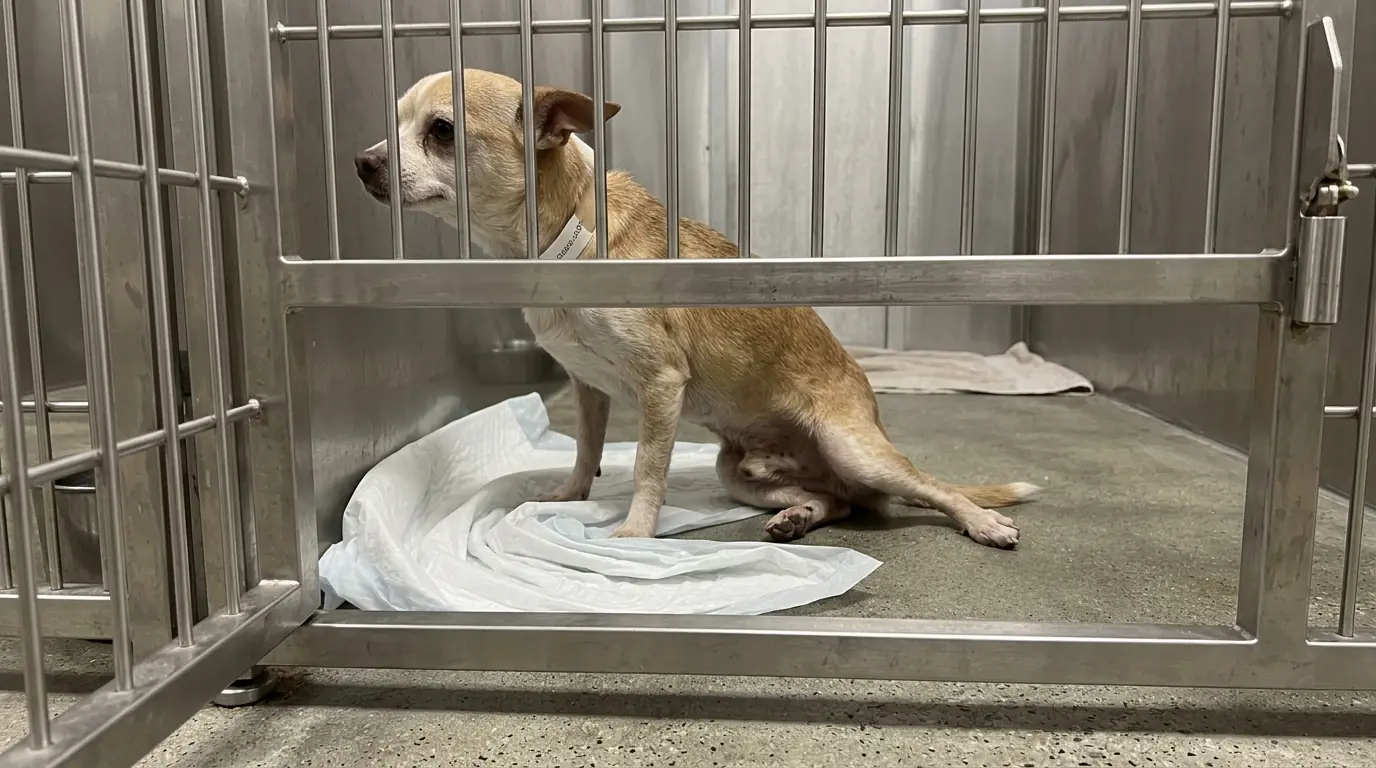
Peanut does not need much space to begin.
The seven-year-old Chihuahua mix can be standing quietly inside his medical kennel, one weak hind leg positioned slightly differently from the other, when a sudden noise carries through the hallway.
A metal door closes.
A dog erupts into barking.
Something drops.
Peanut's head comes up.
Then he starts turning.
One small circle.
Another.
He stays close to the wall, rotating in a tight path that barely gives his little body enough room to straighten.
At first, his front and back legs keep up with each other.
Then the circles get faster.
Peanut's front paws continue moving.
His weaker hind leg begins falling behind.
His rear paws slip.
His hips swing sideways.
And eventually, his back end collapses onto the floor.
For several seconds, Peanut lies there.
It seems as though his body has finally forced the spinning to stop.
Then he plants both front paws beneath his chest.
He pushes himself up.
And before his hind legs have fully recovered, Peanut looks ready to start another circle.
The Noise Comes First
Peanut does not spin constantly.
That distinction matters.
During calmer periods in the medical kennel, he can rest.
He can watch the hallway.
He can move carefully around his enclosure.
His gait is abnormal because of his neurologic injury, but he is not continuously circling.
Then something loud happens.
His behavior changes almost immediately.
His First Circle Is Usually the Best One
Peanut turns close to the wall.
His steps are relatively coordinated.
His stronger limbs compensate for the weaker one.
If the sound ends quickly and the environment settles, sometimes Peanut stops there.
But if the noise continues—or his arousal keeps building—he turns again.
The second circle is faster.
Then the third.
That is when his physical limitations become much more visible.
His Front Legs Can Move Faster Than His Back Legs Can Follow
Peanut's forelimbs remain comparatively strong.
They pull his body around the curve.
His hindquarters have a harder job.
One rear leg is neurologically weak.
His balance is compromised.
As Peanut accelerates, the difference between what the front and rear halves of his body can manage becomes increasingly obvious.
His front paws say go.
His hind legs cannot keep up.
The Circle Begins to Collapse
Peanut's path becomes uneven.
His rear paws may cross awkwardly.
One foot slides outward.
His hips drift toward the wall.
He corrects himself.
Then tries to turn faster.
Eventually there is no correction left.
Both hind legs slip away from beneath him.
Peanut falls.
The Fall Doesn't Always End the Urge to Move
That is one of the most concerning parts.
If Peanut simply became tired and rested after falling, the situation would be different.
Instead, only seconds may pass before his front paws begin working again.
He lifts his chest.
His head rises.
He braces on the stronger half of his body.
His rear end is still struggling to find a stable position.
Yet Peanut is already trying to get back up.
Staff Realize There Are Two Problems Happening at Once
The first is physical.
Peanut has a neurologic injury affecting a hind leg and his balance.
The second is behavioral.