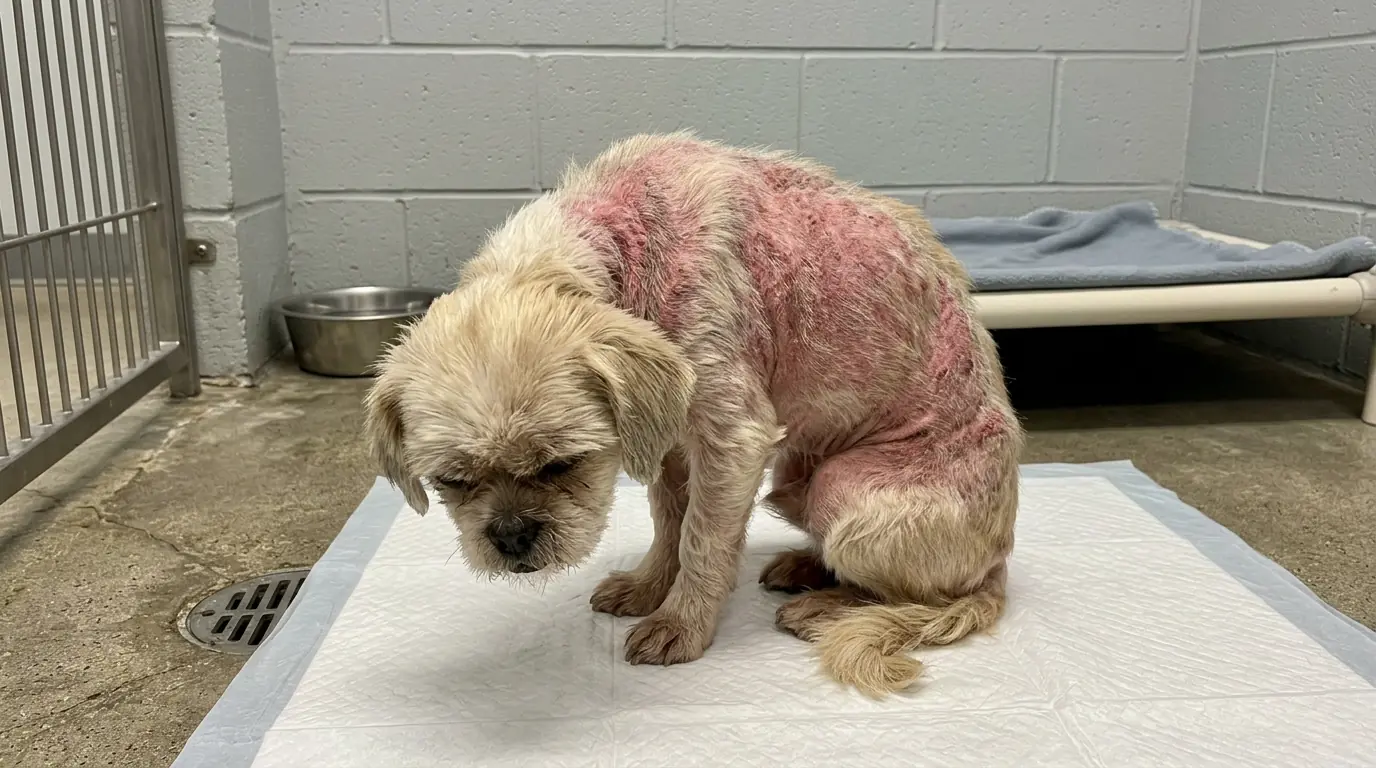
Peanut is exhausted.
The seven-year-old Shih Tzu mix has spent much of the day inside a medical kennel, barely moving except when he needs to change position.
His body looks painfully different from the fluffy little dog his breed mix might suggest.
Most of the hair across his back and sides is gone.
The exposed skin underneath is red and inflamed. Some areas are crusted and irritated, while others are undergoing treatment.
A clean pee pad covers part of the kennel floor.
Peanut walks onto it.
He turns slowly.
Then he begins doing something dogs normally perform without thought.
He tries to curl up and sleep.
His front legs fold.
His body lowers.
One bare side touches the pad.
Peanut immediately jerks himself upright.
He stands for a moment.
Turns again.
Tries the other side.
The result is almost identical.
Eventually, Peanut stops trying.
He sits with his back rounded, his head hanging between his front legs.
His eyes begin to close.
Peanut is desperate for sleep.
But right now, even lying down seems to hurt.
His Skin Condition Is Impossible to Hide
Peanut's coat loss is extensive.
Large portions of his back and both sides have little remaining hair.
That leaves irritated skin completely exposed.
There are red areas.
Crusting.
Changes in texture.
Places that appear especially sensitive.
For Peanut, this is far beyond a cosmetic problem.
Skin is an organ.
When large areas become severely inflamed, ordinary activities can become uncomfortable.
Walking.
Being touched.
Changing position.
And, as Peanut demonstrates repeatedly, resting.
Severe Dermatitis Can Have Many Causes
Looking at Peanut cannot reveal exactly what caused his condition.
Dogs can develop significant skin disease from parasites, allergies, bacterial or fungal infections, immune-mediated conditions, endocrine disorders, chronic irritation, or combinations of several problems.
Secondary infection can make an existing skin condition considerably worse.
A dog may also injure his own skin through persistent scratching, licking, rubbing, or chewing when severe itching is present.
Peanut therefore needs diagnosis, not assumptions.
Treating only what the skin looks like may not solve what caused it.
The First Problem Staff Notice at Night Is Simpler
Peanut cannot get comfortable.
He is tired enough that his eyes repeatedly close while he is sitting.
But every attempt to place a large area of his body against the bedding seems to fail.
He lowers himself.
His skin contacts the surface.
His body stiffens.
Then he rises again.
For a dog who desperately needs rest to recover, that creates another problem.
Curling Up Normally Protects a Dog
Dogs curl for many reasons.
It can conserve warmth.
It can create a comfortable resting posture.
It allows the muscles to relax.
Peanut still attempts the familiar movement.
His body turns.
His head lowers.
His legs fold.
But curling also places pressure against the sides of his torso.
Those are exactly the areas where Peanut has lost much of his coat and developed severe irritation.
The position he instinctively wants may currently be the position his skin tolerates least.
The Pee Pad Isn't the Cause of the Problem
The pad is clean and relatively soft compared with bare kennel flooring.
But Peanut's skin is so sensitive that even ordinary contact appears difficult.
Changing the surface may improve comfort.
It cannot substitute for treatment.
Peanut needs the inflammation itself brought under control.
Until then, every bed has the potential to touch the areas that hurt.
His First Attempt Usually Lasts Only Seconds
Peanut circles.
His movements are slow.
He bends his front legs.
His chest reaches the pad.
Then one hip begins lowering.
The moment his side settles, Peanut's head rises.
His body tightens.
He pushes himself upright again.
Sometimes he immediately tries another position.
Other times he simply stands there.
Too tired to continue.
Too uncomfortable to lie down.
Eventually, He Chooses Sitting
Peanut lowers his hindquarters.
His front paws remain planted ahead of him.
His spine curves.
Then his head drops.
The little dog almost folds over himself.
It is not a normal, relaxed sleeping posture.
His muscles still have to keep him upright.
Yet it minimizes how much of his irritated back and sides press against the ground.
For Peanut, sitting has become the compromise between pain and exhaustion.
His Head Sometimes Drops Lower as He Dozes
The kennel becomes quiet.
Peanut's eyes close.
His head slowly sinks.
His nose approaches his paws.
Then his body sways slightly.
Peanut wakes.
He straightens just enough to keep from falling sideways.
Then the process begins again.
He is trying to sleep while remaining upright.
That Means Rest Itself Has Become Work
Healthy sleep allows the body to relax.
Peanut cannot fully do that if he must maintain a sitting posture.
His muscles remain engaged.
His balance still matters.
If he becomes deeply asleep, gravity may eventually pull him toward one of the painful areas he is trying to protect.
So Peanut repeatedly drifts toward sleep without reaching a comfortable resting position.
For an already sick dog, poor-quality rest can make everything harder.
Pain and Itching May Both Be Involved
Severe skin disease does not always produce one sensation.
Some dogs experience intense itching.
Others develop tenderness, burning discomfort, or pain from inflamed and damaged skin.
Secondary infection can add another layer.
Peanut's behavior alone cannot tell staff exactly what sensation is strongest.
But his reluctance to let the affected areas touch the surface is an important clinical observation.
His Skin Needs a Complete Veterinary Workup
The visible lesions are only the beginning.
Veterinary assessment may involve skin scrapings, cytology, examination for parasites, cultures or other testing when indicated, and investigation of possible underlying disease.
The treatment plan depends on the cause.
Parasites require one approach.
Infection another.
Allergic disease may require longer-term management.
An underlying systemic condition could require entirely different treatment.
Peanut cannot recover simply by waiting for his fur to grow back.
Comfort Has to Be Treated Alongside the Cause
Diagnosis can take time.
Peanut still needs to sleep tonight.
His care therefore has two parallel goals.
Find and treat the underlying problem.
And make him as comfortable as possible while that treatment begins working.
Appropriate pain or itch control may be important depending on veterinary findings.
Skin treatments need to be used exactly as prescribed.
Bedding needs to remain clean and dry.
Anything that increases friction against damaged areas should be minimized.
More Padding Isn't Automatically Better
A thick, fluffy bed sounds ideal.
For Peanut, it may or may not be.
Certain fabrics could catch against crusted areas.
A warm surface might worsen discomfort for some inflamed skin.
A deeply cushioned bed could wrap against more of his sides.
The best resting surface is the one Peanut can tolerate safely.
That might require trying different clean, smooth, supportive materials while watching his response.
Peanut gets a vote.
His body will show which surface hurts less.
One Softer Setup Helps—But Only a Little
A smooth padded layer is arranged in his resting area.
Peanut approaches.
He sniffs it.
Then he turns.
His front legs fold.
His chest comes down.
For several seconds, he stays there.
That is already longer than before.
Then his hip lowers.
The exposed skin on his side makes contact.
Peanut immediately lifts himself again.
The new bedding reduced one problem.
It did not remove the pain.
His Coat Once Protected These Areas
Hair provides more than appearance.
It creates a physical layer between skin and the environment.
Peanut has lost much of that barrier across the areas that contact the floor when he rests.
Now friction and pressure reach the affected skin more directly.
Temperature changes may also feel different.
The loss of fur therefore changes how Peanut experiences ordinary surfaces.
Something another dog barely notices can be significant to him.
Cleaning Must Be Gentle Too
Damaged skin needs hygiene.
But more scrubbing is not necessarily better.
Overhandling can irritate already inflamed areas.
Any bathing, topical treatment, or cleansing needs to follow the veterinary plan.
Peanut's skin should not be treated like dirty fur that simply needs washing.
It is diseased tissue.
Everything touching it matters.
Staff Begin Tracking Where Peanut Can Tolerate Contact
His chest seems easier.
Certain portions of his legs are less affected.
His sides are much more difficult.
That information can help with positioning.
Instead of repeatedly encouraging Peanut into a curled posture, his environment can support whatever resting position currently creates the least discomfort.
Recovery does not require sleeping in a normal-looking pose.
It requires sleeping safely.
One Night, Peanut Almost Lies Down Completely
He is visibly tired.
His head has been dropping while he sits.
Eventually, Peanut stands and turns.
He lowers his chest.
Then one side.
His body stiffens.
But this time he does not immediately jump up.
Five seconds pass.
Then ten.
Peanut's head reaches the bedding.
His eyes close.
For a brief moment, his entire body is supported by the floor.
Then Peanut shifts slightly.
A painful area rubs against the surface.
His eyes open.
He pushes himself upright again.
The attempt is over.
But it lasted longer.
Tiny Changes Become Important
How long can Peanut remain down?
Does he change positions less often?
Is he scratching less?
Does the redness begin decreasing?
Are crusted areas improving?
Is he eating?
Is he sleeping longer?
Is new hair beginning to appear where the skin has stabilized?
No single observation proves recovery.
Together, they create a trend.
The Goal Is Not a Beautiful Coat
Eventually, Peanut may regrow much of his hair depending on the cause and severity of the damage.
That would make the transformation visually dramatic.
But the important milestone comes earlier.
Comfort.
Peanut needs skin that no longer dominates every decision his body makes.
He needs to be able to move without anticipating irritation.
He needs to be able to rest.
His First Comfortable Nap Could Matter More Than the First New Fur
Imagine Peanut walking onto his bedding.
Turning once.
Lowering his chest.
Letting one side settle.
Nothing makes him jump back up.
He adjusts his paws.
Places his head down.
Then sleeps.
Twenty minutes.
An hour.
Long enough for his muscles to fully relax.
No sitting upright because lying down hurts more.
That would be real progress.
Until Then, Exhaustion Keeps Winning in the Wrong Position
Late in the evening, Peanut tries again.
He walks across the medical kennel.
Turns slowly.
His front legs bend.
His chest touches the pad.
Then he begins curling his body.
A large irritated patch along his side reaches the surface.
Peanut freezes.
He rises immediately.
His legs look tired.
He turns in the opposite direction.
Another attempt.
Another painful contact.
Peanut stands again.
This time he does not try a third time.
His hindquarters lower.
He sits.
His spine rounds.
His front paws remain together beneath him.
Then Peanut lowers his head until his nose is almost between them.
His eyes close.
For a few seconds, his body sways.
He wakes and catches himself.
Then his eyes close again.
Only a few inches away is enough space for Peanut to stretch out completely.
His body is exhausted enough to use it.
His skin simply will not let him.
For now, the most important sign that treatment is working may not be new hair or clearer skin.
It may be something far more ordinary:
the first night Peanut can finally curl his little body onto a bed, put his head down, and stay there because his own skin no longer hurts too much to let him sleep.