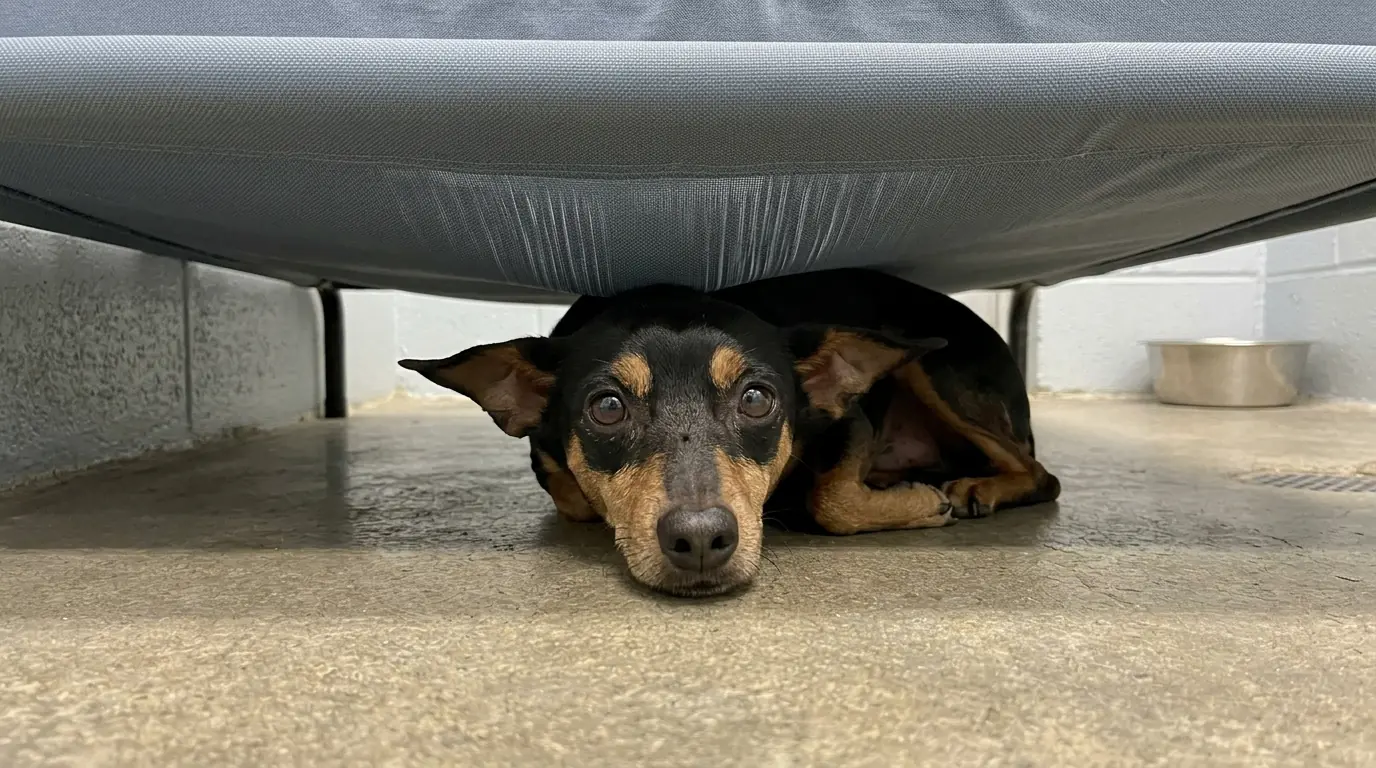
Pickles looks completely different when he is asleep.
The seven-year-old Miniature Pinscher mix stretches across the low cot inside his shelter kennel, sometimes curled against one edge, sometimes lying on his side with his legs relaxed.
His breathing becomes slow.
His muscles loosen.
For a while, nothing about him appears unusual.
Then Pickles wakes up.
His eyes open.
For a second, he does not move.
Suddenly, his entire body tenses.
He scrambles toward the edge of the cot, slides onto the floor, and immediately begins trying to force himself into the narrow space underneath the very bed he was sleeping on seconds earlier.
His front half disappears first.
Then his shoulders.
Pickles wriggles until his hips squeeze beneath the frame.
There is barely enough room.
But he keeps pushing.
Only when his back is pressed tightly against the underside of the cot does the trembling begin to slow.
Then Pickles lies completely still.
The strangest part is that nothing entered the kennel.
No door slammed.
No person approached.
No dog passed outside.
Pickles simply woke up.
And somehow, waking seems to be the thing that frightens him.
Pickles Can Fall Asleep Without Hiding
That detail quickly separates his behavior from ordinary use of a sheltered sleeping spot.
Some dogs simply prefer resting beneath furniture.
Pickles does not.
When he is ready to sleep, he frequently chooses the top of his cot.
He climbs onto it voluntarily.
He settles.
He can remain there for a long time.
The frantic movement underneath it usually begins afterward.
After sleep.
Staff Start Watching the First Few Seconds After His Eyes Open
Those seconds become the most important part of the pattern.
Pickles wakes.
His eyes open.
His head sometimes lifts quickly.
Then there is a brief pause.
He looks around.
His body becomes rigid.
And he moves.
There may be almost no transition between quiet sleep and frantic crawling.
It is as though Pickles has awakened before he has fully worked out where he is.
An Old Injury Makes Those Moments More Concerning
Pickles has a history of previous trauma and continues to experience episodes of disorientation.
That does not automatically explain everything he does.
But it means the shelter cannot dismiss his strange wake-up behavior as a harmless quirk.
Disorientation can have neurologic, sensory, medical, and behavioral contributors.
If the episodes change in frequency or intensity, or occur with other neurologic signs, his veterinary team needs to know.
Pickles Is Not Simply Running to the Back of the Kennel
There are other places he could retreat.
He could move behind the cot.
He could press himself into a corner.
He could stay on top and curl against the wall.
Instead, he repeatedly chooses the smallest available vertical space.
Underneath.
That specificity gets attention.
He Has to Work to Fit
The cot is low.
Pickles is small, but even he cannot simply walk beneath it.
He lowers his chest first.
Extends his front paws.