At first, Officer Nathan Cole thought the woman was charging at them.
That was the first honest thought that crossed his mind when she burst from between two parked cars on a quiet California street at 9:37 on a Tuesday night, one hand wrapped around a baseball bat, her white T-shirt stained red across the stomach, her hair loose and wild around her face.
The street was called Mariposa Lane, a narrow residential road on the edge of Riverside County, lined with duplexes, older one-story homes, small apartment buildings, palm trees, cracked sidewalks, and parked cars squeezed bumper to bumper along both curbs. It was not the kind of street that usually made the evening news. It was the kind of street where porch lights came on automatically, dogs barked from behind fences, children’s bicycles leaned against garage doors, and arguments sometimes spilled through thin walls before cooling into silence.
Nathan and his partner, Officer Jenna Ruiz, had been on foot for less than ten minutes.
Their patrol SUV was parked half a block away near a small corner market, its emergency lights off, engine idling low. They were walking the neighborhood because dispatch had received two vague calls that evening: one about a man yelling outside a residence, another about a loud crash from somewhere near the 1400 block. Neither caller had stayed on the line long enough to give a full address. That happened often. People heard things, worried enough to call, then worried more about being involved.
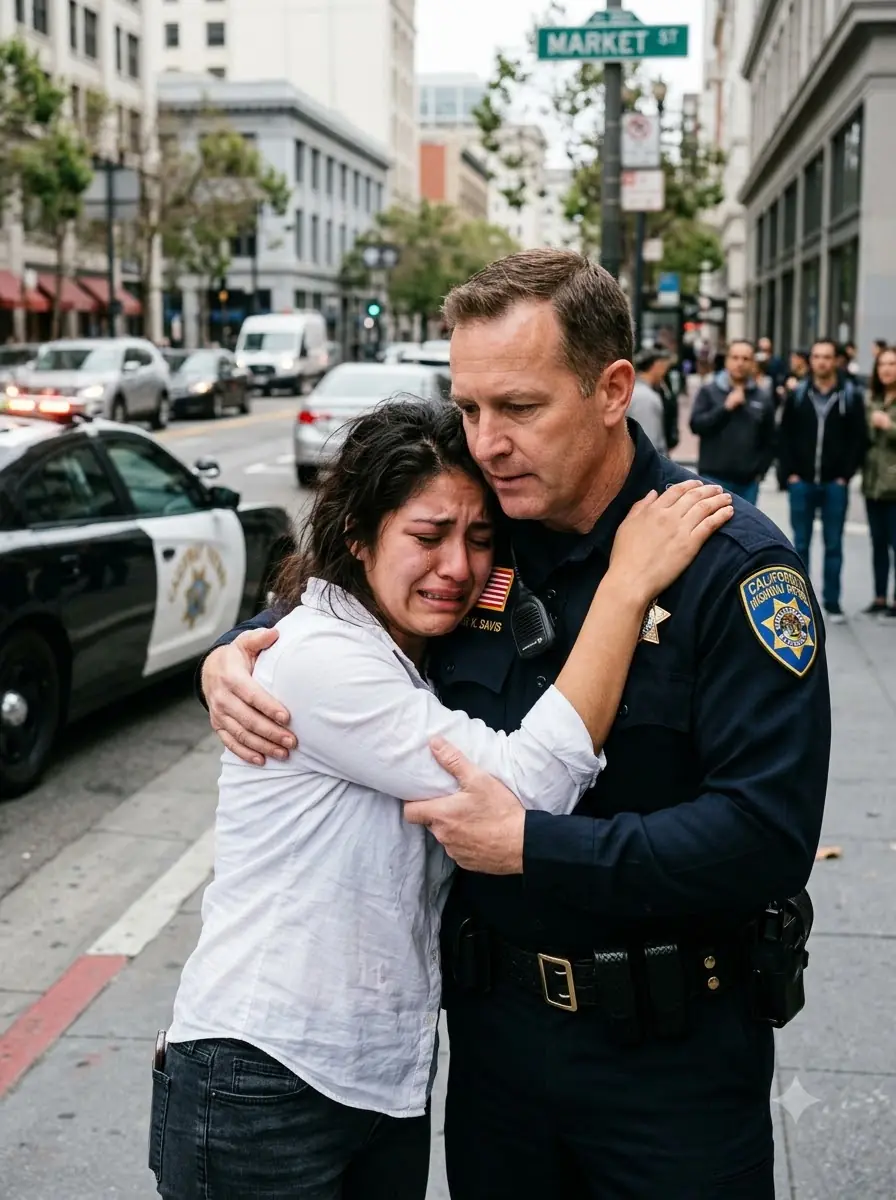
So Nathan and Jenna walked.
Flashlights down. Hands free. Listening.
The California night was dry and warm, the kind that kept heat radiating off pavement long after the sun disappeared. A lawn sprinkler ticked somewhere behind a fence. A television glowed blue behind blinds. Farther away, a motorcycle accelerated onto the main road and faded into traffic noise.
Then the woman appeared.
She came fast.
Not jogging. Not stumbling. Running like something behind her had burned every normal thought out of her body.
Jenna saw the bat at the same time Nathan did.
“Ma’am!” Jenna shouted. “Stop right there!”
The woman did not stop immediately. She ran three more steps, sobbing so hard the sound reached them before her words did. The bat was not raised over her head. It was not pointed at them. It hung from her right hand, swinging low and unevenly because she was losing strength. But a bat in a panicked person’s hand at night is still a bat, and Nathan’s body reacted before his mind finished interpreting the scene.
His left hand came up in a clear stop gesture.
“Drop it!” he shouted. “Drop the bat!”
The woman’s eyes snapped to the bat as if she had forgotten she was holding it.
Then her fingers opened.
The bat hit the sidewalk with a hollow wooden clatter and rolled once toward the curb.
She kept moving toward Nathan.
Jenna kicked the bat farther away with one boot while Nathan stepped forward just enough to catch the woman before she collapsed completely. She crashed against his vest with both hands, grabbing at him like a drowning person grabbing a railing.
“Please,” she cried. “Please, please, please.”
Her voice was torn open with terror.
Nathan held her by the shoulders, firm but not rough.
“Ma’am, listen to me. Are you hurt?”
She shook her head, but her eyes were not focused. They kept darting past him, back toward the duplex she had come from.
“My son,” she gasped. “Please save my son.”
Jenna’s face changed.
Everything changed.
Nathan looked down at the red stain across the woman’s white T-shirt. It spread from the center of her stomach down toward her waistband in a dark, wet-looking smear. Under the yellow porch lights and streetlights, it looked enough like blood to tighten his throat.
“Where is your son?” Nathan asked.
The woman tried to turn, almost falling as she pointed toward a pale green duplex halfway down the block. Its front door stood open. One window near the living room was cracked. Light spilled out at an odd angle. A dining chair lay on its side just inside the doorway.